
Best Of Mythmakers Replay: Oxford As A Fantasy Hotspot

 Apple Podcasts
 Amazon Music
 Spotify
 JioSaavn
 Castro
 Today we're re-releasing one of our most popular podcasts!
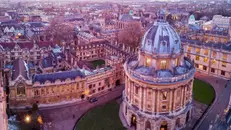
Why is Oxford, England, such a fantasy hotspot? From Lewis Carroll to Philip Pullman, Diana Wynne-Jones to Deborah Harkness, it has inspired writers and is even the location for many fantasy stories. It is famously home of the Inklings whose leading figures, Tolkien and C.S. Lewis, established two of the biggest fantasy worlds yet invented. So what's the secret? Is it the university with its exchange of ideas, the beautiful built environment and countryside, or a combination of factors that make it a place where fantasy seems possible? Step through the wardrobe to find out. Stay listening to find out the pick for the best library in a fantasy series. Let us know yours if you want to suggest another top fantasy destination for bookworms.
Visit https://oxfordcentreforfantasy.org/mythmakers
Welcome to MythMakers. MythMakers is the podcast for fantasy fans and creatives brought to you by the Oxford Centre for Fantasy. My name is Julia Golding, a writer and director of the Oxford Centre for Fantasy. In today's episode, we're going to be looking at why is Oxford, a city in the centre of England, a fantasy hotspot. It's very hard to deny the truth of this because if you just look at the writers who have come out of the city, it's like a role call of some of the most famous. You have Lewis Carroll, who is obviously the creator of Alice in Wonderland and Alice through the Looking Glass, and he did that back in the Victorian era. Just on the list, and my personal favourite is J.R.R. Tolkien, the creator of the Lord of the Rings and the Hobbit, and the whole myth of Middle-Earth. And famously he was very good friends with C.S. Lewis, the creator of Nania. And if you just think of those two writers, Lord of the Rings and Nania, right there you've got two of the mainstays of the fantasy genre, one obviously for the big-scale epic and C.S. Lewis leading the way in children's fantasy for so many years. But the story didn't stop with them. In more recent times, Diana Win Jones was living in the city, and PD James, more well-known for her crime writing, wrote a fascinating sci-fi fantasy book called Children of Men set right on my very doorstep here in Oxford. And Debra Harkness very recently, in the discovery of witches, has used Oxford as the starting point for her story, finding inspiration in a place that she visited. And of course, I can't leave out Philip Pullman, who is still living and working in the city, and his stories are very much rooted here, and it's great fun to see Oxford being reimagined by this wonderful contemporary writer. And in my own way, I've also used Oxford as an inspiration for my fantasy stories, but more about that later. Anyway, what about Oxford? What is the reason why it has become this magnet that produces and draws to it so many fantasy writers? Well, looking at the window, I can tell you that undoubtedly we are helped by beautiful surroundings. You've probably seen pictures, their colleges are a great range of architectural styles, but many of them look like little castles, of honey stone walls and gargoyles and chapels, and it's actually a bit like living in Hogwarts, except not by a Scottish lock, but not all colleges are like that, obviously. There are more contemporary ones, and there are some strange buildings like Keyboard College to Google that and have a look, because if you also have a look at Tolkien's view of what the Tower of Baradou might look like, there is a strange similarity to the base of Keyboard College. It's this amazing Victorian red brick extravaganza. And along with the 1,000 years of a university in this city set between two rivers, there is that great depth of history and culture. Round every corner, down every street you'll come across buildings and places that feature in history or have their own special tales. Very near where I live, there are two streets, for example. One is called North Parade and the other is called South Parade. You may be expecting to imagine where those are on the map, but in fact North Parade is south of South Parade, and this is because during the English Civil War, the parliamentary troops, the southernmost limit where they paraded, was north of the King's troops and the northern most limit where they paraded is in North Parade. So this bizarre story has ended up with two streets that seem muddled up, but yet there is a logic to why they are there. So you can go shopping by your croissant and have a coffee and think about the soldiers of the 17th century who are ready to fight to the death for the principles of Parliament or King. So I find all that absolutely fascinating and food for thought. And these kind of ideas feed into how a fantasy writer comes up with their own stories because all of us are drawing on real events and real history as a source for inspiration. I think Margaret Ackwood says that nothing she puts in any of her books and she's the author of the Handmaiden's Tale, nothing that she ever writes in her speculative fiction has not existed somewhere at some point in the world. Which I find absolutely fascinating. But in addition to the buildings and the history surrounded by the actual physical architecture of Oxford, it's also a place which is very close to countryside. J.R.R. Tolkien only had to walk out of his front door for a few minutes to be in the Willow Meeds of the Charwell River, which is one of those beautiful, slow-moving, gentle rivers surrounded by meadows and wildflowers. That this part of the world is very blessed with. And as for C.S. Lewis down on a shot over hill, he only had to have a short stroll to be lost in a wood. And there's also a pond at the end of his gardener always makes me think a little bit of the wood between the worlds in the Narnia stories. So you can see where these visual prompts come just in the daily life of the authors. But it's not just about bricks and mortar and trees and flowers. I think that the other part of what makes Oxford this hotspot is of course the university. It's because as well that it's a peculiar place and the only sort of similar place I think is probably over in Cambridge. It's because ideas mix here, rather than have a department of English and a department of history and a department of physics, which do exist, the real mixing point is actually in the colleges. They're like little independent fiefdoms, little kingdoms. So at the high table of each college, the professor of poetry might be sitting next to the professor of quantum physics or a medic or a geologist. And that means that the conversation is wide ranging and interdisciplinary. So when you look at someone like Philip Pullman, when he's talking about dust and drawing on sort of physics and scientific ideas, no doubt that's because living here, he's been hearing local people talking about these ideas at the cutting edge of science. And what then happened is lots of little circles form of people who share the same interests, sort of really, you know, specialist groups that wouldn't thrive elsewhere or in very few places around the world. And that's how the Inklings met, which was the group that both C.S. Lewis and Tolkien belong to. Originally, that group had like a prior sort of expression in a group called the coal biters, which Tolkien set up in order to read Icelandic sagas. He had like a campaign to make the old Norse stories, sort of central part of the English literature syllabus. And C.S. Lewis came along to this and, you know, the rest of his history in a sense in that they became friends. And eventually, when that coal-biter group disbanded, they set up, or it wasn't really formal, but they started and got into the habit of meeting together and find a place to share their work. So they had two kinds of meetings on the whole. They would have famously a sort of meeting down the pub where they would just discuss stuff. And that would happen at many of the pubs around Oxford, but in particular the eagle and child, which is known as the burden baby. That is not very far away from where I'm talking to you on a wide street called St. Giles right in the heart of Oxford. But also for the more sort of intimate sharing of work, they were in the habit of meeting in C.S. Lewis's rooms in Mordlin College, which is the other side of Oxford. And Mordlin is arguably the most beautiful college in Oxford. I have to admit I'm a bit biased because I am a graduate of that college. But if I tell you it has a deer park, are you sold? You can look out the window and see the college herd of deer. And it has beautiful, beautiful buildings. Anyway, C.S. Lewis had a room in what is called the new building, though that also is very old. And they would gather and sit down of an evening once a week, and C.S. Lewis, after a while, would say, right, has anybody got anything they want to read? And off they would go. And it was meant to be robust discussion, but also to build people up and encourage them to write. And I think one of the success stories coming out of that is probably less well known. That is C.S. Lewis's brother, Warney, who had a professional life outside of academia. But because he came along to this group and they encouraged people to write, he actually went on to research and write some very well-regarded books on French history, which I doubt very much he would have been encouraged to write without those people around him. Of course, of course, I know I'm biased. Of course I am. But Oxford isn't the only place to nurture groups of writers. At the very same time as the Inklings, and probably more famous in the sort of classic literary world, as opposed to fantasy writing, is the Bloomsbury set, who lived in and around a few squares in the heart of London near the British Museum, most famous of those who you undoubtedly have heard of is Virginia Woolf. But that set didn't meet in the same way as the Inklings. I think it was Lucerneet. It wasn't set up as a writer-support group. It was more of a label given to their writing afterwards by people seeing similarities or saw that the exchange of ideas amongst a group of friends. So it's hard to think of a place other than Oxford, but do tell me if I've got this wrong, which is so influential in the formation of what we now think of as fantasy. And that really lies back in the Inklings group. Obviously, before the Inklings, you've got Lewis Carroll, the writer of Alice in Wonderland, but he in many ways, though being extremely influential, he was also a bit of a one-off. And it took a while before fantasy hit the stride that it has now, and I think the origins are more readily found in the Inklings world than in the Lewis Carroll world. Having said all that, when I was thinking about this, I would allow that you could say that Hollywood itself and the Disney studios, wherever they're based, around America and outcroppings elsewhere, they do have a claim to be a home of a certain kind of fantasy. But I think that's another kind of discussion as to how much is original, how much original writing is coming out of those places. I think more now than ever before, but screenwriting is a different skill and well worth looking at in its own right. OK, so if I was going to come up with the top five reasons why Oxford is the hotspot, I think at the top of the list would definitely be the possibility here of a fellowship of like-minded people. CS Lewis told Charles Williams, another notable Inklings, who actually did most of his writing in London where he was a publisher before moving to Oxford during the Second World War. He was evacuated out here with his publishing house. Anyway, he said that to come to the Inklings and to belong to the Inklings, all you needed was a tendency to write and Christianity. That was enough to make the group gel and feel a safe space to share their stories and poetry. I think also you probably had to be a man because it was very much that kind of time, that kind of world, all the Inklings were off that gender. But that was the norm in the academic circles of those days, so they probably didn't even question the fact that they were all men sitting in a room. Anyway, I'm interested in this idea of a safe space because I think that was key to how they functioned. And as the Inklings expert Diana Pavlak-Gliar in her book Banda Snatch points out, the Inklings lasted as long as that pact to keep it a safe space lasted. Once somebody dismissed or rubbish the work of another without actually really admitting that it had any value, the group folded. And ironically, that was a gentleman called Hugo Dyson who dismissed Tolkien's now world famous masterpiece, The Lord of the Rings. And it was a bit like, you know, Tolkien retreated and no longer felt, well, you wouldn't wager, you didn't want to offer in front of a hostile audience something that you felt so passionately about. And once that compact was broken, the group kind of folded. But it did last for an impressively long length of time when you think about it. These were all busy people doing academic jobs, but yet they had this commitment for meeting together for almost 20 years. And I think fantasy in particular does need a place where it feels accepted and allowed to flourish because fantasy, you're showing, yeah, it's like showing the inner workings of your mind, your wilder thoughts, all writing betrays the nature of the author, if you're being honest, but, you know, are you going to feel comfortable admitting to that to somebody who you know is going to crush it and say, you know, rubbish, don't tell me any more about elves, I've had enough. Anyway, what would you find in Oxford if you came here today? Well, there aren't so many professional gents, pipe smoking gents as in Tolkien's day, but there are a few. You still see them. The university regularly tops the international chance as a best place to study with extremely clever people tackling cutting edge issues like COVID vaccine research, treatment of COVID, quantum computing, cancer research, but it also has a strong arts tradition with wonderful writers in many fields such as English literature and history. How do I know this? Well, because living here, I have the great privilege of meeting people like this all over the place. It is really an extraordinary place once you're sort of part of the community. You can't go to a dinner party or stand at the school gate or go to a church meeting or whatever your place that you hang out, the tennis club or whatever, without finding out something wonderful and new once you get into conversation. And I'm really not joking about the school gate. I have a vivid recollection of when I'm standing at the primary school gate with one of my children, so this is a few years ago now, talking with a mum who turned out to be a very, she's a German lady, a very eminent mathematician, now a professor, winner of all sorts of prizes. And she happened to mention that she was researching into how knots behave in dimensions beyond four. And I was absolutely fascinated. Apparently it's easier to undo them once you go into all these dimensions. This makes my brain sort of act like that, not twisting in on itself. And of course, I drag it down to my simplistic understanding of what that might mean. But my mind was challenged and expanded. And when I went on to write a fantasy series for children, set in Oxford, called Young Knights of the Round Table, which is published by Oxford University Press. One of the key ideas was how these multiple worlds work like these multiple mathematical dimensions. So yeah, it's a place where if you keep your ears open, it's always going to be challenging you and giving you fuel for your imagination. And I've realised that I haven't even started on the Bodleian Library. What's the name of the university library? This place crops up in so many stories because obviously writers are book lovers and the idea of a library that goes down under your feet in the centre of Oxford underneath all those colleges. And it also holds a copy of every book published in the UK, as well as many others and priceless archives, including many of Tolkien's papers, by the way, but isn't that bewitching? And it's not surprising that Deborah Harkness, when she started her novel, A Discovery of Witches, actually begins there in one of the oldest parts of the library, it has an old building which is very, very old. And the Duke Humphries Library, which sidebar was the model for the Hogwarts Library, you know, one of the chain books and Hermione is shelving the books and they float back on the shelf. That is very much the Duke Humphries Library. She uses that place as sort of a key location to start off her story. So I've got to add very impressive libraries to the mix of what inspires fantasy. So where has that led us? It's led us through fellowship of people interested in similar things, but also those chance meetings of those who know something very different from you, but that feeds into what you're thinking. There's the environment, both buildings and countryside, there are the libraries. And I think that all adds up to the fifth element, which is less quantifiable. It's the can-do feeling. You can hear makeup your own myths. It's ready to receive more. It's ready to have them in book form so that they can go down into the depths of the Bodleian and join those other stories, which are already filed down there. Alice can rub shoulders with Lyra. Bilbo can sit next to Aslan. The white witch can cozy up with Diana from the discovery of witches. So that's my little analysis of what makes Oxford a hotspot. It'd be very interesting to hear your views. If any of you have been here, perhaps you can tell me from a visitor's perspective what you think is inspiring. And I hope to see many of you come here and visit the Oxford Centre for Fantasy as well at some point in the future. And in every episode, I thought it'd be fun to have a section where we have a best place to go in a fantasy world for something. And today, I've picked on libraries because I've been talking so much about libraries. What do you think is the best library in fantasy fiction? Well, I've been thinking about this and I came up with a couple. I mean, obviously there is the library in Gondor, in Minnes Tirith, where Gandalf finds the all-important manuscript telling him about the origin of the ring. But maybe that's a bit too predictable. I actually started thinking about this and decided that the one that really sticks in my mind is the one in Garth, Nick's, Apostle and Trilogy in the book Lirial, which has this amazing library which I just felt I could walk around inside. Why not let me know about your favourite? And in the next episode we'll be looking at some lesser-known facts about Tolkien and C.S. Lewis and how they lived here in Oxford. If you have any ideas for things that you would like us to talk about on Mythmakers, do let us know. That's all for this episode and we look forward to talking again next time.