
Celebrating Fantasy Illustrators - John Tenniel

 Apple Podcasts
 Amazon Music
 Spotify
 JioSaavn
 Castro
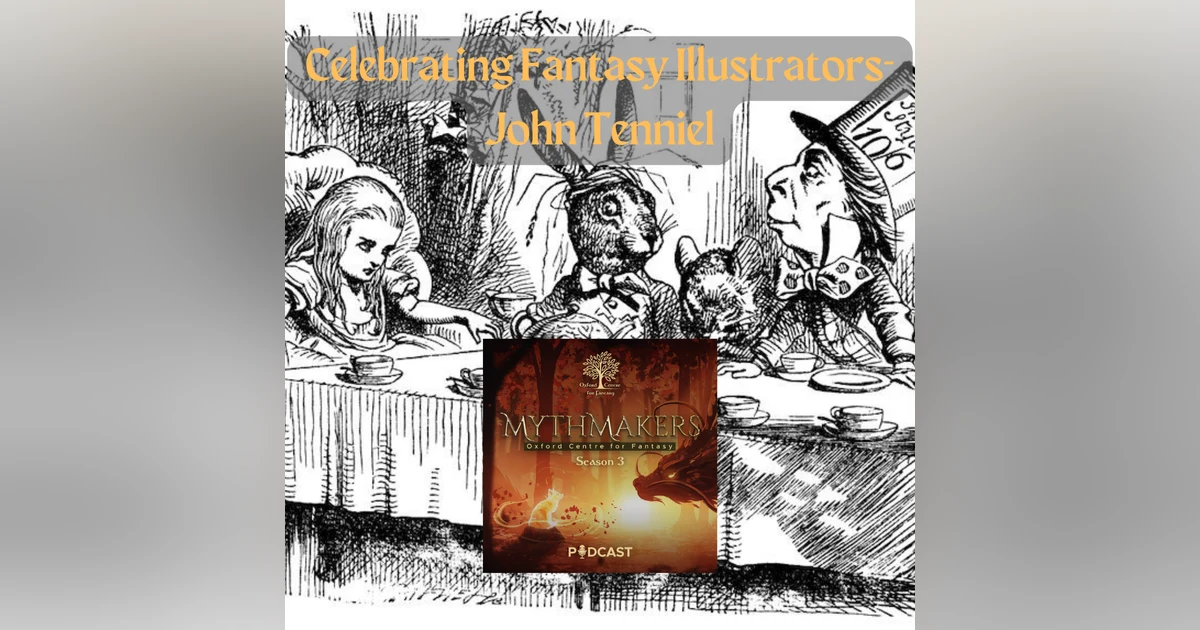
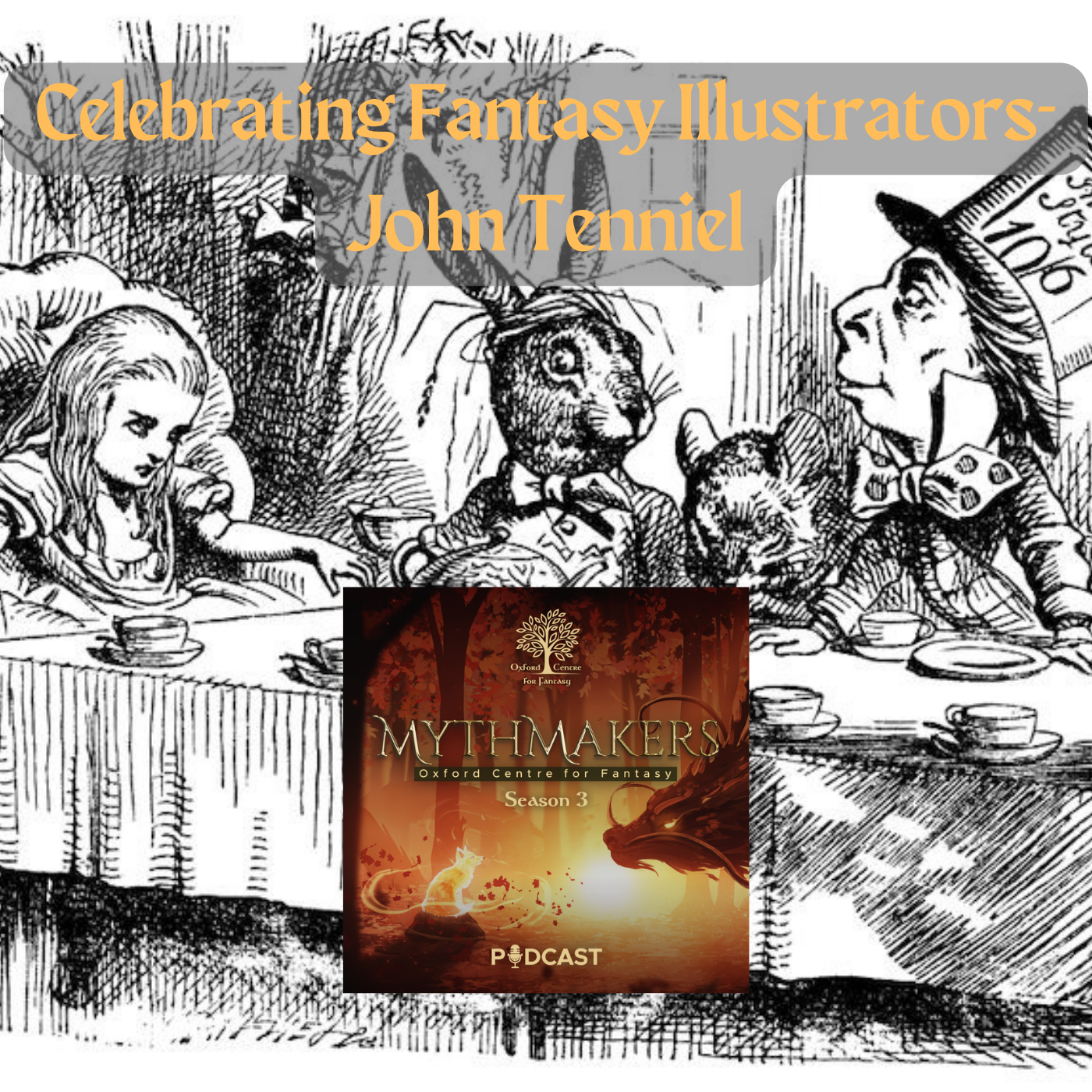
 Let's celebrate the contribution to fantasy by our favourite illustrators! Today we start by taking a look at the grandfather of Oxford Fantasy Illustration: Sir John Tenniel, the illustrator behind the iconic Alice in Wonderland images. Listen in to find out about the unfortunate accident in his youth that he hid from his father, his extraordinary memory, and his artistic influences. Guess who was at his retirement dinner- it was quite the fantasy dinner party moment!
Hello and welcome to MythMakers. MythMakers is the podcast for fantasy fans and fantasy creatives brought to you by the Oxford Centre for fantasy. Now my name is Julia Golding and I'm the director of the Centre and also an author. One thing I'm not though is a professional illustrator. I do like drawing and I have had a few maps included in books, that kind of thing, but I absolutely take my hat off to anybody who can illustrate. And in this era when there's a lot of discussion about AI generated images and their value versus those produced by like real people, I thought I would start dedicating a few of our MythMaker podcasts to the people behind some of the most famous illustrations that we all have in our imaginations to help us understand somebody's fantasy world. And thinking about this I knew exactly where I wanted to start. I wanted to start by celebrating John Teniel who is associated very strongly. In fact he is the original illustrator of Alice in Wonderland and Alice through the looking glass. Now the one thing about John Teniel, which struck me when I began reading up about him, in fact going down my own kind of rabbit hole following things about him, was that he himself saw the Alice commission as somewhat of a side show to his main role, which was as a lead illustrator for the satirical magazine Punch. Punch was a magazine famous in the Victorian times for its political satires. And if you pick up any history book about their era, you'll no doubt find elements of punch you brought in to illustrate it. It's become synonymous with the periods. And he was one of the lead illustrators. And so his weekly life was thinking about political cartoons. But let's start at the very beginning. So he was one of a large family born at the beginning of the 19th century. And he had actually a long life. He died either 92 or 93 because he died around his birthday in 1914. So he basically lived the whole Victorian period and into the Edwardian period before dying. His actual private life doesn't seem that tempestuous, but it is quite sad in that there's quite a lot of deaths in the family and his own wife, whom he married in 1853, only survived two and a half years. She had ill health. So she died in 1856. Her name was Julia from an Italian family. And after that, his mother-in-law stayed with him in his house until her death and then a sister. So he was a man without his own family, next generation family. So living quite quietly. So a lot of the energy and his connections were through his work and his art from what I can gather. He also does seem an incredibly kind man and desperate not to make other people suffer. One of the strange things in his biography that came up in a number of sources talking about him is that his father was a fencing and dance master. Sounds quite a decennan character. The sort of person we gave lessons in schools to teach people those social graces. And when he was young, he was said to have been fencing with his father just as a friendly match. And the tip came off the end of his father's foil, which went into 10 years' eye and course and damage. And then increasingly over life, he lost the sight of that eye. But he never told his father because he didn't want his father to worry about him, which I think that is sometimes it's these small things about somebody. It's a big event in his life, but a habit or a trait like that really says a lot about the innate kindness of someone. And actually, when you look at the world of Alice's drawing, so there is a satirical feel to it and certainly a quirkiness and a grotesqueness. There's also an element of his kindness, the right word. I always feel they feel quite a welcoming world, despite the fact that the characters are so outrageous. Anyway, so that was some of the things I learned about him as a person. He also had the distinction of having a photographic memory. And the way he got into art was he would go around sketching, creating a portfolio, which got him into the Royal College of Art. And these were in the era when what you did is you went and drew statues, quick statues, that kind of thing and showed that you were a good craftsman. He was very unimpressed by the education he then got at college. And it was other places that he drew his inspiration, notably the theatre. He would go and sketch, sitting, watching performances. He would appear in them himself. There's an article about him on the VNA website, the Victoria and Albert Museum, when they had an exhibition of his work, which includes the absolute classic photo of him because he's in the era when photography is just happening. He's in a production which is a benefit performance, like a charity performance. And it's a kind of who's who of luminaries at the time, including Arthur Sullivan, the Gilbert and Sullivan composer, and Ellen Terry, who was the lead actress of her day. She was the most famous. And he's there in the cast with his wonderful Warris moustache in the back row, well worth looking at. So theatre was definitely an influence, but looking through where he got his sort of artistic influence from. Many of the articles, books about him mentioned the Nazarene movement of the early 19th century. Now this was new to me. My background is more in literature rather than in the fine arts. So I hadn't really heard of this movement, which was a German romantic movement of young artists who were revolting against the idea of the neoclassicism. They thought that was cold and lacked spirituality. And they lived together in an experimental community. They left Germany, went to Rome, and a group of them lived together for a few years until the about 1830, where they were taking their models from Medieval and early Renaissance art. This makes them precursors to the movements I am more familiar with. I expect many of you are, which is the pre-Rafflight movement. And it was that the German version of this, the Nazarene movement that influenced Teniel. And if you're thinking, well, what does that mean? Apparently it means that you have a sort of shaded outline. And if you think of how the Alice illustrations have produced, you have that. You've got the sort of outline, but you've got the shades and the hatching to kind of give the sense of the character and the landscapes. It also leads to and it's a good way of building up the basis of a fresco. There was in public buildings, there was a fashion for the old idea of frescoes, which obviously you would have found in many buildings in Greece and Rome, but also in Medieval periods. And Teniel was part of that movement because he entered a competition before he was known to design a fresco for the newly rebuilt houses of Parliament. The old houses of Parliamental parts of them had burnt down. And the building that we know today, the one with big Ben, was built in the 1830s. And he entered that competition and one and that became his sort of start in life. So competitions are obviously he then became an illustrator for books. And his first commission in that way was the 1842 book of British Ballads. He was also illustrating for people like Dickens in the magazine world. And it was from that that he then got the role of working for Punch, which demanded a lot of drawings each week. So how did they actually go about doing their art? Now we're used to the idea of people designing on computers and iPads and what have you. What was the equivalent then? Well, he would draw his illustrations and then it would be transferred to wood blocks. And one of the reason why he got his job was he knew how to do that. And these wood blocks would then be they're engraved by people who knew how to do that. And then they were turned into electrolyte copies for reproduction. That was what the publisher used. So there's like a three-stage process. You've got the drawing. So there's Teniel doing his drawing, but he has to bear in mind that it's going to become a wood block. So he can only use techniques that transfer to wood. They're engraved from the wood block and then become electrolyte copies. So he had this long and successful career. And during that, he met many people in the Victorian establishment. And one of those people he met was Lewis Carroll. And so Lewis Carroll probably didn't know him from the time before Punch as far as we can tell. But he understood that there was something particularly suited the world of the caricature cartoon that suited the zany world of Alice in Wonderland. And there were a number of strings, I think, that drew him to Teniel. One is this ability to have something that could well-produce in the book. He's got the craft and he's got the craft. But there's a sense of something specific about the faces. He's very good at individual characters. And even his settings, there are just little details which really do root it. And another part, which is pushing the grotesque button, not to the point where it becomes to act against the words. There's a very important relationship between the words and the illustrations in the Alice books. If you've looked at one that reproduces the original pages, you'll see that the words fit where the illustrations are in vice versa. It's not a situation where you've got color plates that sort of slot into the book and could almost be anywhere. The words and the illustrations work together in the same way as a shape poem like the mouse's tail has to be set in a certain way. So it is very much a collaboration. Probably the words came first, you know, it's that thing. The words came first, but then once they were putting it in the book, the illustrations were very much meant to enhance the the experience of reading. So how did it come to an end? So after these two most famous commissions, he also did further work for Lewis Carroll, but they are obviously his most famous ones. He lived a long, successful life, one fascinating thing about John Teniel, which I have no idea about before I started reading up on him was that he was the first illustrator to be made into a knight. So he ended his life as Sir John Teniel. After that stage, it was quite rare for somebody in the arts to be knighted, but there was a change during the Victorian period with famous actors being knighted and the occasional author, but he was the first in the illustrators to be knighted for that reason. When he retired, because of his failing eyesight amongst other things, he had an amazing retirement banquet where on the guest list were Bram Stoker, he of Dracula, and Arthur Conan Doyle, he of Sherlock fame. So what an amazing banquet. And it was actually held or chaired by the then leader of the House of Commons. So he did struggle this well between politics and literature, which makes him a very interesting figure. What has been his legacy? Well, I think his legacy is seen in later illustrators like Chris Rudel, the idea that you can be a both a cartoon, a cartoonist, and an illustrator seems to have a sound lineage. I think he also set up this idea that you could make a book, almost like a visual experience. You knew exactly what it was. It was so distinct. And because it's never really gone out of fashion, why bother to re-illustrate Alice? And people have done, but all of us have in our minds, those original images, unless you grew up on the Disney film, which I'm sorry if you did, but even the Disney film has the tenual drawings underneath. And I think that this shows how when there's a really good strong collaboration between an artist and the writer, as there is in this case, that this is something that no commission that doesn't involve real people, so no sort of, it could be AI generated or just an illustrator doing drawings when they haven't read the book, which something does happen. You know, you often get front covers sent to your authors where you think, have they read the book? Where there is actually the knowledge of the material and understanding of the material, the illustrations really send it off into a much better, they improve the art artistic experience. And I think the other thing about tenual is that there's an understanding that fantasy can be serious, seriously funny, but also serious. I think there's an the identity of the Alice books is adult. The philosophy of it is something which definitely you realize as you get older, how clever they are. In fact, I'd like them more reading them as an adult than I probably did as a child because there's something very random and anarchic and unsafe about the Alice worlds, which as a child, you were unsettled by, whereas now as an adult, I think they're absolutely brilliant. So I think the tenual drawings grow with that, a bit like Alice grows and shrinks. So here we are with Teniel at the beginning of the most famous phase of Oxford fantasy. The artist who gave a eye equivalent for the reading experience of the Alice books. And it goes to show that illustrators come in all kind of flavours. Here we've got a grand old man of political satire in Victorian period able to turn his hand to these charming but challenging illustrations. If you have a favourite illustrator, do let us know and we look to feature their work in a later episode. Thank you very much for listening. Thanks for listening to MythMakers Podcast. Brought to you by the Oxford Centre for Fantasy. Visit OxfordCenterForFantasy.org to join in the fun. Find out about our online courses in person stays in Oxford plus visit our shop for great gifts. Tell a friend and subscribe wherever you find your favourite podcasts worldwide.