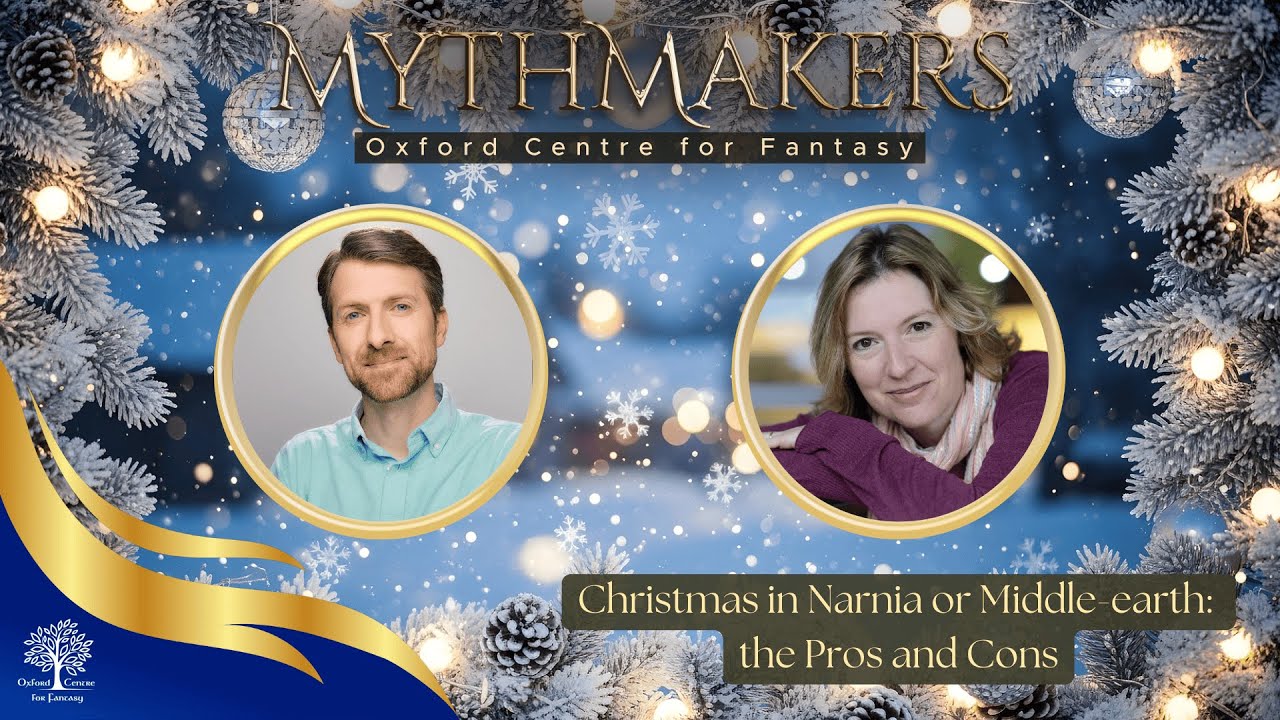
(0:00 - 5:48)Hello and welcome to Mythmakers. Mythmakers is the podcast for fantasy fans and fantasy creatives brought to you by the Oxford Centre for Fantasy. My name is Julia Golding, I'm an author but I also run the Oxford Centre for Fantasy and as I have been on many occasions this year, I am joined by my good friend Jacob Renneker from Across the Pond.And Jacob, who is an expert on all things to do with the world of fantasy games in his professional capacity, he is also like me, very keen on Tolkien and C.S. Lewis. So we thought today we would discuss the vexed question of would we like to spend Christmas in Narnia or in one of Tolkien's worlds? So Jacob, hello, welcome. Thanks, Julia.So let's start off, shall we, with the one that's most obviously a Christmas setting, the Lion, the Witch and the Wardrobe. We talked about that a few episodes ago, celebrating the 75th anniversary. But let's just lean in now to its seasonal relevance, because of course there are now Christmas shows based on the Lion and the Witch and the Wardrobe and others.Tell me what your impression of Narnia at Christmas is. Would you like to be there? Yeah, I think so, at least in the time of Lion, the Witch and the Wardrobe, when that's happening chronologically. Maybe not like a little before that, because it wouldn't ever be Christmas, and I don't think I can handle just pure winter for an age.But yeah, so I think yeah, it does, in revisiting it specifically through the lens of the Christmas season and Father Christmas and kind of tying together Tolkien's approach to Father Christmas and Lewis's approach to Father Christmas. Yeah, there are some really interesting things this time that stood out that I hadn't really picked up on, I don't think, as much last time. So this was yeah, so reading it through that lens, I thought was really helpful and really interesting and fruitful for helping to develop what Lewis's idea of Christmas or his ideal of Christmas and Father Christmas in particular.So this is, yeah, I'm looking forward to our conversation. So I think what we're dealing with in both writers to sort of draw them together is the idea of the Winter Festival, which is obviously a festival that predates Christianity for a start. But the idea of when in the northern hemispheres, it moves from the shortest day of the year and that's the turning point of the year, and the days start getting longer.And it seems to me that in Narnia, what he's doing is he's got kind of two versions of the Winter Festival, because the White Witch is very close to me, to the folkloric tradition, the more Hans Christian Andersen, Snow Queen version of this. And there's lots of parallels, the physical parallel of this beautiful woman on a sleigh, who enchants the vulnerable boy. And that whole story where Kai in the Snow Queen story, his heart melts, I think it's when Gerda cries, or there's a sort of point of thaw, shall we say, that's the key word, later on in that story, when she goes to retrieve him.And Edmund's journey isn't someone coming to get him, it's a personal journey where his own heart melts as spring arrives, because he sees he's on the wrong side, it's that moment. So there's a lot of folkloric resonances between that version of winter. Who knows, maybe the Snow Queen did have, not the Snow Queen, that's Freudian slip, maybe the White Witch did hold fantastic winter festivals in her palace.We don't know, but we suspect not. Yeah, certainly cold, at the very least it's cold. And if she was displeased with anyone, we know exactly how that would have turned out.And looking at those, that's really interesting, two winter festivals, the older Yule festival and Christmas. When I was rereading the chapters that dealt with the White Witch, first encountering Edmund, and with the Father Christmas chapter, In Line, Witch in the Wardrobe, one of the things that I was struck with was the parallels that are clearly set up, right? So first introduction to these is the bells, right? So you have the sound of bells with both. And this is what actually scares the children with the beavers, is because they hear the bells and they're assuming that it's the witch.But then they both arrive on sledges pulled by reindeer. And at the helm you have, well, you have a dwarf actually doing the driving with the White Witch, but the main occupant of the sledge is this kind of winter festival figure that you kind of pointed out, Julia. And so just looking at their descriptions, the witch is this kind of like white, pure white with just this kind of, what Lewis says, kind of like this unnatural kind of like bright red on her lips, this very kind of austere figure.(5:49 - 8:00)Whereas Father Christmas has this, you know, kind of like ruddy, this kind of jovial, warm demeanor. So that's one of the differences. The reindeer, the size of the reindeer at the White Witch has these kind of like white, shorter reindeer that have like gold.Their antlers are described as having gold. So like very beautiful, but cold. Whereas the reindeer that Father Christmas has are brown and they're, you know, making noises and seem more natural, which is, yeah, which is interesting.So they're both kind of arriving in the same manner, using the same imagery. But then of course, how they're interacting with the children and the way that they give gifts, I thought was particularly interesting. So the White Witch, she gives Edmund gifts based on what he wants, right? So she's finding what he would want most, what would allure him most, what would kind of, would she be able to kind of pull the strings and reel him in to get her for him.And so she's giving him his heart's desire. So it was a gift based on what he wanted. Whereas Father Christmas comes, he doesn't even ask what they want.He has, he sees what they need and he gives that to them instead. And, you know, some of them are happy with it, with what they received. Some of them are confused, maybe even a little concerned, like Lucy, when she's told, you know, that she isn't going to be in battle and all she has is this, you know, vial and a dagger.Whereas Peter gets this, you know, large sword and this gorgeous shield. But Father Christmas is giving them what they, it's essentially like what they need, what he sees that they need. And it's a gift based on a perceived need instead of a gift based on a want for the purpose of extortion later.So that was something I hadn't noticed before was like the type of gifts that, then the manner in which the gifts are being given between the two of those. So then of course you also have the drinks that are being provided. Yeah, they both serve hot drinks.(8:01 - 12:03)Yeah, yeah. Which is interesting, right? So with the witch, she's giving him the drink and it's not described, it says, you know, it's kind of like warm and frothy and sweet and something that Edmund had never tasted before. And she uses that drink as a way to get him hungry, to try to get him, to lead him on because she says, you know, it's dreadful not to eat.If you drink it, you know, you've had, you've drunk something. It's dreadful not to have something to eat afterwards. So she is providing all that.She was like, oh yeah, so you want a little of this? You need a little drink? Oh yeah. Now you need something more to eat. And so she's kind of like slowly stringing him along.Whereas in the Father Christmas episode, right, it's just kind of as he's leaving, almost as an afterthought, they say pulls out this plate and these cups and they're not exactly sure, they assume that it's coming from his bag, but he just somehow pulls out this, you know, tea set and gives that to him and says, okay, you know, Merry Christmas, right? Long live the true king and heads off. So he doesn't want anything in return. It's just kind of a true free gift.And he's not, Father Christmas isn't providing the food. That was something that was provided by the community themselves, right? So the beavers, it was Mrs. Beaver in particular, everybody else was trying to hurry everyone out the door because they're trying to run from the white witch. But Mrs. Beaver said, no, like, hold on.If we're going out, we need to have a proper, you know, proper food. And she says that she was glad that she brought the bread knife, which is funny because she says that right after Peter is examining his sword. And so she says that she was glad that she brought the bread knife for slicing the bread and the ham that they have there.So it was like the community. So it's more kind of participatory that Father Christmas is providing a part of this meal and leaving it for others. Whereas the white witch is kind of the soul, you know, the founder of the feast and like the own, like the controller of the feast.Whereas yeah, Father Christmas is this kind of this just, you know, overflowing giving of gifts and of wisdom and giving them what he perceives that they might need that they might not see themselves. So yeah, so those are some of the things that jumped out to me this time. I don't know what, yeah, what do you think? Comparing Father Christmas and white witch there, what are some of the things that you noticed, Julia? Well, one gives and the other takes away.So it's not just the children and the beavers who get the gifts because we also find out that Father Christmas has been giving other gifts to other groups because the white witch comes across the dinner party or the Christmas party and very much rains on that parade or snows on that parade by turning into ice. But it's the bounty of Father Christmas has been shared. So he's passing through with generosity and going on the, what they need rather than what they want.He does give them what they want as well. And he gives them things which they don't think to ask for. So Mr. Beaver gets his dam fixed or something like that.And Mrs. Beaver gets a sewing machine. If you'd ask them what they put on their Christmas list as beavers, that would be right up the top. But they haven't asked for it, they've given it.Whereas if you notice with Edwin, he asked for more and he's told, oh no, no, you can't have more unless you do this for me, which is that extortion element. He has been given the magically intoxicating, I mean, probably, who knows what was in that Turkish delight. It could just be greed, but it could also be some kind of foul magic upon it.There's a feeling that it's all not good, like a drug, but he's taking in. And she won't give any more. There's no little extra and there's no sparkle.(12:03 - 12:38)There's no, I've given you enough just so that you want more. It's the drug pusher side of the White Witch. So I think obviously the two gift givers are very clear, but the other associations with them just spinning off from the pictures around them and their slave.Of course, the Queen is associated with wolves and the wild. And that goes back to this folklore idea of who is the big enemy in the world? Well, it's the big bad wolf. So she's got more grim and that is her association.(12:39 - 15:52)Father Christmas isn't associated with any of that. And he's passing through. He's going on to other lands.It's that he's a figure who passed through just spreading cheer. Of course, the big issue that has been written, much ink has been spilt on the question of, does he fit? In a world of talking animals, should we be bringing in this Christian story figure of Father Christmas, who probably himself is already a sort of mash up of some saints and some traditions around Christmas. So I don't know.What do you think about the does he fit question? Yeah, it does seem jarring as a bit, but again, as I was reading it alongside Father Christmas and kind of in conversation with Tolkien this time, I see him fitting in a little bit better in the sense that, so Lewis says that when the children see Father Christmas, that you see characters that are from Narnia differently, that they're like, there's like this vivacity to them. They seem more real in Narnia. So he suggests that Father Christmas is actually a native of Narnia and that the pictures that we see of Father Christmas are imperfect sketches, trying to capture Father Christmas, but when you're in Narnia, you can actually see him as he truly is.So suggesting that Father Christmas comes from Narnia, in a sense, or that's where he belongs. I see that as kind of being similar to Tolkien's early attempt to create this kind of Ur-mythology, this kind of foundational myth for England that in a sense kind of explains all of the different fairy tales and legends that exist. So similar to linguistically, the reconstruction of Proto-Indo-European, right? So we don't have anybody actually writing in this hypothesized Proto-Indo-European.There's this attempt to come back for the different related languages to find what was the one language that these all sprung from. And Tolkien is trying to do that with his, especially in the earlier myths that he's creating. Like you have with Beren and Luthien, when Luthien's in a tower, you see this attempt to have the Rapunzel myth.This is where the Rapunzel myth comes from, is here. So Tolkien's gathering all these different myths and trying to get a unifying idea behind them, a unifying myth that then could in some ways explain the proliferation of fairy tales, legends, and such. And so when Lewis says that Father Christmas is actually coming here, is coming from Narnia and then goes out into the world, I saw kind of echoes of that in some ways, a way that Lewis is trying to incorporate a Greek mythology and some elements of Norse mythology.(15:53 - 19:20)And so whereas Tolkien is doing that within fairly, for him, kind of more strict, I think, regimented parameters, Lewis is doing that more... Lewis would say, I think, that he's doing it more generously, that he's trying to incorporate more myths, whereas Tolkien is more systematic and particular about how he's trying to weave different myths together, at least in Tolkien's in his earlier mission, kind of what he sees as his task there. So for me, him weaving in Father Christmas, it isn't as jarring by virtue of the fact that, again, he's pulling in all these different mythologies, but he's also bringing in the secondary, the primary world into the secondary world. So there's a mingling of the primary and secondary world that isn't part of Tolkien's legendarium, the Middle Earth project, which is different from the Father Christmas project, where there is this free mingling between the primary and secondary worlds, which we'll talk about later.But I think in this sense, it seems... I also almost get echoes of hints of Tolkien rubbing off on Lewis here with the Father Christmas character, in the sense that Father Christmas appears as kind of a sort of eucatastrophe. It's a eucatastrophic moment for the children, right? They're on the run. And you wouldn't expect... The one thing you wouldn't expect is Father Christmas at this point.But yet here he comes, and he gives them exactly the gifts that they need that are going to help them, and then is off, similar to the eagles at Mount Doom, right? So one of the problems that some people have with The Return of the King is the appearance of the eagles, right? It seems to come out of nowhere. But Tolkien, in his mind, is saying this is a eucatastrophic moment. It's something that comes that you can't expect to happen, that will happen once, and then changes.It's the happy turn of events. And that seems to be kind of what's happening here, although it's in the middle of the story and not just at the very end. You have a kind of a second eucatastrophic moment with Aslan returning from the dead as well.So I think, again, putting these two kind of in conversation with each other, with Lewis and Tolkien, I think I see more ways that Father Christmas does kind of fit in in what Lewis is trying to do than I did before. So it didn't bother me as much this time, because in part, I think I was expecting it, and I wanted to see if it was kind of trying to drill down in what Lewis was trying to do with Father Christmas. So what do you think, Julia? I think I might have set you up there, because my response here is, come on, adults, get over ourselves.Because when I read it as a child, it was a wonderful, exciting moment, in the same way I anticipated Father Christmas coming. How is a child, if you're not doing a Christian world with Nativity scenes, how is a child going to know that Christmas has arrived? Well, you sent in Father Christmas. It's an obvious answer.So you can think up complicated reasons. In Planet Narnia, there's a well thought through examination of the roots of Father Christmas and all the rest of it. But actually, I think it's actually simpler.(19:20 - 23:21)This is a story written for children in the 1950s, and Christmas comes with Father Christmas, and he has a sleigh and he has reindeer. And then he goes, he doesn't interfere. If he hung around, I think the issues would get problematic as to who he is and what he's doing.But he comes and he goes, and he moves on. He's like a natural phenomenon, a weather system. He passes through and moves on.So I think it's fine. If it was an adult novel, then I would ask more searching questions. But as it's not, I think, great, this speaks to a child reader.I do agree with your idea that he is like a sudden turn to the goods, which is the kind of eucatastrophe definition. Definitely. But from a pure reader's perspective, yeah, absolutely.If this is primarily for children, yes. The name of the chapter is The Spell is Breaking. So Father Christmas is the herald of Aslan, in a sense.He confirms that Aslan's on the move. If you're looking at the Christian analogies with Christmas, this is the John the Baptist figure that's heralding the way he's giving his gifts beforehand. Not completely changing everything, but essentially saying that, yes, the spell is breaking and Christmas is coming.Aslan's coming to conquer the White Witch and the hold that the White Witch has had. So yeah, that all makes perfect sense. I don't think very many children would be asking in what sense Father Christmas evoked X, Y, or Z and world building wise, how it fits into there.You're right, in the same way that children wouldn't bat an eye at, you know, Nyads being next to giants and trolls and werewolves, right? Yeah, we are allowed to do these things in fantasy. Okay, let's move on. So let's park Christmas in Narnia, because we've got to decide if we're going to spend our Christmas there or not, but we'll just leave it parked.And we are going to move over into Tolkien's versions of Christmas. Now, I was thinking for our conversation, we've got, obviously, the Father Christmas letters. Then we've got, which we'll talk about first, then we've got Middle Earth itself in ways in which it does and doesn't have Christmas.And then at the very end, I thought we would look at Sir Gawain in the Green Knight, because this is a work which is set at Christmas and which Tolkien translated. So we'll just dip into a little bit of his translation, so we can celebrate that version of Christmas that he has interpreted or translated from the Gawain poet. Okay, so the Father Christmas letters, you have a small child, are you writing long, complicated letters in the guise of Father Christmas to them? Not yet, but I did start doing that before my child was born, and I had just had nieces and nephews.I did invent, taking Tolkien as a cue, I did create kind of a larger mythology, where I tried coordinating letters between sets of nieces and nephews, that some information would be parceled to this family, other information would be to this family. There were pictures, little illustrations that kind of filled in the gaps, in the hopes that they would be talking with each other about it. My naive hope was that they would be excited and would want to find out more about it when really they were more interested in other things that Christmas than these silly letters I put far too much time into.(23:22 - 23:58)That's incredibly sweet, and so your family can look forward to this in a year or two. I think it's clearly the Father Christmas letters are clearly the whimsical side of Tolkien's world building, as you were pointing out to me. I see it as very much Tolkien, the father, the nursery Tolkien, the place where the Hobbit comes from.You get his drawing, of course, beautiful drawings in that sort of naive style he has, which is very hard to do. It's not that naive at all. His handwriting skills, the beautiful calligraphy on the letters.(23:58 - 24:04)Very shaky, yeah. When he's writing Father Christmas's letter, it's perfectly wobbly. I'm shivering with cold.(24:04 - 27:37)Yeah, he's shaking, but it's consistent throughout. Then the multiple colors that he's using, when he uses green ink, he'll start the sentences with red. It reads like a medieval manuscript when you look at the actual pictures of these, which is really fun.I'm sure he had a blast doing those. In terms of where we're spending Christmas, we have a choice here. We could be in the, I suppose, the early 1930s Tolkien household in Northmore Road, among the family receiving these letters, or we could be in the imagined world of Father Christmas and the polar bear up in the North.What did you think of the hilarious goings-on at the North Pole? Yeah, they're really silly. This is very much, like you said, in the vein of The Hobbit, this Tolkien in the nursery telling stories to the things that are going to entertain the children. This isn't, he's not being fastidious.I don't think you don't see the same level of attention to detail or consistency. Well, you do see consistency. You see some of the same underlying tendencies as he's developing the stories, but it is more silly.There's a lot more play on words and just mistakes and buffoon characters at the North Polar Bear is just comically inept at a number of different things, always creating problems. I think you see more of a sense of humor and explicitly drawing in kids and finding things that he thinks they would think are funny. To try to get them engaged with the story instead of just laying out, okay, here's the mythology of Father Christmas.That doesn't seem to be what he's primarily concerned about. That's a secondary concern. He just wants to tell an entertaining story to his children.That's been little bits and pieces, little snatches of narrative and feel like they're part of the story. I think that's what you have here is drawing them in when he says that here's why you received what you did or why you didn't receive what you did. You're part of a larger story, especially during the war years for the Father Christmas letters for World War II.He's talking about all the other children. More people are away from their homes than are at home. He laments the fact that there isn't, he has trouble getting supplies to be able to get gifts for other children and so many other children are far worse off than the Tolkien children.He invites them into this world and has them feel like they're part of this larger story themselves, which I thought was really charming and I think would be special for the children that they feel that they're getting special attention from Father Christmas and that they're drawn into this world. One of the things Father Christmas says, after talking about these troubles with goblins, he says, I hope your toys don't smell of goblin. I could see them maybe sniffing at the train to see if they can smell goblin on the train.Just a little touch of that world building that make it more inviting. It's invitational world building in some senses. That was one of my first responses to what he's doing in engaging with the children at their level and what would engage them.(27:38 - 31:51)There is a sort of collapse as the letters go on where literally underneath Father Christmas's house, there's this whole world of goblins and much more like in the drawings, you've got a little golem sort of peeking in around the corner and it's as though the world of the is sort of creeping into the world of Father Christmas letters. Because these are family letters meant for a home audience who get the references. It's probably a joke here as well about how Father is always going back to this world and everything comes back to this conversation he's having with his own work.In terms of where you would spend Christmas, it's quite risky spending Christmas towards the end of these letters up in Father Christmas's house because he might have to go to war. That's the one thing. World War II, this is something that is massive and probably front of the mind of a lot of people and his children as well for how they're being affected by this.You do have several different skirmishes with goblins. This is what you get later in the letters where you get a deeper world building where he says, there's a specific mention he has of a conflict with goblins in 1453. He gives a specific year and he says, that was the last time that we had this goblin onslaught.Then he's talking about these things in broad swatches of time. He says, I think we've probably gotten rid of the goblins for at least another hundred years. Father Christmas is thinking in terms of hundreds of years and millennia.We see this as this broader picture that's being painted that does include, like you said, in the caves beneath that you have where he starts going into the world building Tolkien about larger worlds, maybe not things that his kids would necessarily appreciate, but his own world building inclinations where he starts talking about different species and the ancestor species or what was above and then the cave drawings. That's where you get into black, where he's mentioned, maybe looks like black magic was possibly being described in some of these pictures. Then in the wards themselves, you get then the naming in the traditional fantasy, epic fantasy, the paradigm of you have named weapons or named objects of power.He has this horn that he blows for help. It's very analogous to the horn of Gondor that essentially Father Christmas dusts off and then uses to call for help. What was the name of that? It was something, it was wind.I can't quite remember that. He names the horn and then he brings it up a second time later. Then later, when it's just to Priscilla at the very tail end of the letter, so Tolkien's youngest daughter, he says that while the broader world isn't war, his own world at the North Pole is at peace.There's this bastion of peace and safety that Father Christmas in some ways is trying to spread to children. War, it comes in there. It sets off, I think, Tolkien's greater world-building impulses.Then he goes back to saying that, okay, this is actually the North Pole and Father Christmas ultimately should be a comforting figure. That's what he ends up lands on at the very end of the letters. What are your thoughts on some of Tolkien's world-building as he goes along with Father Christmas? It reminds me a bit of the World of the Silver Chair with the underworld.(31:52 - 32:33)I don't know that Lewis would have known about these letters unless they just chatted about them. There's an element of familiarity in this whole other world beneath the surface world. I would love to see a Christmas film which adapts like they've done with Beatrix Potter, where they have Beatrix Potter as a character with her animated characters as part of the story.I would love to see a version of this which is looking at Tolkien in his real world with this breaking in. I think it'd be great. That would be fun.(32:33 - 37:47)So that's the bit I like. In this frame, I like his real existence of the 30s and 40s with this commentary going on in the Father Christmas letters. Okay, so let's move on to Middle-earth.I was having a think about Middle-earth and its calendars. It doesn't mention many festivals during the course of Lord of the Rings, but they are there in the calendar. So if you look at the Hobbit calendar, it has two days of Yule, which are outside the count of the years.So clearly there is a Yule being the old name for that midwinter festival. Clearly, being hobbits, they would probably celebrate it, with eating and drinking and telling tales by the fire, perhaps playing in the snow. So that's the sort of feel of that.But it's not the way that Tolkien's imagined Middle-earth. We don't often land on a festival. There's an interesting bit in the appendix about how some of the events that happen in Lord of the Rings are so important.They themselves become festivals, which is rather nice. So if you want to dig deep, it's in the calendar bit, if you want to have a look at that. But there is, I think, a coding of how important it is underneath because Tolkien uses key dates to move his story on.And the one for Christmas is that if you look at the sort of list of what happens when, the Fellowship leave Rivendell at dusk on the 25th of December. So he's sort of marking it as an important date. So I think we'll be left to spin ideas about what this winter festival would have been like.So what is your feeling about a Middle-earth Yule tide? What would it be like? Which of the cultures would you want to be with? Yeah, it seems yeah, right. So the cozy Christmas clearly is at the Shire. I mean, you'd want to stay at the Shire anyway for a cozy time.The coziest of times would be at the Shire. So yeah, that makes sense that that kind of festival and celebration of the festival would be associated with the Hobbits here. But yeah, Tolkien is trying to explicitly stay away from Christian holiday or even religious ceremonies, more or less.We have a few different instances of them doing things like turning, as they're eating with Faramir, and this kind of ritual of turning to a particular direction and in silence. And you have some of that in their period of talking about Numenor, kind of going into the broader Lost Tales, where they actually have temples being created and some worship. But Tolkien really wanted to kind of stay away from this intrusion of our modern understandings of religion and religiosity into Middle-earth, as he was telling it.But yeah, so I think you kind of get hints of it. Yeah, it's brilliant, the calendar, what you're mentioning with Rivendell, the Fellowship leaving on the 25th of December as heralding. Certainly symbolically, that's this moment of hope, right? That's when it goes from the darkest day of the year, as you mentioned earlier, Julia, these kind of winter festivals celebrating the turn from darkness, from ever-darkening days into the further brightening of days and daylight getting longer and longer in the northern hemisphere.So yeah, I think that's the best that we really have. And so who knows, what would a dwarf equivalent of Yule look like? I think the dwarves would do a really good eating and drinking festival. And I think they would celebrate it.Where I'm not sure is because of the timelines of elves, that for them, the passing seasons are but ripples in the river. And Rivendell seems to be always switched on to feasting and poetry without there being a particular event. Whether or not they would celebrate it, it might just be lost in the passage of years.So if you want to actually have a Yuletide, I think you might be quite good to go to either the dwarves, the men or the hobbits. I actually live in a place which is a bit like the shire, really is. So I think I would have to go away.I think probably I would find it a bit much, the drinking expected of one at a festival in some kind of dwarven kingdom like the Lonely Mountain. I wouldn't mind. I don't know about Gondor.(37:47 - 44:31)It might be a bit too far south to really sort of feel the bite of winter. But I think the place I would go because it's most like the medieval Christmas is I would go to Rohan. I would invite myself to the Yuletide because I think it would be a bit like Sir Gawain in the Green Night.So I'm just going to read you a little bit of Tolkien's translation of this wonderful poem. So this is right at the beginning of Sir Gawain in the Green Night. This king, that's Arthur, this king lay at Camelot at Christmas tide, with many a lovely lord, leges most noble.Indeed at the round table all those tried brethren, amid merriment unmatched and mirth without care. There tournèd many a time the trusty knights, and jousted full joyously these gentle lords. Then to the court they came, at carols to play.For there the feast was unfailing for fifteen days, with all meats and all mirth that men could devise. That sounds a bit like what they might get up to in Medusel, don't you think? Right. That's great.No, that's beautiful. Yeah, the fifteen days, right. So this isn't just a single day.Yeah, I'm not sure where the fifteen days comes from. It must have been some medieval expanded version of the twelve days of Christmas. Maybe they started counting earlier.It's always a debate about what point you start, whether or not twelfth night, for example, is the fifth or the sixth of January. If you Google that, you'll find that opinions differ. So there is clearly a sort of slightly baggy version of Christmastide.So, okay, we are now going to have to make our decision. We've gone through our choices. We're going to have Christmas in Narnia, but after the White Witch is done, because there is no Christmas otherwise.Christmas in Narnia, or we can have Christmas in 1930s Oxford with the Tolkien household and receiving Father Christmas letters. Or we can spend it with Father Christmas up at the North Pole in that fantasy version. Or we can go to one of these Middle Earth kingdoms and celebrate it.Or, outside chance, you can go and join Arthur and his court and Sir Gawain in the Green Knight. Jacob, which door are you choosing? Yeah, I think this is, yeah, so, yeah, so food, like you said, I think like the hobbits, if it's turned in terms of food, yeah, Lewis also in Narnia also has some some pretty lovely descriptions of food as well, right? So I think they both do food pretty well. But there's more of a focus emphasis on it or an entire, you know, species, the hobbits that kind of build their life around eating and food.And there's a lot more of it kind of built in. So I think that one, I think the edge for Christmas feasting would go to Middle Earth, as opposed to Father Christmas letters necessarily and probably and probably the Tolkien household in the 30s. If you're looking at like singing, which is kind of mentioned, you don't have Middle Earth winds, birds by virtue of the number of songs that you have mentioned there, right? So there's clearly this tradition of singing and it's more prevalent there.The tone, I think tone is a different, is an interesting question, the tone of the winter holiday in these different works. So this is, and I'd be interested to hear your thoughts on this, Julia. So Christmas and Middle Earth, I assume that it would be at least from the elves perspective and those who had no dealings with the elves, Christmas, I assume would would kind of be framed and at least in as it's being expressed to us, like as it's written about in Word of the Rings, being framed by the long defeat, right? So Christmas is bittersweet, it would be this kind of reminding of hope.But the reality is, things are just going to keep getting darker and darker. Right, exactly. So the sense that I get is kind of in Middle Earth, then that Christmas, that it would be more of a bittersweet Christmas from taking that long term.Now, for hobbits who wouldn't have had frequent dealing with elves in the times of just before the Fellowship of the Ring, then they're probably insulated and they're just happy just being hobbits and not a care in the world beyond their own community and the annoyances of their neighbors. But for the larger Middle Earth project, especially as it comes across in the Lord of the Rings, yeah, I think it would definitely be bittersweet. And so I think if you're the type of person that is, you know, you feel worn down, and you're on empty, and you need to feel like there's a way that they can face insurmountable odds to get through, just to get through and come out on the other side, that fighting for a good cause, no matter how much damage it's causing you is worthwhile, then that's really, I think, the story that like the Christmas in Middle Earth would be this sense of like survival and hope in the face of insurmountable odds, and that there's still value in fighting even the least person kind of fighting against there.So sheer grit and determination, win out in the force of good. So I think if that's what you need at Christmastime, and sometimes, sometimes you need that, I'm gonna have to put you on the spot, you've got to choose just one, give me reasons for all of sorts of reasons, I'll say, yeah, so I'm gonna say for yeah, for like, Narnia, at least right, right. So today, for the state of the world, and household, an infusion of, like, hope.I think, I would, I think we're kindness, or mercy, wins, and is easier to feel joyful within. And I think for the brightness of joy, I would have to go with Narnia today. I will, I will do it.For hope of bounds, I will say that. How about you? I'm not going to Gawain's world, because great big giants come in and cut people's heads off. So no, no, thanks, not going there.(44:35 - 45:12)Middle Earth, I'd just love to go there, but not necessarily at Christmas. So I'm following you, I'm going through the wardrobe with you. And I'm going to Narnia for Christmas, because talking animals, you know, Aslan, mermaids, I mean, and Father Christmas, you actually get presents too.So you get delivered, you get food delivered to your house by, by Father Christmas. So the delivery service, I think is, is more. So definitely, I'm going to Care Paravel, wrapping up warmly, and Mr. Tumnus can, you know, play me a tune on his pan pipes.(45:12 - 45:30)That would be a wonderful Christmas. So yeah, I'm going to Narnia. So we wish everybody who's been listening to us a very Merry Christmas.And we hope that you have found your hopeful, joyful Christmas wherever you are around the world. So Merry Christmas. Merry Christmas.(45:30 - 45:36)And don't forget to celebrate for 15 days. Thank you very much.