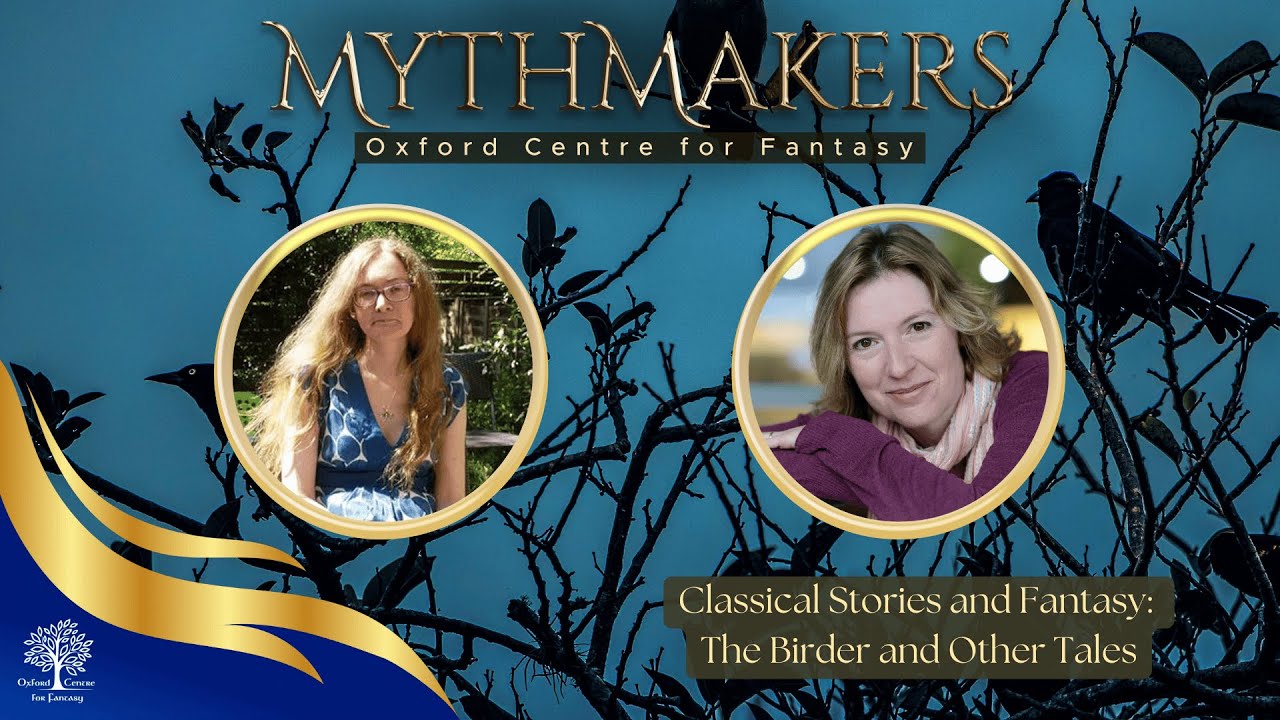
(0:05 - 24:45)Hello and welcome to Mythmakers. Mythmakers is the podcast for fantasy fans and fantasy creatives brought to you by the Oxford Centre for Fantasy. My name is Julia Golding and today I am joined by a very special guest who I met in our favourite town of Oxford and that is Dr Lorna Robinson.Now I invited Lorna onto the podcast because she has a number of interesting strings to her bow not just as a writer herself but also through her work in education. So Lorna is the founder of the Iris Project which takes information or exposure to the classical world and its myths into state schools in the UK and she's also the founder director of the Rumble Museum which is a very unusual project in that it's an accredited museum but actually in a school in Oxford and that is the Cheney School. So if you know anything about Oxford that's up towards where CS Lewis lived on the road up to up the road to Headington, a large state school.Anyway so welcome to Lorna. Thank you, I'm really delighted to be on the podcast today and looking forward to having a chat. Yeah so Lorna is actually, if you're looking at this on YouTube, she's actually sitting in her museum in the school so lots of all sorts of creative things like scissors and interesting artefacts behind her so a creative space within a school.So Lorna let me ask you first, what took you in the direction of, I suppose, spreading the good news about classical myths for this generation and why you think it's important to do so? I guess if I want to trace it right back to its inception, it was someone giving me an Usborne book of Greek myths and legends when I was about seven years old. I think that's where the journey started because I remember being completely enamoured with stories that I met there and those of you that know the book might have seen the book, it has these amazing illustrations of like Medusa and the Minotaur and things like that. So I think I was gripped from quite an early age and then I was fortunate enough to study Latin at secondary school and it was through learning Latin and then later ancient Greek that I found my love of classics deepened.I went on to study it here at Oxford University, did my first degree in classics and then a doctorate in Ovid's Metamorphoses, this amazing poem that we'll probably talk about a bit later on and this literary movement, radical realism, which I was really interested in and it was around that time I was supporting my doctorate like a lot people do with teaching and I discovered therefore that I really loved teaching, I really loved talking about classics and telling young people about classics and that I was aware that the jobs that I could get were all in private schools at the time and that was something that I suppose was kind of quite deeply on my mind, that I was aware of the limitations of access to classics and this subject that I loved so much and I guess I knew I wanted to be involved in broadening it. I didn't just want to kind of stay teaching in private schools, I wanted to do something that was a bit wider and so I came up with this idea of setting up a charity that I called the Iris Project after Iris the messenger goddess that travels on a rainbow and it started off with a magazine that was designed called Iris Magazine and it was designed to present classics in imaginative and creative ways and we sent free copies to state schools and we sold it to private schools so that was the model of it and then gradually we started running projects in state primary and secondary schools looking at storytelling of myths to teach Latin and then many years later I set up a community classic centre at Cheney School, a big comprehensive school as you mentioned in Headington in East Oxford and since then for about 20 years really it's been the base for a lot of the activities and teaching that I do, so a bit of a potted history there. Yeah so quite a lot of our listeners are over in the US so just to explain the sort of state private thing here, the state education sector is where the vast majority of people go and the private system you'll have heard of schools like Eton and those kind of places better resourced and that's where classics and classical languages tend to still get taught so it is regarded as a bit of an elite subject which is odd really because I was about to say that I think this current generation of my own children I think to go by actually know a huge amount about classical stories through very new routes so they know about it from playing various video games and in the world of reading they know about it from the Rick Riordan, Percy Jackson series but also they read Atticus the Storyteller you know another of these collections of books of stories and I think that they probably don't need an awful lot of persuading about how relevant it is because they'll be at you can point to programs on TV I mean there was a recent series called Chaos wasn't there which was another version of this so when you're talking to young people what's the starting point of their knowledge do you find? Do you get some kids who know absolutely more than you? I find that sometimes going around schools or are you often starting from zero with people trying to actually explain the classical world? Yeah so it's a big mix definitely I will occasionally come across students that have like obsessively read every variation of Greek myths and they'll be like ah but myths what about this and so they've got kind of an intimate knowledge but equally I will meet students that have arrived at Cheney that won't be heard of the mine at all or kind of stories that I always sort of associate with lots of children knowing and that's partly Cheney is a very diverse catchment and you get children from lots of different backgrounds so there's sort of quite a mix of knowledge of classics that comes from different backgrounds so but you're absolutely right I think that there are things like the Percy Jackson novels, things like Harry Potter those have got young children really kind of interested in stories and myths that are connected to classics they might not necessarily realise in the case of Harry Potter for example which ones you know which things are connected to myth and which aren't but they're aware of classical stories and of Latin and they're interested in it so I would say that I never experience any kind of negativity about classics from children whereas very occasionally from parents who have had negative experiences at school because Latin I think for a while it was compulsory for everyone before the school system changed and it was probably taught in quite an old-fashioned way and put some people off so I do occasionally get those sort of negative reactions from people who are older but from children it's just like wow this is really cool stuff we love these stories we've read these books or they might know nothing but as soon as they hear the stories they're really interested because who wouldn't be they're really great stories.And I suppose it's also a bit like being aware of let me guess King James Bible underlying so much of literature and poetry that if you want to understand the history of culture you need to understand what a reference to Cerberus might mean or a reference to Eumenides or I mean you can go through pick your poison in the sort of mythical world because it's given rise to so many retellings or metaphors or images in poetry or references in Shakespeare that if you don't have some of the big hitters under your belt like Icarus or something like that then you will be missing out on a huge range of enriching cultural references. Yeah yeah I think that's definitely true I think it's sort of I mean I definitely think the stories in their own right even without that knowledge are really interesting but knowing the layers of storytelling that lie beyond adds this enriching aspect to it and I kind of I love the children's faces when they realize some of the kind of back stories things that they're aware of as well so it's like this this moment of enlightenment and I am one of the reasons I was really drawn I think within classics even before the classical reception of today where there's lots of retellings even in the period itself the Roman authors for example they were always trying to retell older Roman and Greek stories so that spirit of what you might even call like fan fiction was already there in Greek and Roman times I feel like Ovid's Metamorphoses in many ways was a little bit like a kind of fan fiction of all the myths that came before him so I think that that spirit is there and it kind of continues today. So speaking about the Ovid Metamorphoses it links very well to your own book you've written and published independently The Burda which you have done in conjunction with the illustrator Lydia Hall who you've worked with on previous projects retelling so in a way it's your own fan fiction about this can you say what what drew you to write this book it's not actually aimed at very young children at all it's very much adult or YA title because of the nature of what it's dealing with do you want to tell us a bit about that because it's got an interest really fascinating interesting central conceit which is your starting point.Yeah so in fact it started life back when I was doing my doctorate so you know this is like 25 years ago and I was reading lots of because my doctorate as I mentioned was looking at magical realism this literary mode associated with Latin America primarily and this Roman poem of its metamorphoses and I've always loved writing and I always just wrote lots of random stuff and I just one day decided oh imagine a universe where people metamorphose instead of dying so I wrote a short story at the time but I just shoved in a drawer and didn't do anything else with for many many years because I just wanted to explore what what might a world look like where this was what happens to people. Can you explain that term so people know what you're talking about? The term metamorphoses? Yeah what happens if you don't die but you metamorphose what happens? Yes so in Ovid's poem the poem is strung together by interconnected stories where people change into other things or usually things like trees but sometimes people change into rocks or insects and all things like that so there is in the world of Ovid's poem people die as well but they transform usually at a point of heightened emotion or drama so for example Daphne when she's running away from the god Apollo she prays to her father for help and then she starts to transform into a laurel tree so you get these kind of intense moments where people transform. In the Birder it's different in the sense that there is no death in this universe people don't die everyone transforms into an animal of some sort but this usually happens just like death in our universe as people you know become old but sometimes again like death in our universe people might suddenly metamorphose as young people and that's something that always is a great tragedy and scientists and medical professionals are trying to work out why that happens so we see that in the book that they are aware that with brain scans they can see if someone is going to metamorphose sort of before their time and they're trying to understand the processes why so I really in the book I suppose I wanted to use metamorphosis as a way of like I suppose a bit of a mirror of how we think about death but because we're looking at it differently through this different concept it changes it defamiliarizes death I suppose and that shifts how we think about lots of different things so it was very much inspired by Albert's metamorphosis and trying to kind of put into action the central concept of his poem but also I wanted and this is where the magical realism comes in I wanted to make it feel real like feel like a kind of normal universe but with this one key change and I suppose as well as classics a big inspiration for the book is a book that maybe many of your listeners might have heard of called Never Let Me Go by Kazuo Ishiguro and I must have read that about 15 maybe 10 years ago and I was very struck by the way that he presented quite a big change in his universe a scientific change as it was but in a way that made it feel very normal so Albert's poem and that book in many ways were the two things that intersected to create the style of the murder.So your main character Meryl you start with her brother suddenly when they're young people together you know children he suddenly turns into a black bird and it's quite disorientating that first chapter when you first read it and you think what's going on you know and then as the book unfolds she's traumatized by that event but also intrigued by it so she's trying to in a very scholarly way which perhaps reflects the writer I don't know but she's looking into if there's any difference between the birds song of creatures of birds who have been people and changed into birds and you come on a garden you know bird and so she's on that quest and she has a very good friend Daniel whose secret is that he knows when he's going to well die metamorphose yeah so John who's the priestly character in it who's in a way trying to defeat the death in this world by persuading people they don't have to change so it's I would say it's the story of those three but you've divided it into chapters named after different birds and each story reflects something connected with that bird different ways of metamorphosing and this this lends to great work by your collaborator Lydia Hall because she does these wonderful are they wood cuts or lino cuts lino cuts yeah I know cuts of the various birds so it's a beautiful volume to actually look into so it's a case where I would definitely suggest people get the physical copy it's great fun to actually read and find these very careful illustrations so when you were writing this and you're saying you're in the this magical realism strain were you thinking about it makes me wonder what the Greek writers as far as we can imagine what they thought they were doing when they were coming up these stories because they treat these stories as serious real stories don't they yeah it was very difficult this is one of the big questions about the ancient world actually is what what did people really believe and of course it's to a great extent unknown but I mean I would suggest that a poet like Ovid who comes quite late in the tradition and he's quite a he's sort of a bit of a man about the city of Rome and he quite likes being clever and witty and you rather get the sense that he doesn't take any of it too seriously whereas if you look at say like a poet like Virgil who Ovid is borrowing heavily from Virgil is very serious and intense poet and it feels like there's more of a deep belief in in the gods and everything that's going on so yes it's very difficult to tell one of the things I loved about the Metamorphoses is the way in which if you look at how Metamorphoses stories are told by the Greek writers and by some of the Roman ones the actual moment of change is passed over so Apollo turns I mean Daphne turns into a tree but it's not really described it's just presented as something that happens and what Ovid does is it's he almost behaves like a scientist he like wants to get inside what how did that happen so he imagines you know first of all her hair turns to leaves and then her feet feel a bit heavy like they're turning into bark and so he's definitely very interested in the moment of change the moment of transformation. It feels to me that he is someone that's enjoying the stories but doesn't really believe that they happen certainly if we go back to very much more ancient writers like Homer then it's much more up for grabs you know what's what they believe and obviously the gods are a key mechanism behind a lot of the magic in their universe or a lot of the supernatural in the universe and we the bird are very specifically obviously there's a bigger character in it but it's it's not the metamorphosis cast not explained by any religious view. No but his role in society is to be at the ceremonies and so it's you know he's he's conflicted because he's they're both he and Meryl both feel they're in the wrong universe.Yes. And they often say that. They do and I mean in many ways I suppose the deepest inspiration for the book is I suppose my own and I'm not a sort of person of sort of faith as such I don't sort of have a certainty about anything I'm very uncertain about why the universe is the way it is but I've always had this feeling that that we we we live our lives as mortal creatures and we know we're going to die and this feels like a very traumatic thing but it's just embedded in our universe and we accept and part of writing the birder I suppose was to imagine a universe where there wasn't death and then use metamorphosis as the way of I suppose exploring this.So you mentioned at the beginning it's not really a book for small children and you're absolutely right because it is it is exploring this big theme of death and how we live with death and we accept that it's something that's absolutely central to our lives and yes it is this very traumatic thing in many ways or at least most people feel this is it. Yeah I mean I don't know why that can't also be what the Greek writers and others were also doing because perhaps our categories of did they believe this or not is not the right question so much as to what did they think this said about the nature of being alive you know the experience of this strange if we're lucky 70 plus years we get just a blink in the eye of the universe and where that fits. So where are you going next with your exploration of classical myths? There is an environmental theme that you very strongly follow at the Rumble Museum the connection between these stories and the environment so where are you going next? So since the birder I've published another book which was set in Minoan times but I'm now writing a new book which I'm hoping to finish in the next few months and this has a very strong environmental theme in that it's set in a future universe where the environment has changed and it weaves in ancient belief in the sense that there is a political party that is in power that is trying to return some of the Roman ideas about worship of nature into society so it's I suppose this book is a blend of exploring Roman religion and myth with environmental change and therefore also it's sort of straying a little bit into science fiction because there are some scientific advances as well.Now I'm not a scientist so it's been quite difficult to write those in a way that sounds plausible so sometimes with the scientific advances I sort of left the details a bit opaque so I don't fall into some kind of error but that's what I'm involved in at the moment and I'm really enjoying writing about it and yes that sort of environment is something that like a lot of people is sort of a source of deep anxiety and concern for me personally in terms of thinking about the future of society and are we all going to manage to make this work and sort of mitigate some of the effects and also as a mother thinking about what kind of world is it going to be like for my daughter when she's I don't know 50 or 60 and things like that. Yes indeed so as your book is very much founded on Ovid's Metamorphosis, would you have a favourite edition of that? I mean I've most recently read it in the Ted Hughes Poetic Treatment. Where would you direct someone if they wanted to have a go at reading the Ovid version of it? Of course, so I do really like the Ted Hughes version.I think it's very loose in the sense that he's not stuck closely to the Latin but he's done it in a really interesting way so I would definitely recommend Ted Hughes coming from the outside. I think who is interclassicist and is not kind of looking at the original Latin, I think Ted Hughes is a great place to start. Other than that, I don't think I have a particular favourite translation.(24:45 - 26:35)I mean for example, I quite frequently just use the Penguin translations when I was working with the text and so there isn't really one to me that stands out. It's not like with the Iliad, I have a very strong sense of I for example really enjoy the Latin translation. I just think that's the one that I like the best although I know there's a newer one by Emily Wilson I haven't read yet so I should really get myself reading that.But with Ovid, yes I think I'd probably say have a look at Ted Hughes like you suggested because he has such an interesting take and such a modern take and I think that some of the translations might feel a bit clumpier. Well he definitely has that kind of blood and sinews sort of because of his poetry and that sort of grittiness, the Yorkshire in him I think sort of adds that weight to the physical experience of change. Yeah definitely, it's very visceral and also just the sort of rhythm of his translation I like.It's really quite different from Ovid but I think it's a really good starting place if someone wants to kind of pick it up from fresh knowing nothing about it. There does seem to be a bit of a, well it's never really gone away but just thinking about recent treatments of classical stories we've had the Ralph Fiennes film The Return but also coming up we've got the Christopher Nolan epic Odyssey. So I think young people are going to be very familiar with many of these stories by the time we finish this year.(26:37 - 28:15)So are you looking forward to that film? I'm hugely looking forward to it because I'm actually quite a big fan of Christopher Nolan as a director. I think he's very atmospheric and has a really interesting sort of soundscape that he creates so high for detail. In fact I just the other day YouTube with its clever algorithms worked out to advertise it to me and so the trailer popped up and I was gripped.I think that went everywhere because I don't think it's short of a marketing guide. No I'm sure that's true yes and so I'm hoping to organise a trip for my SIGFORM classicists that we'll all go together and watch it because I think that would be really exciting and I love the fact that there's so much retelling of classics going on. It makes it such a fresh and exciting field to be working in and to be teaching them.Yes because each generation finds its own relevance of course. Yeah okay well thank you so much for joining us Lorna and we look forward to seeing what else you do with Classical Myths as you go on. So thank you.Thank you for having me. Thanks for listening to Mythmakers Podcast brought to you by the Oxford Centre for Fantasy. Visit oxfordcentreforfantasy.org to join in the fun.Find out about our online courses, in-person stays in Oxford, plus visit our shop for great gifts. Tell a friend and subscribe wherever you find your favourite podcasts worldwide.