
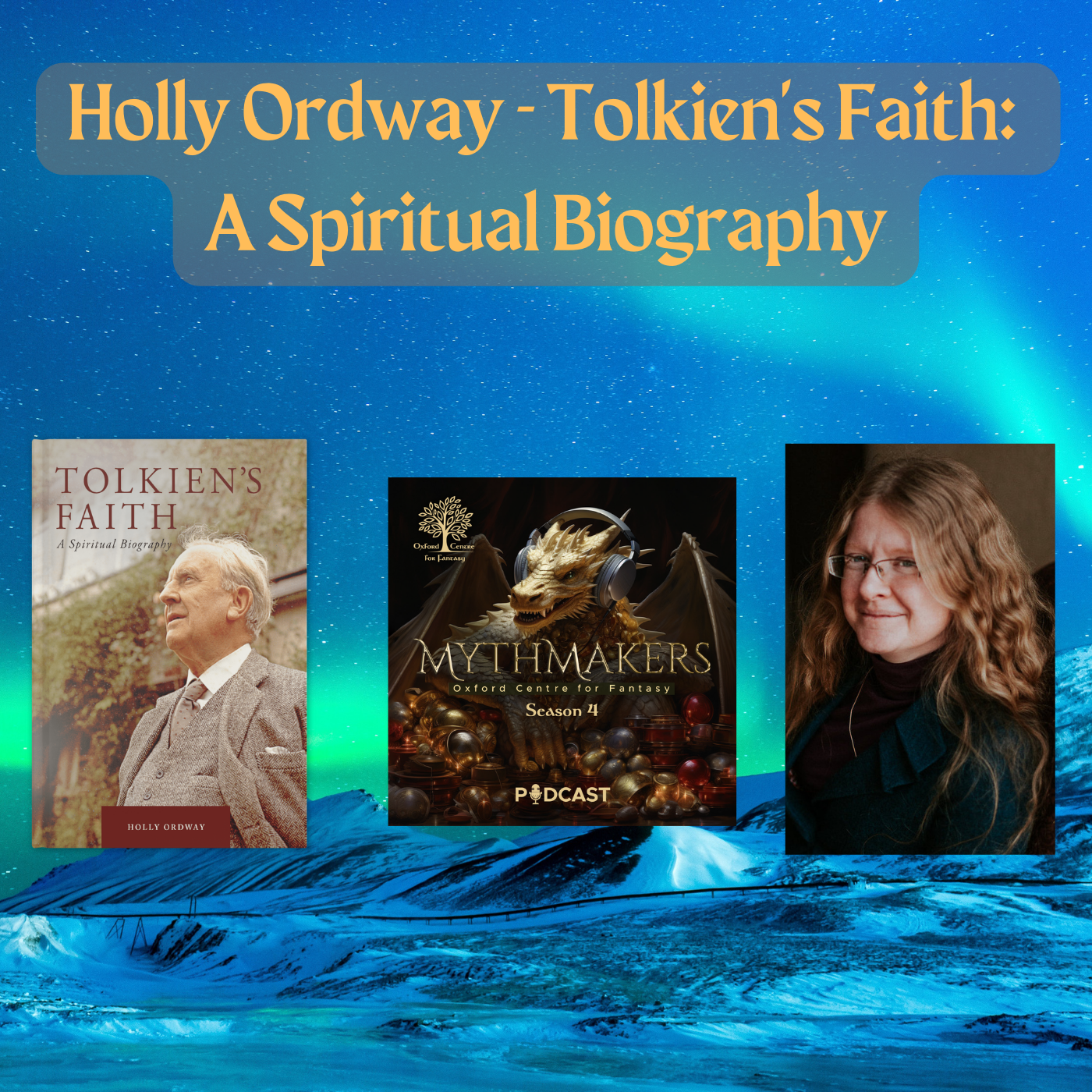
Tolkien's Faith - a Spiritual Biography
Where in all the fantasy worlds is the best place for a place of worship?

 Apple Podcasts
 Amazon Music
 Spotify
 JioSaavn
 Castro
 Professor Holly Ordway returns to Mythmakers on today’s episode to discuss her new book on Tolkien's Faith. Having been first an agnostic, then an atheist, and now a Catholic, Professor Ordway uses her insider/outsider perspective to elucidate this fascinating topic. Join in as Professor Ordway discusses with Julia Golding the many flavours of Catholicism and the particular, and unusual, one that Tolkien followed as part of the English Oratory movement. Take a listen to what this offers to everyone, Catholics and non-Catholics, and how it relates to his writing within Middle-earth.
To find out more about Professor Ordway’s book and to purchase a copy visit hollyordway.com .
Hello and welcome to MythMakers. MythMakers is the podcast for fantasy fans and fantasy creatives brought to you by the Oxford Centre for Fantasy. My name is Julia Golding. I'm a writer of many novels but I also run the centre where we teach creative writing and do this podcast amongst many other things. And today I am joined again. I'm delighted saved by Holly Ordway who we first met when we were talking about her book Tolkien's Modern Reading but her next book which comes out at the end of August is an exploration of Tolkien's faith and it does what it says on the tin because it is called Tolkien's Faith, a spiritual biography. Now Holly do you want to tell us a little bit about your own story about how you came to write this and where you sit within the academic world as well so we got a sense of where you're coming from? Right well first of all it's a pleasure to be back on the show and to be talking about my favourite author and as we come up to the 50th anniversary of his death which is September 2nd of 2023 it's a good moment to kind of try and take stock of the full picture of his life and one of the things that I realised as I was researching and writing Tolkien's Modern Reading which was a 10 year project that that book took a long time to to write into research. I kept discovering along the way lots of references to his faith that we're kind of adding up to a richer picture. I knew already that he was a Catholic that he was a devout Christian and that's why they recognised but I had gotten the impression from the biographies that I had read that it was a bit compartmentalised and of course there's the debate you know to what extent is the Lord of the Rings a Christian book. This is a very complex question because Tolkien himself says very famously in a letter that the Lord of the Rings is a fundamentally religious and Catholic work unconsciously in the writing but consciously in the revision. Wow that's that's a pretty firm statement yet he goes on to say that's why I've cut out all the overt references to religion which okay that's interesting choice and the book itself as with all of his writings is accessible to writers of any faith and to to no faith as I know myself from personal experience because I you know I am myself now a Catholic but I grew up sort of agnostic nothing particular and none became an atheist when I was undergraduates and was reading Tolkien during all this time you know as a as an agnostic as an atheist and then later as a Christian. So I know first hand that you can love Tolkien and be moved by him without even having much awareness of his faith let alone sharing it. I mean I was quite hostile to his faith for much of you know my early life yet I still loved him so how do we make sense of this how do we make sense of this question and that's been in kind of the back of my mind and then as I researched Tolkien on a reading coming across so many references to the depth of his faith and the way that it was such an important part of his life many realize that that there needed to be a reconsideration a re-examination of a spiritual life to get the big picture of it. Now along with this there comes the fact that I'm I'm I'm obviously an American but I spend a great deal of time in England I spend time there every year and have done for about 15 years now you know I spend several months every year in Oxford and so I worship in the same church as the Tolkien worshiped as a Catholic I'm I've been deeply influenced personally by English Catholicism and I began to realize that for American Christians English Catholicism is a is a whole different world and that's the world that Tolkien grew up in and then specifically within that the oratorians the Birmingham oratorians realizing that this the Birmingham oratory wasn't just the name of a church where his guardian happened to be a pastor it's the congregation of the oratory of St. Phil of Neary which was brought to England by John Henry Newman which is a whole congregation it has a spirituality of its own and a very distinctive spirituality and I remember one time I had gone to mass I think I've gone to confession and mass at the St. Aloysius which is now the Oxford oratory although it wasn't in Tolkien's day and I remember walking out and thinking to myself wow the oratorians their their spirituality their their liturgy is a very Tolkienian and then I stopped and said to myself wait a second I got that reversed and that was one of the things that started to make me interested and exploring not just the biographical fact that Tolkien had been raised effectively by an oratorian priest but what was the influence of oratorian spirituality on him and what was the influence of being raised of growing up as a convert because he was a convert he was he he became a Catholic when he was old enough to remember what was the impact of growing up as a Catholic in English Catholicism and that became a major part of the research for Tolkien's faith putting Tolkien into his context especially of Catholicism as an utterly marginalized and and socially you know minimal and socially disliked and and marginalized community I mean they didn't even have full civil rights until well into Tolkien's adulthood which was a sort of shocking fact to realize yeah so just to set the I mean it goes back to Henry VIII everybody so if you're listening to this in America you probably well you're probably aware of Henry VIII and his wives but how that all kicks off is he doesn't have a legitimate heir and his first wife who's a Catherine of Aragon she is getting a bit old and he's he's not going to work and so he wants to get a divorce he's not allowed a divorce because it's a legitimate marriage in the eyes of the church and she's well connected so this forces the rupture where you get this division where you get the Church of England set up separately which allows him to go ahead and sort of basically undo the power of the Catholic Church because after that point the Catholic Church was very much part of the state and the Anken Church the Church of England then was set up as the the state church and still is our established church so at the coronation that is what King Charles III swore that he would be head of because it has the monarch at the head that isn't like the pope at all he doesn't then decree on things it's just a figurehead role the Archbishop of Canterbury is ahead so there's a whole separate history that then sets off and the Catholics are seen as the enemy like insurgents really for quite a few years and a lot of the history of the next 300 years for 100 years is explained by this including things that people would have heard of like the Gump out of Plot and Guy Fawkes and the Jacobite Rising and things like that it's all to do with this split so roll forward and I'm sure a lot I'm teaching a lot of people here with things they already know so I won't go on about it but just it's an interesting context that the Catholics were regarded as other so when his mother becomes a Catholic which wasn't the faith of her family it sets her apart it's a bit like I don't know a child now converting for say Muslim to Christian or Christian to Muslim it it was a division whereas now we don't see much of a difference at the time it would have been regarded as quite a big step which made her quite an isolated figure and it also under sort of explains why it was the church fathers who became the guardians for the boys because that's where she had had her family so that's just a yeah trying to explain why being a Catholic wasn't just a kind of shrug thing which is now as fine you know nobody nobody bats an eyelid then there was still the hangover of these centuries of problems between the church and the state that thing you said about how the liturgy is very talkinian or talking was inspired is fascinating I can't wait to read your book so that I can find out the detail of that but what do you think that there was in the English version of Catholicism in particular that inspire talking creatively is there anything you can think oh yes there's some kind of aesthetic here some sort of feeling about his faith that then becomes that in woven into the creation of Biddle Earth well yes this is a huge huge question um I to kind of narrow it down a little bit you know to to be a Catholic in England was its own experience which which we've already sort of lightly lightly touched on um but specifically I think he was really influenced by the by oratorian spirituality which is a charism within yeah Catholicism I think often people who are not Catholics and many who are tenethe of Catholicism as as uniform like well this is what all Catholics do there are obviously many things that all Catholics do um but there's a lot of diversity of sort of spirituality is within Catholicism you know the Dominicans are very much you know their ministry is preaching their church is going to be much sort of simpler like block fires in Oxford very sort of simple plain design you know there's the Franciscans with emphasis on poverty of life um and so there's different sort of spirituality within Catholicism and oratorian spirituality is not very well known this is the the congregation founded by Saint Philip Neary who was a Italian saint um 16th century who inspires the oratorian Rome and it goes it spreads to other places and John Henry Newman brought it to England and there are a couple of interesting points about the oratorians one is that they place a particular emphasis on um ministering to the more highly educated in the community they always go into cities and they so Birmingham for instance and they all they place a great emphasis on music um and beauty and liturgy and this is then an aesthetic he grew up in in this this real sense of beauty and we can't take that for granted because not all English Catholic churches are or certainly would have been then um beautiful or with good music because as partly as a result well as a result of the reformation and the establishment of the uh of the church of England all of the existing churches which had been Catholic up to that point were converted to Anglicanism Catholics no longer had places of worship um and even after meaning for and for a long time it was illegal to be a Catholic to to attend mass um even after those penalties were lifted it wasn't until 1791 that Catholics could even build churches again and even then there were restrictions they couldn't for instance put steeples on them for a long time so it would call too much attention to these you know these Catholic places and of course Catholics in England were much poorer significantly poorer than their Anglican counterparts so the churches tended to be cheaper and uglier generally speaking and so there's a real cost in lots of ways to becoming a Catholic not just socially but even aesthetically and that would have been something that Tolkien would have been well aware of in the oratory he had the great privilege of being able to grow up surrounded by beauty um and interestingly he would also have seen that happening because when he and his mother and his brother started worshiping at the Bermam oratory it was not the big beautiful church that we see now if we go and visit it that was built um during Tolkien's teenage years he was originally a very small shabby kind of blah um building that was then rebuilt into this big beautiful church sort of built up around him so he has this early exposure to beauty um and music and a sense that it's important it's not just a little optional extra that it's an important way that we worship that we express our faith and one other point they'll just make briefly although I talk about it at much greater length in the book oratory and spirituality really puts a great emphasis on joy um it's a spirituality of joy but it's a spirituality that incorporates sorrow joy is not the same thing as happiness and I think that this has profound influence on Tolkien and we can see it in many ways throughout his whole his whole work all his his ability to to get through these sorrowful periods and still have a sense of joy that's very that's very much in line with with the spirituality of the Oratorians I suppose the one big difference thinking about it between middle earth perception of faith and what we might or might not believe is um they knew the gods were there the valla were over in the undying lands and there's nobody who says oh Eru Eluvatar doesn't exist it's not a world of doubt do you agree um it can be a world of despair but well that's a really interesting question um I mean Tolkien is obviously writing middle earth from a point of view of natural theology this is a pre-Christian world he's very clear it's pre-Christian world um so so there obviously there isn't any Christ figure in it um and he's also very clear that the valla are angels angels are archangels um and he makes the point in one of his letters that um the that um the inhabitants middle earth might call on the valar as a Catholic wood on a saint so they're intercessory figures but of course Eru Eluvatar you know the who told his quite clear is is god as he as he understands and the one god the god um I mean he's he is not visible to the people of middle earth in that sense just as you know just as now um may perhaps much less so because this is pre-incarnation and we see not so much in the Lord of the Rings but in the in the legendarium you know the story of of Numenor is a story of um you know worship of Eru perverted into you know you know you do human sacrifice and and worship of uh of uh Morath so I think Tolkien's not specifically working in the modern um very modern struggle with does god exist because he's working in a natural theological framework in which he's taking it for granted that god does but he's still certainly giving plenty of room for the people of middle earth to act as if god doesn't exist yeah no that's true and there's and there's also plenty of room for the bad guys and the fallen good guys to try and you know achieve a power that is not appropriate for mortal or immortal people even um you know like the ring for example because it corrupts but but this theme is making me think some interest it's intriguing me and I'm sure is it this is what I'm going to be reading your book to find out is things like well why can't men um and other races go to the land the undying world why can't they go there why they separated why are only elves allowed because that's the place where the angels uh hang out why do men not know what happens happens to them after death whereas elves do know that they wait in the halls of mandos um and there's some suggestion that they sort of come back again they don't leave the confines of the world he's already perplexing theological questions in a sense um but they're very different from the kind of theological questions we would be asking in our well because we don't have those dilemmas um maybe disagree because i think we're asking those questions i mean we don't ask them the same way as the elves because we were humans not elves but what happens when we die is quite possibly the question right you know what what does happen can we be sure where where do we go um that's as profound a question now um as it would be for you know barren um in middle earth but what i meant was there isn't a group of people who have like special access you know like a that part the big division between elves and men the mortal and that obviously isn't our lived experience so right the the theology of that why that is set up like that is something which is made up for middle earth uh and that's i think talking's his way he's exploring he's exploring certain what now obviously fundamentally talking is telling a story yeah he's yeah it's the narrative of the characters i mean his his elves come out of his languages um so we mustn't ever ever fall into the trap of thinking that he had a theological puzzle he wanted to work out and so therefore he he acts winds he characters utterly antithetical it's Tolkien's way of thinking but that doesn't mean that he didn't think about these things and weave them in because he he writes for instance that the the main theme of Lord of the Rings is death and the desire for deathlessness and this is a theme that he explores throughout the whole legendarium and the elves allow him to do this in a really interesting way because the elves don't experience death in the same way that that humans do so what it effectively allows him to do by contrast is to explore what does what does death mean in what way is is death a gift to human to the human race why might elves view it as a gift when we might view it as a burden that so the separation of the elves as these as these people who did have a chance to see the light more directly and yet they still manage to to fall in rebel i mean the whole the holster is similarly and is fan or please stop it yeah exactly fan or no fan or give up then not yours yeah so i mean in a sense um you know Tolkien is exploring this idea of you know what do we do with the light that is given to us um just because the elves had a more privileged access to that light did not immediately empower them to lead perfect lives his elves are so far from being seamless perfect people they're they're really not um but they have different gifts and different temptations and i think that allows him to explore things like temptation and and grace um i mean grace much grace is given to the elves to think with it well that's exactly the question that any Catholic would have to answer like well we have all this abundant grace coming to us in the sarkmas what am i doing with it am i attempting to conform to it or am i just saying whatever and entering away from it so i think this gives him a freedom work with these themes because which is the freedom of the fantasy gives i think that's a probably more helpful way um the way you're talking about it is you you see a theme like grace that is playing amongst the elves and you then take that out i was just getting a bit annexed by thinking about the other way in you know when you're sort of looking for how it goes the other way and i think that so the idea of overweening ambition um the numinole story uh the falling for the temptor the corruption um it's not really a question of what a why question it's uh oh yeah i've seen that before and isn't it like isn't it that that particular thing um of the fool and of course the numinole is interesting it's the only place with an actual mentioned place of worship isn't it sort of escapes the escapes the delete line so um holly i'm really looking forward to reading this but we also have to of course face up to the fact that for some people uh in the Tolkien fandom out there find mention of um Tolkien's faith and Catholicism um not something that's empathetic with and and indeed something which scares them or makes them feel a bit outside uh you know the Tolkien's world in a way so how do you feel he handles his faith and the way it touches into his creativity that actually suits our diverse world you said at the beginning that you had your own experience of sort of coming through various stages of faith no faith to be in Catholic so you obviously were able to um navigate that yourself but for someone who's listening who doesn't have a faith or is from another faith is Tolkien still okay to read or is he only talk is he only preaching to the choir should we say well he is you should read him he is he is he yet read Tolkien um and this is something that i found very encouraging for me as i researched this this book um and i wouldn't think i i want to know when i when i wrote Tolkien's faith i'm very keenly aware that you know he has a readership of so many people who don't share his faith um who may be as you noted a little bit maybe nervous about it or off-putting and so as i as in this interview i've been quite straightforward in the first chapter i say look i i am myself a Catholic i share his belief but but and i say this right in the beginning in the first chapter it has been my effort in the book to be just treating of his faith as he understood it i neither critique it nor recommend it my ancestors are what did it mean to him because he's a genius he's a if you're listening to this podcast you probably don't have any you know i think with that he's a brilliant writer so if it was important to him i think it should be important to us we don't have to share it we don't have to like it um but i think it's really important to approach his faith without any presumption of of either affirming it or rejecting it because both of those attitudes lead to distortions where you the find what you want to find whether it's positive or whether it's negative and as i looked at Tolkien's life i realized that he had grown up really in such a way as to have a lot of sympathy and openness to all sorts of different people he had the experience of being a convert who then was mentored by the oratorians who were themselves nearly all converts and had a great deal of sympathy for angthinism so from the beginning he was not raised by by men who thought oh the Church of England is evil Protestants are all heretics no they said well we we have this blessing of becoming Catholics but the Church of England is are still there still Christians and they are you know in some sense really anticipating what will be explicitly taught at Vatican 2 that was what was lived out in Tolkien's life in the influences john Henry Newman was a kind of you know early ecumenism saying okay well we differ but we're not enemies he went to school at a Protestant school king Edward school um which i learned was distinctive in that not only did a half both Catholics and Protestants but even Jewish students and that is very not typical of English you know grant schools of his day so he grows up with friends from diverse backgrounds and throughout his whole life he has friends who are Protestants of all different kinds and also he has friends and acquaintances who are not believers and he's always quite forthright well this is my faith no one ever thought he wasn't a Catholic but he's always able to relate other people and not to not to let it be a barrier between them um it's quite moving really some of the things that he writes um and says about um his non-Catholic friends so i think that folks who are a little bit maybe worried like oh if i read a book about Tolkien as a Catholic am i going to am i going to learn that he was really a bigot who thought that everybody was going to go to hell if they weren't a Catholic i can give a little bit of a reassurance he was serious in his faith and some of what he believed might be challenging or a little bit difficult um how did he believe those things but he definitely had an openness and a a respect um and a sense that God is working in people's lives in all sorts of ways that he can't judge and he didn't try to judge so you need to have no fear dear reader um i think i think you'll find that you get a much better picture of who he was and what was important to him and and that's i think useful for any any reader of Tolkien whatever whatever their their faith background might be yes thank you that's a very good place to you know land this discussion so we look forward to seeing that book and having a reset particularly like the idea of actually being a bit more clever about understanding what Catholic ism is rather than just saying he's a Catholic saying actually there are many flavours and this particular one is the one that we see working its way through his his work in honor of this discussion we're going to do our special segment on where in all the fantasy world is the best place for something to choose best place for a place of worship now this does not have to be in any sense a world religion it can be a made up one on a moon it's just the idea of where do you think would be a good place to go and experience the worship of that world in whatever contacts that is well you did you did give me warning on this and so i was able to think about this and i i think i will pull up a Tolkien example and i would go to the passage in the Lord of the Rings where Frodo and Sam have been going through it really and that they've they've encountered pharamer and his crew and he's brought them to their you know their their secrets cave and then they're about to have the meal and then i'll go ahead and i'll just read i pulled up the passage so they were led then to seats beside pharamer barrels covered with pelts and high enough above the benches of the men for their convenience before they ate pharamer and all his men turned and faced west in a moment of silence pharamer signed a Frodo as Sam that they should do likewise so we always do he said as they sat down we looked toward new menorah that was and beyond to elven home that is and to that which is beyond elven home and will ever be very liturgical very much so very much so and this is this is in fact one of the instances of religion that Tolkien chose to leave in this is an example of a sort of natural theology of worship and i think i like that as an example of a place or occasion of worship because it kind of gets to the foundations that it isn't necessarily you know it isn't just about the place this is about a recognition of what was and what is and what is to come whatever that might mean to you at that particular moment it's a good thing to be reflecting on and i think it's a very inviting moment in the Lord of the Rings so i would pick that i would i would join in that yeah no i think that's a perfect example so i've got to choose like different so the thing that came to my mind is early on in out of silent planet by cs Lewis when ransom who's been basically kidnapped and taken on board a spaceship it's very flash Gordon in its kind of technology but anyway this spaceship has a sort of deck where you can see out and the great revelation that ransom has is that ours is the dark silent planet and the solar system he's traveling in is the singing spheres it's using that medieval idea of the heavens and giving it a sort of sci-fi makeover but there's a description of ransom lying naked in bathed in this light and just sort of absorbing the praise of the universe it's a marvelous piece of writing it's when cs Lewis seems to really take off and produce some amazing word pictures so it's like a moment of worship on a spaceship so that's my own free oh and that's that's such a such a great a great scene yeah you're like great line where you know the idea of space emptiness is a blasphemous libel because that's not what it is it's full of the it's the heavens which is why we should call it the ransom trilogy or the cosmic trilogy and not the space trilogy yeah yes that's a great passage thank you so much Holly for joining us and we wish you all the best with that new book and yeah I'm waiting to get my hands on a copy excellent well my pleasure thank you thanks for listening to MythMakers podcast brought to you by the Oxford Center for Fantasy visit Oxford Center for Fantasy.org to join in the fun find out about our online courses in person stays in Oxford plus visit our shop for great gifts tell a friend and subscribe wherever you find your favorite podcasts worldwide you're listening to this podcast so I know you've got a curious mind here's a helpful fact you might not know yet drivers who switch and save with progressive save over $900 on average they make it super simple pop over to progressive.com answer some questions and you'll get a quick quote with coverage options tailored to your choices plus you'll see which discounts you may qualify for like the online quote discount or savings for paying in full in fact 99% of progressive auto customers earn at least one discount see if you could save when you switch to progressive you'll feel good about making a savvy choice visit progressive.com and see if you can enjoy a little extra cashback progressive casualty insurance company and affiliates national average 12 month savings of $946 by new customers surveyed who saved with progressive between June 2024 and May 2025 potential savings will vary