
Why it is dangerous to study Tolkien?

 Apple Podcasts
 Amazon Music
 Spotify
 JioSaavn
 Castro
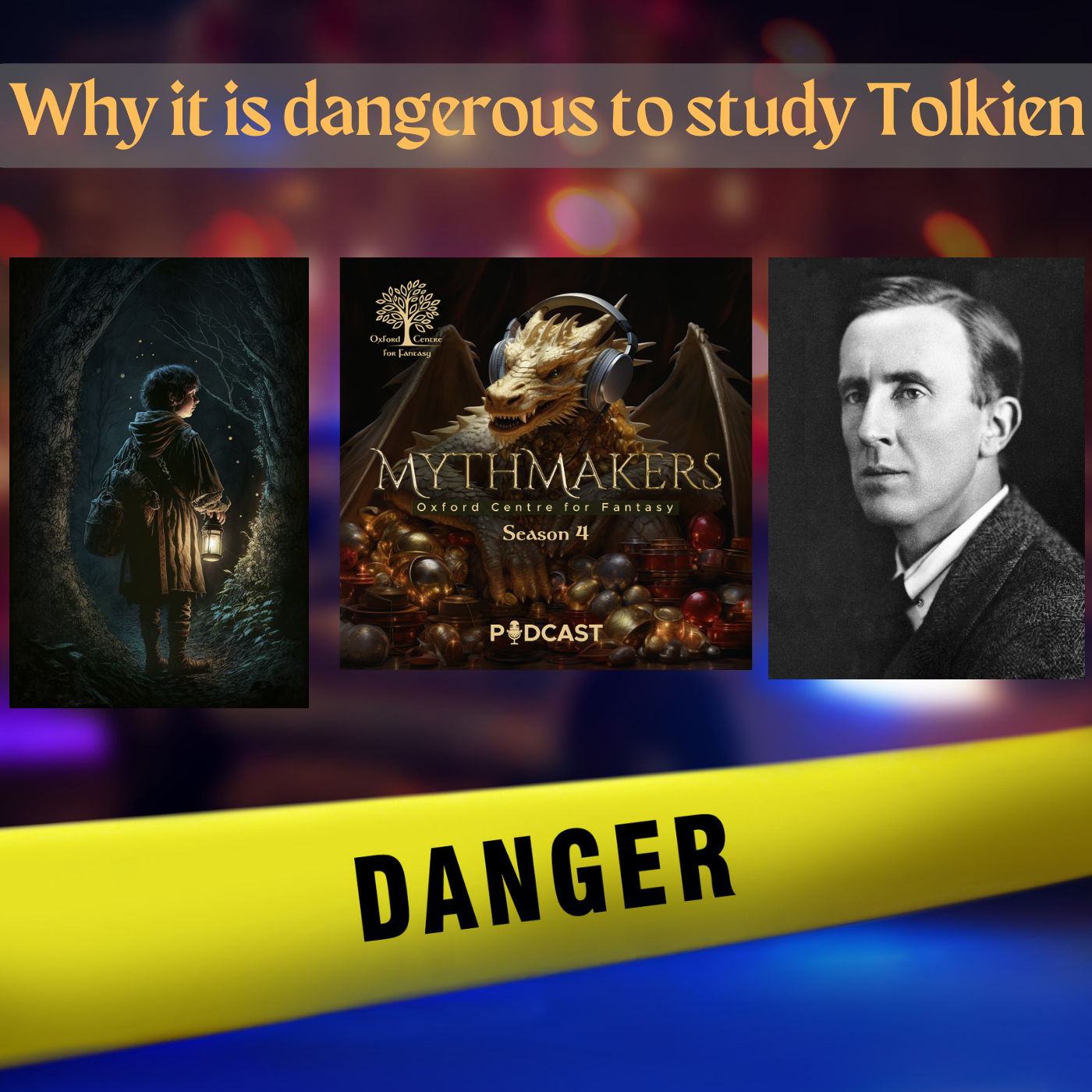
 It is a dangerous business going out of your front door, according to Bilbo - but so is studying Tolkien! On today’s episode, Julia Golding reports on current scholarship on Tolkien, thanks to the Tolkien's Words and Worlds conference at Corpus Christi College on the 2nd and 3rd of September of this year. What is the big mystery behind Tolkien's name? What is so special about the Fields of Cormallen? And who did C.S. Lewis dislike so much he spent a decade writing rude poems about him? Take a listen to fine out!
For more information on Tolkien’s life and his literature, check out the works of authors John Garth, Holly Ordway and Michael Ward.
Hello and welcome to Mythmakers. Mythmakers are the podcast for fantasy fans and fantasy creators brought to you by the Oxford Centre for Fantasy. My name is Julia Golding and today I want to talk to you about the issue of why it is dangerous to study Tolkien. And yes here I am looking at you academics, all those people out there who are producing these great big books on Tolkien these days are going to look at why it is so dangerous what they are doing. But first of all let's give this some historical context. There's a short term historical context and there's a longer term so I'm looking further back. Fifty years ago when Tolkien passed away in 1973 it would have been very unnatural for people to suggest that he would be studied at university. That was still the true when it came to the eighties when I was at college myself. He was regarded as on one hand an English professor of older languages Medieval and Anglo-Saxon, Norse and Celtic those languages. But he was also well known of course as a writer of popular fiction and it's that popular there which made him thought to be below the interest of academic study. Now in the eighties that was just beginning to change and be quite interesting to find out when the very first academic article was written about him actually so if you know do send me a line. But at the end of my undergraduate study at Cambridge I told my supervisor that I wanted to do my final thesis on Tolkien and CS Lewis and creativity. That's the whole idea of myth appear. The subcreation, the secondary creativity of the author and other creatives in a context where you think of there being like a creator god that's how they pursue creativity. And I found that idea really inspiring because it gave you the idea that you could be a subcreator of your own world and in way for me that released a whole sort of new aspect to creativity. Anyway when I said I wanted to do this so this is Cambridge in the late eighties there was a bit of a mmm from the people who were in charge of finding me a supervisor. They did find me one and I was allowed to do it but there was definitely a feeling that it wasn't quite fully academic. I remember even thinking at the time that surely it'd be fine because I'm doing all these you know stiff papers on tragedy and you know all sorts of other serious subjects so I was allowed to do a little bit of what I actually loved in my thesis. And I think that attitude was prevalent in the university systems of the eighties began to fade a bit in the nineties but still today you can find an element of sniffiness about Tolkien. I noticed for example that most universities who do teach Tolkien tend to do him as a gateway to medieval and old English. It is though he's a sort of gateway drug. Once you get hooked on Tolkien you'll then be interested in Beowulf and Sagawayne in the green night. It's kind of a utilitarian way of looking at Tolkien rather than someone to be studied in their own right as you would study Dickens or you know Jane Austen. It has to be linked to something which is already recognisably an academic discipline. Okay so things are changing and I think that thanks to the work of scholars in the nineties and the two thousands but certainly to say you wanted to study Tolkien at that stage in the eighties nineties was dangerous. It was a career risk really but now we've moved on to a different kind of danger and this was brought home to me at the beginning of the month of September 2023 when there were two conferences running in Oxford at the same time both were there to mark the 50-year anniversary since the death of Tolkien. One of these conferences was the Tolkien Society Entmute which took place at St. Catherine's College. If you went to that do let me know how it went I met a couple of people who participated in that so it seemed to be good fun but a more sort of rigorously academic conference was held at the much smaller college right next door to the college where Tolkien was a professor so it's next door to Merton College and it's a tiny little college called Corpus Christi and that was aimed at the academic world so we had leading scholars such as John Garth, Michael Ward, Holly Ordway and it was convened by a Tolkien expert called Giuseppe Pazzini. Now this one was a day and a half's conference and it brought home to me the dangers of actually studying Tolkien in great depth but in a new way. So what did I learn from this conference? I thought I would kind of report back to you to give you some of a flavor of the studies that are going on about Tolkien at the moment because many people were talking about upcoming articles or books they've just published. The first insight it gave me is how international study of Tolkien has become so we had scholars from all over the world. I've mentioned Giuseppe Pazzini who won, who convened the conference he obviously is Italian but we had Yokohemi from Japan showing that interesting Tolkien has gone over there which isn't that surprising because when I was doing my own doctorate in the romantic period it was clear that there was a great love of British nature writing as a sort of romantic poets in that case but I can totally understand the connection between the nature loving Japanese culture and Tolkien's work and there was also a scholar from Poland called Wukash, Newbauer and so on there was lots of real international flavour to that room plus the participants were from all over as well so it gave me a sense of the breadth of Tolkien's scholarship. So what were the highlights of the conference? Well there were many. A couple of the things I loved listening to so for example Michael Ward who you might be aware of as the author of Planet Narnia so he's well known for his work on C.S. Lewis and in Planet Narnia he gives a revelation about how you can read the Narnia stories mapping it onto medieval cosmology but he's turned his attention to Tolkien and Tolkien's use of the calendar. Michael's own background is his a Catholic so he's particularly aware of the the church calendar from Catholicism and how it might be brought to bear on Lord of the Rings. Now obviously already you've probably noticed if you looked at the appendices some key dates so for example the the actual birthday when Frodo and Bilbo have their birthday but also when both Bilbo and Frodo set off on their journeys is the 22nd of September and that's very close to some michaelmas that is sort of the autumn festival of the church and then when they leave Rivendell it falls on the 25th of December which is as christmas I sure you know. Tolkien apparently said that was just a happy coincidence but he was happy with the coincidence but what was totally on purpose was the date in which the ring goes into the cracks of doom and that is the 25th of march which is lady day in the old festivals and it was the day on which the church's new year was dated it's it's marries day in the church so it's the beginning of a new year which you see that sense of moving into a new age is very much linked to the day on which the ring is destroyed anyway so those are well-known dates that have significance but what Michael Ward was doing was looking at the date the 8th of April you're scratching your head thinking what happens on the 8th of April well it's the date on which the scene the fields of corn mullend takes place now perhaps this is a scene that you don't think about very much it comes after the the ring has gone into the far but before they go back to gondol for the coronation of arrogant it's when Sam and Frodo wake up and there is a feast in the honour they're reunited with most of the fellowship ones who survive and they hear a song about their journey sung by a bard which fulfills a kind of moment of wish which they express when they're when they're in the darkest part of their tale on the stairs of Kirith Ungl anyway this actual scene Michael was stressing was the most important scene in the entirety of the Lord of the Rings to Tolkien so obviously go back and read it now now you've heard that and he showed us a photograph of the manuscript talking talks about crying as he writes this and sure enough on the manuscript there are tear drops which I found so moving to see that why is it important well lots of reasons but it is the moment in which they are recognised it doesn't make it into the Peter Jackson films if that's your main familiarity with Lord of the Rings but it is referenced I suppose at the coronation where arrogant says no one bows to you and everybody bows and the four hobbits are left standing in the novel version of that same sentiment arrogant puts Frodo and Sam on his throne his chair and that's when everybody recognises their heroism that's important because it's the reward it's the payoff it's the happiest moment and for Tolkien it was the culmination because of course then they get the song which is like his book it's telling of their their heroism anyway that's an important scene yes we can all agree that but why is it set on the 8th of April I will leave Michael to publish his article about it but let it be said that there is a connection between the private story of Tolkien and his wife and what happens nine months later a sort of a sense of that so um actually notice the other way around it's what happened nine months before there we go Michael I was listening um I actually was thinking maybe that might be going a bit far on reading in today's but this is where academics will scroll scroll with each other um anyway it was fun to think through the significance of the calendar another excellent highlight was from professor Simon Horobin he currently holds the same position at Mordlin College that C. S. Lewis held during his lifetime when he was at Mordlin he's the medievalist he's been writing mostly about C. S. Lewis recently but he's been looking at how C. S. Lewis was converted by Tolkien now not to faith but to into an appreciation for philology which obviously was Tolkien's world of linguistics and languages so how this works out is that C. S. Lewis finished his first degree which was basically classics as we now call it and he was told in order to be more employable as a university level he should take some of the papers from the English syllabus so that he could potentially get a job in English faculty it's turned out to be excellent career's advice because that's exactly what happened but one of the things he had to do is go and sit through some lectures of a professor of philology a guy called professor wild and clearly he took strongly against this professor to the extent that he had his textbook and he kept writing poems in dishonor of this professor how much he disliked every word that came from his mouth but the funny thing is he was doing it in different languages so there's a Latin one and there's an old English one and so on the old English one is quite remarkable because he'd only just started learning old English so he'd had to really struggle with that one and there was a German one and so on and the revelation that Simon had was by showing this primer this textbook to a handwriting expert on C. S. Lewis was to find out that the handwriting was actually indicative of 10 years of C. S. Lewis's handwriting because it changed over that time so you get a picture not just that he was annoyed by this guy sitting there as a a young man as a student but he was still carrying this you know annoyance 10 years later when he was a colleague in the same faculty which was I must admit absolutely hilarious but that was the bad version of philology at which C. S. Lewis really disliked and it took meeting Tolkien with his love of language and showing him the the possibilities of a love of language and the inspirational love of language that then C. S. Lewis changed his mind about the value of the subject and in fact you'll remember if you've read his out of the silent planet and his ransom trilogy the space stories that a philologist is becomes his hero a little bit of a nod there to Tolkien and John Garth was there which was great because I never met him and I've used his books a lot particularly the ones about the places that inspired Tolkien's work it's a wonderful book save up your pennies for that book he's also of course written about Tolkien and the Great War he's currently working on Tolkien and literary biographies and this is one of the ways in which a conference is so great because while I was listening to his work and talking about the suspicion that Tolkien had about literary biography because how do any of us know what really goes on in the mind of any author even the author themselves but it made me think about talking himself as a kind of biographer the way he tells the same life stories again and again so take for example Baron and Luthian he tells that in prose he tells it in poetry he tells it in longer form shorter form so many versions of the same tale so he himself even though they're fictional characters he treats them as real people in this suspended disbelief that he has he makes middle-earth reals so therefore these are real historical figures within his own creation so I was thinking about that in the relationship how he has to find a way to be a biographer himself anyway so that was great listening to John Garth Holly Ordway who people who listen to this podcast well have met her recently on two occasions her book on Tolkien's faith has just come out and I'm halfway through that myself learning a lot but she also has written a book called Tolkien's Modern Reading about all the material post 1850 that Tolkien read and she was drawing on some of that for what she was talking about at the conference and it underlined something she touched on in her interview with me which is about how different Tolkien was to other writers focusing on the kind of empire period in British history the scene in Lord of the Rings which brings this to the fore there's the skirmish with the south ronds and Sam sees for the first time the war of men against men and he sees a fallen victim from the enemy side they've just met pharomies men the mumma kill the big elephant thing comes through the landscape with the men alongside and Sam is horrified and he has this moment of humanity where he thinks about what was it that brought this man here and his motives and how he in a way is the hero his own tale how he has his own reasons for being here not looking at the enemy as holy evil so one of the things that this sets him apart this is Tolkien now is that he always questioned the existing race relations of his day having been born in South Africa he had no truck with that system he hated it he said he hated it and when he was asked by a German publisher in the 30s about his Aryan background he was very unhappy about that kind of questioning so if Holly was comparing Tolkien's approach to the more gung-ho boys own stories of the era which schoolboys of his generation brought up with with their stereotypical views of natives you couldn't even that word native is problematic isn't it and things which we find totally abhorrent now were accepted as being just ordinary then and it was his reading against that kind of casual racism which led to such scenes in Lord of the Rings so anyway that was lovely to hear her talking about that and one of my favorite speeches of the whole conference was the convener's Giuseppe Pesini's because he talked about Tolkien's creative process and I thought I'd share with you a couple of the quotes that he came up with because they're such they're such fun and as an author I find this really inspiring so Tolkien is asked what is Lord of the Rings about so he writes in one of his letters the Lord of the Rings is to me anyway largely an essay in linguistic ascetic as I sometimes say to people who ask me what it is all about it is not about anything but itself if you've read the preface to Lord of the Rings you'll see that he tries to separate himself from any simplistic allegory about you know the ring being the atom bomb and so on but he's saying that what it is about is exploring the beauty of the language it he was creating and then the stories grow out of that it doesn't mean you as the reader can't find applications to our lived experience but he doesn't want you to feel that you've got a one-on-one allegory going on and he goes on in a letter to his son Christopher no one believes me when I say that my long book is an attempt to create a world in which a form of language agreeable to my personal ascetic might seem real but it is true an inquirer among many asked what the Lord of the Rings was all about and whether it was an allegory and I said it was an effort to create a situation in which a common greeting would be Ellen Sila Lumen Ormien Tielmo and that was the phrase and that phrase long antidated the book I forgive forgive me if my Elvish pronunciation isn't up to scratch but that's the greeting I think Frodo says it to the Elves on first meeting so echoes throughout the Lord of the Rings and he had this language in his head and thought okay I've got this wonderful language let's go and write the place in which it could be spoken so from that tiny seed grew this enormous myth and when I look at my own experiences as an author obviously I'm nothing like to the nothing of the standard of talking but I've written a lot of books I can see similar seeds which get into the creative process and they sprout so for example my very first novel is set in jury lane theatre and it led to a series of six books and that came about because I grew fascinated by the location of jury lane theatre in 1790s because it was in a particularly exciting part of London at a pivotal moment in history French revolution is going on and so I thought and studied and dreamed about the place and eventually thought I've got to have a story I want to live here so I'm going to occupy it by writing a story where I can go from the down from the basement up to the Attics and that's how that book grew it came from a place so if place was my spark language was Tolkien's have you noticed that there is on some editions of Lord of the Rings a kind of initial of Tolkien where each of his letters J are put over the top of each other it's quite a strong almost like emblem emblem or a heraldic device that goes on the front of some of the books it looks like something that might appear on a flag you can see the J and the R and the R they're sort of all laid on top of each other something Tolkien designed but there's also a sort of loop sticking out on one side which kind of looks so maybe that's just a flourish but actually between John Garth and Holly Ordway who've obviously been talking about this between them they've worked out that this is actually because Tolkien had a name that we've all kind of ignored so yes is John Ronald rule but he had another four name this was the name he took when he got baptized as a Catholic when he was about 10 and that name was Philip a P and he does actually use it in his correspondence it's a name that was important to him because it was part of his life of faith which is obviously yeah a big part of Tolkien's world view so that had been hidden there in plain sight and all of us had ignored it because it's not on the spine of the book so I suppose we should be calling him John Ronald rule Philip that's a bit much isn't it so perhaps we'll just stick with J are anyway and now I can look at that initial and see what's really going on underneath the surface there were two more wonderful parts of the conference which were the exhibitions where we got a chance to see the manuscripts things belonging or indicative of Tolkien's life in Oxford the first was an exhibition at an annex of extra college extra was where Tolkien was a young man and undergraduate they had him signing in as he joined Oxford for the first time that must have been a very special moment for him they had pictures of him in his rugby team his year photo and of course that has the added melancholy because so many of the people in that picture didn't make it through the First World War and we all recognise that Lord of the Rings has this undertow of melancholy and the loss of companions and seeing those faces of those hopeful young men in sort of 1913 is very very moving but he had even in his I suppose the teenager isn't he teenage Tolkien had one forehand writing so puts us all to shame and then the second of his he had several colleges in Oxford but the one where he spent a lot of his time as a professor which was Merton College they put together an exhibition of letters and other things that he'd written during his time at the college there in fact it was a college that he retired to and he lived in college accommodation until very late in his life he had there was a few years when he went away and lived in Bournemouth which is a seaside town with his wife when his wife passed away he lived in college accommodation it just so happened he was down in Bournemouth visiting friends when he had his final illness so he died in hospital down there but anyway it was very lovely on this anniversary year to see again things that connect us to the man himself the pages is touched the letters is written the kind of things that were going on in his head and also just to mention that Merton College Library is the most gorgeous ancient library the building itself is so inspiring you can think of the libraries in Gondor must have looked something like that why is it dangerous to study Tolkien I started off by saying it was dangerous in the eighties because it was looked on as being not sufficiently academic I think now we've reached a point where it's suddenly going to be a very popular area to study there are some things which are going to help that there's a new addition of his letters that is about to come out or shortly I'm not sure we know the exact date but soon and these will bring into everybody's reach more letters than were in the original volume edited by Humphrey Carpenter and Holly Ordway has pointed out when I interviewed her that quite a lot of the selections that Humphrey Carpenter made when he was editing that volume are ones which cut off some interesting parts of the letter there's some lack of sympathy between Humphrey Carpenter and his subject some biases which you can see if you read the four letters I think that's how she describes it is but anyway there are shortcomings so we'll have to get the new volume when it comes out we want to see the four letter without these editorial interference and that will encourage scholars to uncover yet more new angles to Tolkien and I think the danger now is that Tolkien is an author who has such depth he connects not just to Medieval and Old English Viking sagas and so on you can look at him in that sense but he also connects to the classical tradition this is particularly in the Silmarillion with it's quite harsh it feels they feel more like Greek tragedies many of the stories there and if we think about him having done classics first as many did in their generation you can see those influences so there is so much to uncover but there's also a lot to understand in about Tolkien shaping of our modern period the cultural reception of Tolkien which only grows in scope as time passes and I'm not talking here about fandom only though that's a big part of it I'm talking about how he has given us a shared language to describe good and evil for example and how he has shaped the idea of what fantasy looks like and what it does I think we're very lucky it was him to kick this all off because his work is so rewarding of this in-depth study so where does the danger come the danger comes in in that you can get lost in that as a creative I think that there is a famous book called The Anxiety of Influence which you've done any English literature you will remember from your 20th century literary criticism but the thesis there is that we all get kind of overwhelmed by the voices have come before us and it kind of stifles our own creativity I think it's a creative and if as a fantasy creative in particular what you need to do is you need to be able to enjoy but also to a certain extent uses a springboard or set aside an escape you've got to walk out of your fascination with Tolkien so that you don't just make ersatz poor versions of Tolkien's world you've got to think well what would it be for me and going back to what I've been describing in this podcast I think the key thing is to find out your seed if you're interested in languages great have at it make up your own language do do it like different don't do elves do something completely different and see where you go but it could also be a place like I was describing or a certain character you might find somebody in the real world who's for you a fascinating character study and you want to sort of sit and play with that character it could be historical character for example which would lead you to explore a whole kind of historical fantasy for you so make sure you find your own seed and you grow it and you don't say stay doing the equivalent of fan fiction within middle earth because of course there is only one Tolkien and any attempts to come on afterwards to expand his world have not been entirely satisfactory have they so I would say it is dangerous to study Tolkien but by Georgie is also a wonderful pleasurable delightful experience so yeah danger deep water but also is quite fun to swim thank you very much for listening thanks for listening to myth makers podcast brought to you by the Oxford Center for Fantasy visit Oxford Center for Fantasy.org to join in the fun find out about our online courses in person stays in Oxford plus visit our shop for great gifts tell a friend and subscribe wherever you find your favorite podcasts worldwide