
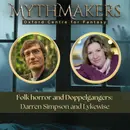
Folk Horror and Doppelgangers: Darren Simpson and Lykewise

 Apple Podcasts

 Amazon Music

 Spotify

 JioSaavn

 Castro
Key Takeaways
- Darren Simpson's children's fantasy novel, 'Lykewise', explores the ancient doppelgänger tradition through the lens of a creepy folk horror story set in a pre-industrial Fenland village.
- The story examines psychological concepts like Carl Jung's shadow self and the inner urges that people suppress, raising questions about morality, responsibility, and the nature of the dark side within.
- Mirrors serve as powerful literary devices because they force characters and readers alike to confront their identities, reflections, and the uncanny anxiety of seeing oneself from the outside.
- While horror stories can range from explicit and gory to atmospheric and suggestive, 'Lykewise' leans into a cozy, creepy vibe that relies on suspense and imagination rather than shock value.
- Writing horror and fantasy for younger readers allows authors to use imaginative worlds as a laboratory to explore difficult emotions while ultimately showing that characters can face and overcome their inner monsters.
Horror is having a moment. Looking at recent cinema releases, you’ll see the genre is booming as a big box office draw. But where on the scale does a horror story become fantasy?
Returning this week to Mythmakers, Darren Simpson discusses this with Julia Golding. They turn to the tradition of the doppelgänger story - the portrait in the attic, the ‘other’ or shadow self – and take a look at what it tells us about psychology. In Darren’s new children’s book, Lykewise, the doppelgänger is the Lykewise, released from a mirror. How do you write about this darker self and its hidden urges for this age group, and what does it tell us about our modern era?
Julia and Darren end off their discussion by celebrating magic mirrors and deciding which one they would most like to encounter.
Order your own copy of Lykewise, and explore Darren’s other works, at https://darrensimpsonwrites.co.uk/
00:00 Introduction: Welcome to Mythmakers and Folk Horror with Darren Simpson
00:45 Is Horror Fantasy? Exploring the Genre Boundaries
06:01 The Doppelganger Tradition: Jekyll and Hyde to Dorian Gray
08:06 The Thing and Mirrors: Inspiration Behind Likewise
10:00 Mirrors and Identity: Who Are We When We Look at Ourselves?
11:35 Introducing Likewise: The Mirror Ritual and the Village of Haramir
17:24 Shame and Responsibility: When the Likewise Causes Harm
18:25 The Shadow Self: Psychology and Dark Desires
24:15 Modern Mirrors: Social Media, AI, and Digital Doppelgangers
30:04 The Fenlands: Creating an Atmospheric Liminal Landscape
35:04 Independence and Rebellion: The History of Fenland Communities
37:11 Bloody Mary and Modern Folklore: Mirrors in Youth Culture
38:32 What's Next: Strange Blooms and Future Folk Horror
40:56 Magic Mirrors in Fantasy: From Snow White to Alice
For more information on the Oxford Centre for Fantasy, our writing courses, and to check out our awesome social media content visit:
Website: https://centre4fantasy.com/website
Instagram: https://centre4fantasy.com/Instagram
Facebook: https://centre4fantasy.com/Facebook
TikTok: https://centre4fantasy.com/tiktok
Frequently Asked Questions
What is the book Lykewise by Darren Simpson about?
Lykewise is a children's fantasy horror novel set in a muddy Fenland village where a mysterious salesman introduces mirrors, leading teenagers to perform a ritual that unleashes their darker, hidden selves into the community.
Is horror considered a subgenre of fantasy?
While horror and fantasy occupy different sections in bookstores, supernatural and fantastical horror often overlap with fantasy by drawing upon ancient folklore, myth, and imaginative world-building.
What is the doppelgänger theme in literature?
The doppelgänger tradition involves a double or shadow self—seen in classics like Jekyll and Hyde and The Picture of Dorian Gray—that often reflects a character's darker urges, secrets, or psychological struggles.
What psychological concepts inspired Darren Simpson's Lykewise?
The novel was inspired by psychological theories such as Carl Jung's concept of the shadow self and the idea that individuals harbor hidden thoughts and desires that they typically keep in check.
0:05 Hello and welcome to Myth Makers. Myth Makers is the podcast for fantasy fans and fantasy creatives brought to you by the Oxford Centre for Fantasy. My name is Julia Golding and today I am delighted to be joined on a second visit by Darren Simpson who publishes with Pushkin Books which is an excellent small independent publisher based in the UK but they pick out some really unusual And we are celebrating today the publication of his children's fantasy horror, I would say, somewhere in that kind of genre, called Likewise.
0:45 But, hello Darren, before we actually get to the sort of likewise world, I thought we could actually start by thinking about, is horror fantasy? Yeah. We were trying to work this out. Where does it fit within the sort of genre bracket? Because if you go in a bookshop, they're usually in different shelves. Yes, yes. You're right. Hi, Julia. Yeah, I've noticed actually sometimes in some smaller bookshops you sometimes get a blend of – sometimes they sort of roll up fantasies together with horror or they'll be quite close together. But I guess it's like a sliding scale, isn't there? A lot of horror can be very kind of based in reality. That's the sort of stuff my wife watches.
1:26 Oh, it's too scary for me. Exactly. And that's the thing that I find interesting. My wife can't watch the more supernatural – I guess at the other end of the scale, you get the more supernatural, fantastical horror, which is fantasy in a sense. And often that will draw upon a lot of old folklore, which also has connections to fantasy and things. So I quite enjoy the really horrible stuff on the supernatural, kind of more grotesque and strange side of things. on the more realistic scale of horror, when it's about real people doing really horrible things that really happen, I find that much more difficult to handle than the kind of slight escapism, the thrill and the escapism of more fantastical, I guess, horror. But yeah, it's a kind of interesting area, isn't it? Yeah, I think one of the things that fantasy does is it gives us like a laboratory world where we can run experiments.
2:11 And you always have the sort of ability to say it isn't real. It isn't real. And sometimes if you're watching something which feels as though it could be happening outside and you hear the creepy sound, or the knock at the door, it is real for some people. Yes, absolutely. And that's almost unbearable. So I think that some of us are like self-soothers, self-protectors, and we don't go – and some people are more like the rollercoaster riders who like to imagine that thrill. It's just not me. Yeah, yeah. Also, do you like either end of the spectrum? Are you not into horror generally at all? I don't. I'm okay reading books like your own and horror in the sense of, say, like Victorian horror stories, where there's enough distance for me to see the artifice or the period aspect of it.
3:05 So there's some fantastic, like, Gothic horror tales, obviously, in the Victorian period. I'm not a consumer of horror films. So I have noticed that one of the huge creative burgeonings in the cinema these days are these more fantastical horror stories where young directors are coming through and coming up with some really good ideas. And it's definitely a huge part of the market. So have at, if that's your thing, knock yourself out. Yeah, yeah. I just get scared easily. Well, there's another sort of spectrum within it. So you mentioned the Victorian, I guess, more kind of ghostly stories, that kind of thing. And I think another spectrum within horror is you'll get the very graphic, gory stuff, for example.
3:51 And then you get the stuff that relies less on the explicit graphic things and more on a sort of feeling of being unsettled. And you can get more to your imagination. I always find, I mean, I like kind of all sorts of horror movies and horror books, but I find it's the stuff that... you have to sort of imagine for yourself what might be in the shadows. I find that's far more effective and kind of has a more insidious effect, I think, as a reader and as a viewer of films. So I quite like that sort of horror. I like the explicit stuff too, but I think there's a different art as well to the films and the books that creep you out without putting everything in your face in such an explicit way. Well, of course, the tradition of telling the ghost story around the fire is probably as old as campfires.
4:34 So there is an element in us that seeks that thrill. Yeah. Not all people at all times, but it's clearly a sort of strong societal urge of which the sort of cinematic or TV version is an expression. I think, for me, one of the things I don't enjoy in the graphic world In the same way as I don't like seeing graphic depictions in the news or, heaven forbid, tripping up over something online which you didn't mean to see because you can't unsee it. Yeah, yeah. You can't unhear it, depending what it is.
5:14 So, yeah, I'm on the avoider side. Yeah, fair enough. I should hasten to add to listeners and watchers, there is nothing like that at all. In Darren's book, it's not something that you need to sort of worry about. It is... It's pleasantly creepy without being shocking. So, you know, if you're thinking, should I buy this for my kid? Don't worry. We're not in the schlock world of horror. Yeah, yeah. Some people describe it as more of a cozy horror almost. I mean, it's got its moments, I think, all the sort of village setting and the atmosphere. But I think, yeah, I kind of, again, I'd rather go for suggestion and an atmosphere of creepiness rather than those outright moments, I think.
6:01 So let's actually move closer to where your book sits in the sort of genre, because it's in the tradition of the doppelganger, which does put us into the fantasy aspect of a sort of horror world. I expect lots of people, one of the first ones they will think of, if you are asked to name a doppelganger story, they'll say, well, obviously, Jacqueline Hyde. Yes. The Robert Louis Stevenson. And I think there's a lot of that... somewhere behind this story. And I was also thinking the picture of Dorian Gray, Lost in the Wild, which where Dorian, this beautiful...
6:43 man, all the horror of his behavior is being loaded upon a portrait in the attic. That's where that phrase comes from. You must have a portrait in the attic kind of thing. And then there's a sort of an older book from the beginning of the 19th century by James Hogg called The Confessions of a Justified Sinner, which if people haven't read, it's a really interesting early version of this. And actually Frankenstein itself, another early 90th century novel, the creature is a kind of, he and Victor Frankenstein are in a sort of, you know, they're in an unholy alliance in a way, the creation of the other.
7:25 But anyway, so we've got this kind of doppelganger thing. theme. Were you aware as you were writing it, Darren, of any particular one that was part of that or did it come from a different direction for you? Well, it's interesting because there's something, all the examples you mentioned there, they've all got something quite striking in common, which is that they all tend to explore the dark side of somebody being reflected or showing the portrait as in Dorian Gray. So, I mean, for me, that theme came a bit later on. At first, I was... I really enjoyed writing first and I wanted to explore sort of fantastical folk horror again. And so I just sort of started off by thinking, what are my favourite horror movies, my favourite horror stories? And...
8:06 It's actually less a fantastical thing, but there's an 80s movie called The Thing by John Carpenter. So it's very much in the territory of science fiction, I guess. And it's about, if anyone hasn't seen it, it's this very isolated research space in the Antarctic. And this alien life force gets involved and it's a threat, but... it can mimic people. So rather than looking explicit, I mean, it's quite a grisly film, but the best thing about it is the suspense because you don't often know who the creature has taken the form of. So there's so much dread and suspense and paranoia that starts to affect all the characters in the story too. And I loved the film for that.
8:46 And I thought, how can I sort of take that and put it in a more fantastical, folkloric, you know, kind of old-time setting? So I started researching and there's a whole massive history of this fear of doppelgangers. Obviously there's something quite uncanny about seeing yourself. I think when mirrors were first invented they used to disturb people and sort of get them thinking about what's really being reflected, what it means. You sort of face your identity, don't you? And all those examples you mentioned, Jekyll and Hyde, I realised that looking at the history of reflections of the doppelgangers, there often is the consistent pattern is that what's being reflected is something a darker take upon yourself. And that very much became a massive theme in the story about what it means to have this dark side, to have these thoughts, whether it's normal, whether it's forgivable to have dark thoughts.
9:33 the difference between having them and acting upon them. So basically just the whole, that theme of doppelgangers and the darker side of yourself, it raises so many interesting questions in terms of exploring yourself and readers exploring themselves. And so it kind of just rolled from there. It's a great theme, I think. And I guess it's not a theme I've come across too often in kind of admitting to that dark side and what might happen with it. But it's obviously been around, like I've made all these examples, it's an idea that's been around for a long time. I guess it goes into psychology and all sorts. Yeah, so let's think about the psychology because one of the moment that we all share is when we look at the bathroom mirror and you think, who is that person in the mirror?
10:13 It's, isn't that a line from a musical? Yeah, oh yeah. Well, there's a song in there, Man of the Mirror. It's a big theme, isn't it? West Side Story or something. Anyway, sorry, that's not the right connection. But we've all had that moment where we look in a mirror and you think, is this how the world sees me? You're aware that it's reversed, of course, and you're also told no, because it's not quite what people see when they look at you. And then that is quite easy then to go from that to start thinking, well, what is it saying? And what if when I moved up my hand, it didn't or, you know, that stuff you're picking up on.
10:54 So I think it's a really relatable experience for children that because everyone looks in a mirror. And yeah. The psychology of that is, I suppose, a bit like laying on the psychologist's couch and trying to think, what am I like? What are the urges? What is the public me versus the private me? Yeah. So when you were looking at the likewise idea, likewise being the likewise is the reflected person. Actually, before we go on actually to talk about psychology, you probably should talk a little bit about the setup of the book. It will make more sense if you look at enough of the book so people know what we're talking about.
11:34 Yeah, sure. So it's set in a kind of boggy Fenland village called Haramir. And it's set in a sort of vague pre-industrial time, a very small village, a very close community. And it's quite dull. They spend most of their time fishing for eels and harvesting peat and that kind of thing. And then one day things get a bit spicy because a salesman rolls up with his horse and cart and he's selling something that locals have never seen before ever, mirrors, you know. And they are dazzled by these wonderful things and the guy's practically giving them away. So next thing we know, Harame is full of mirrors. Everyone's got these lovely mirrors in their cottages and houses. And that night at the tavern, three of the main characters, they're called teenagers, called Dun, Hetty and Beer.
12:15 They are sat with the salesman at the tavern. And he mentioned to them a bit of a couple of kinds of magic that can happen with mirrors. He says, you know, there's rumors about something they can do. So, for example, if you stand between two of them, you'll see... eternity, which actually also isn't magic. We know that that's science. If you stand between two mirrors, you've probably seen it yourself. You reflect over and over again. Always a bit weird to see, but that's what happens. But then he also says that if you stand between two mirrors like that and say certain lines, if I find those lines quickly... It's always good to have a little chant or a spell. Exactly, yeah, the ritual element. It's had so many traditions as well. So if you stand between two mirrors and look at yourself and say, like for like, the weird is wise.
12:59 Dare you look yourself in the eyes. Try all you might with airs and lies. The likewise is cunning. Your truth is spies. Yeah. He says, if you say that, you'll see your true self. And then he sort of says, actually, forget that, it's probably just nonsense, which kind of makes the kids kind of put them off. But then he goes, actually, no, no, just don't meddle with these things. You never know what might happen. Maybe it's not a good thing to see your true self. So suddenly it's kind of it's a slightly dangerous thing to do. So obviously the teens are interested in trying it out again. It's a figuring fruit, isn't it, at that point? Exactly. How can you resist? You're far more interested in doing it when you say you shouldn't do it, right? Especially as a teenager, I think. So that night, these three teens, these friends, they set up two mirrors in the shed behind Hetty's house.
13:40 And when they start seeing those lines, after they've had their minds blown by the sort of infinite reflections... So the wind stops and it gets suddenly darker, suddenly feels off and Bea and Dunn get a bit freaked out. Maybe she'd leave us to go back to the tavern and join the rest of the party. I'm not sure about this. And Hetty is much more pigheaded than that. She sinks their cow. So she says, well, she'll see it for herself. And long story short, she tries that ritual. And after she says those lines to the mirror, she thinks nothing's happened. And then she thinks, well, what does it mean anyway to see true self? I can tell this mirror does that anyway. But then she notices her most distant reflection, kind of long into the distance in that kind of corridor of Hetty after Hetty after Hetty, starts coming towards her and sort of absorbing all the other reflections on its way.
14:22 And when it finally stands in front of her in the mirror, it's doing its own thing. So she's quite unsettled by this, obviously. And it asks her what her name is. And she says, oh, it's Hetty. And then it says, and what is it you desire? So Hetty has a little think. She says, well, to leave Haramir when I'm older, it's quite boring around. I'd like to see the world. And a reflection shakes its head and says, no, I know what you really want. And that's kind of the point of the book, in a way. That's the point of the likewise. Yeah. And next thing Hessey knows It steps out the reflection And it's got a bit of A fairy tale It's got a fairy tale Style pin A glass pin And it pricks her in the neck And it's obviously It has her form obviously She falls unconscious It tucks her into a sack And hides her away On a meat hook Not her, the sack And And then it enters her world.
15:04 And that's where the imposter format kicks in. It's a doppelganger that essentially the likewise is a creature that encapsulates all those dark kind of grudges and resentments and dark thoughts that we often bat away or ignore or for the sake of doing the right thing, the moral thing, the thing for society. The likewise has none of those inhibitions. And so her reflection is within the community and it does this terrible thing that Hetty would do a dark part of it might like to do, but doesn't have the courage or the kind of evil nature to do it. And the thing is, likewise, once it's done that, it makes its way through. People collect these dark desires. It collects people. So someone else gets forced to go through the ritual and the reader and the characters don't know who's been taken.
15:45 So one of the points of the book is the reader as well as the characters figure out who the likewise is at the moment. That's a bit like The Thing I mentioned, that horror film from the 80s. It's that idea of the puzzle of, well, this is scary because who actually is? It could be anyone here. Who is and when's it going to act? What's it going to do? So yeah, long story short, the likewise is an embodiment, a personification of all those kind of dark desires and wishes. And some of them often we don't even realize we have. Again, that deeper psychology side of things, there are sides of us that we probably only know a small proportion of who we really are. Maybe that's why sometimes when we look in the mirrors, we're a bit unsettled or, Even beyond this, today people see themselves on a camera, on a photo, on a picture on their phone.
16:26 And that's not me. You know, it's like hearing your own voice recorded. You don't like it. That's not me. So I think, yeah, just tap and explore those kind of themes and ideas. Yes, and I think it's interesting for when there's an element of recovery, when somebody comes back and their likewise has caused harm, it's whether or not they feel shame or responsibility for the act of the likewise. Because, as you say, we all have the moments where we say, oh, I could kill them for brothers and sisters falling out or all that stuff. It doesn't mean you'll do it. No. Because we have, most of us, very rare occasions when it fails, but most of us have an inner policeman saying all those things, but no, or a moral code or whatever it is, depending what the reaction is.
17:24 And I was fascinated by... I don't want to give too much away, but there are some characters who feel the shame of their inner urges being revealed. And some people are harmed in ways that it's hard to come back from. So the person who comes back to the community, can they rejoin the community if their darker urges have been revealed? I thought that was a very interesting question, which was answered in different ways for different characters. Yeah, yeah. Well, it's just like, I mean, it's sort of, I don't really entirely know the answer to myself. It's quite personal, I guess, in terms of the person and the person who's judging that person. But yeah, it's interesting. I mean, how much do you blame someone?
18:05 It also raises the question of when someone does kind of lose that, there's like a sort of societal safety net that stops us. You know, It raises, you know, would you, these dark thoughts you have, would you do it if you could get away with it? Would you actually do it, you know? Do we stop ourselves doing bad things just because it's what's expected of us? You know, what is, is this a nature nurture thing? Are we born bad? Are we born good? It just, again, I don't know the answer to these things, but the story seemed like a great way to explore these ideas. And again, it's, I also researched some psychology to feed into it. And because, you know, these ideas have been reflected in, well, reflected, no pun intended, in fairy tales and fantasy and folklore for a long time. And I think it tapped into, you know, Freud talking about the id and the ego and the super ego.
18:50 I read about Carl Jung and the shadow self, you know, it's kind of the side of yourself that... I think another thing the book explores, the side of yourself that you don't quite... You're not aware is there, but it has a massive profound impact on who you are and what you do. And I think also... You know, I think the book isn't another theme of the book is the fact that this shadow self, for example, this side of yourself you don't know. Maybe it's not all bad. You know, I think that sometimes creativity or life decisions can come from this side of ourselves. We don't really comprehend. So, again, it's just I just it's the same with all my books. I tend to be better questions than answers, really. Yes, and I think that when we're thinking about you writing for children, there is an element of extra responsibility when we're writing for children.
19:32 And one thing the book does say is that you can overcome this. It's a quote about, you know, you read fantasy not for the monsters, but to be told that you can overcome the monsters. That's the message of it. You know, good guys kind of win. It's not like everybody's fine, but there is a sense of... you don't give in to the shadow cells. The world doesn't become the shadow version if you stand up against it. But it does take a society, or in that case, a little village, to stand up to it and sort of take it seriously and believe what they're being told. So there's a sort of group effort to combat it.
20:14 So when you were thinking about this for children or perhaps when you're talking to young readers who might be worried about the completely natural bad thoughts we all have, how would you craft an answer about that? Have you thought about that? I think it's one of the things that's healthy to face and accept a little bit. I think, you know, because some people might have bad thoughts and feel really guilty about it, you know, and it can have quite a negative impact perhaps.
20:59 I think to acknowledge these things rather than to ignore them or deny them and to also appreciate the quality of, you know, I mean, never having them is – I think having them and conquering them is more important than never having them in the first place, perhaps. I think it maybe says a lot about being a person, being part of community – Because that's where goodness – I'd like to say goodness is kind of rooted in who we are, but a big part of it is kind of what's expected of us and it's about the people we love, you know. So, yeah, when children ask about this, I do – basically, it might be my point of view, but I think we all have these dark thoughts. We have these moments. Yeah. And this darkness might come from vulnerability as well and bad experiences, you know.
21:42 But the key thing is, I'd say it's normal to have them, but it's healthy to recognize them and obviously good to avoid them. Explore where they come from, why they're there, maybe address that rather than acting out in a negative way, you know. So it's just all about sort of exploring your own personality and the healthiness of acceptance, perhaps. Yeah, and I think also that you're not alone. Our characters are not who we are on our own, facing a mirror. Our character is who we are when we're amongst other people. And very often it's other people who help us. behave or say, I don't want to make you unhappy or I love you.
22:23 Or there's the connections around us is what forms the moral code or the ethical code, whatever it is, however you would like to talk about that. So it's not that moment in the mirror when we're at our weakest. It's how we are out with others, I would have thought. So you mentioned here about sort of fairy tales, and myths dipping into this sense of what the 20th century psychologists were calling things like the shadow self and all the rest of it. When you're looking at myths, there was only particular ones that you were attracted to because when you go back to classical myths, there's all sorts of like narcissus looking in at his own reflection.
23:07 Yeah. Well, interestingly, yeah. So, I mean, there's this, obviously, we've spoken quite a bit about this, um, seeing a part of yourself that maybe you wouldn't want to see. But I think, yeah, vanity is a big part of mirrors, isn't it? And the dangers of that, which, I mean, that's obviously been an issue forever. And, you know, the damage it can do to be expected to look a certain way. And so, yeah, I think, yeah, narcissists, yeah, this kind of idea has been around for a long time. And going to sort of fairy tales beyond that, there's obviously Snow White with the Queen Asking who's the fairest of them all and kind of, driven to doing bad things for the sake of being, you know, the first of them all. So I think, yeah, Maru's speak a lot in terms of, yeah, to the dangers of vanity and the effects they have on us, which has parallels.
23:53 And that's quite contemporary too, when you think about filters on Instagram and social media and stuff, you know, that vanity and that pressure is kind of more online now than it is on mirrors. And that's another thing I enjoy about writing this book. I think even though it's obviously very sort of fantastical and folklore-ish, it's also, I think those themes still really resonate. And those ideas about mirrors and doppelgangers, they're still relevant today. I think very much so. I mean, many of us use our phones as a mirror. Absolutely. Black mirror, yeah. I'm on a train checking, you know, I don't look right when I get off the train. I use my phone as a mirror these days. Yeah, yeah. So you're quite right. But maybe it's also the aspect of people crafting selves for the Instagram self type thing.
24:40 And then the shadow or the maybe our real selves have become in some of us a shadow self. If you're living so much out there, what's left behind? I often worry about people who put so much of themselves... out there because that's the pressure. I mean, I don't know if you've been given the pressure as an author to keep on, you know, keep the social media stuff. But I'm very keen to have, I'm only really out here in my author professional... Yes, yes. I don't talk about family news or political views or anything like that, if I can help it. It's all me writing and culture.
25:24 That's my cutout of me that I want out there because I want to keep that stuff out of the mirror. Yes, absolutely. Yeah, I mean, I'm similar. I mean, I never sort of share pictures of my children. I might have the occasional thing with my wife, but mostly it's just book-related things kind of within the industry and my own writing. But, you know, when you think about people presenting on YouTube and Instagram, I thought your point was interesting about the real self becomes the shadow self because you are sort of creating the reflection you almost want to see, aren't you? Also, in terms of the personality as well, there's a kind of weird Dorian Gray parallel where there's something being presented that's the beautiful picture.
26:07 Maybe there's something behind it that's not so perfect. And so, yeah, again, it's just, yeah, reflections and doppelgangers. They just, they just, they raise so many questions about ourselves and having to face ourselves and what we want to see in the mirror. Yeah, it's, yeah, it's, you know, you see a lot of damage done today on so many young people. And well, people of all ages because of that pressure to be a certain way online. And yeah, it taps into fears that are pretty ancient by the sounds of it. I did actually write a book a while ago now called Mel Foster and the Queen's Butler, where it's a kind of comic, Victoriana story, with fictional characters are sort of real in this world. And the sort of plot device being used was they'd managed to capture whatever the potion was that created the Dorian Gray picture.
26:59 And they were using it to animate portraits of people. for the forces of evil were sort of, you know, so you go to a big cavalry picture and you get all the cavalry out on your side, but you could go to the picture of the queen or whoever, and the shadow queen would now be on your side, which was playing with this idea. I'd totally forgotten about that because I was fascinated by this idea how the... the shadow self can step into the role of being the real self and sort of take care of that. So I think it's really good fun. That's a comic story. Okay, okay, yeah, yeah.
27:41 Sort of, yeah, comedy version of this. Okay, so we're thinking about the longevity of the sort of the mirror plot, the double in Mists and Legends. But we were talking just before we came online that, of course, these days we have the next stage of this, which is looking forward. We've got already the idea of clones, the kind of Blade Runner stuff. idea of when is something a replicant, when is something real? And of course, AI, us being cloned in some way by AI and likenesses being used and...
28:24 not being able to tell if a generated video is the real person or not. I know that in the last elections in America, there were a lot of short ads people were running where they generated images of their political opponents doing things they don't do. And nobody is saying... hey, stop doing this. They're all just going, ha, ha, ha, isn't that funny? And I think that's really worrying. I think we need to be able to, if someone did that to me, please don't do this folks out there listening to this, I'd be really cross because I'm me, not this favorite version of me. So I think there's a whole area we're about to, we're in, not about to go in, we are in it.
29:05 It's one of those things where the tech is so far ahead of the law and the consent issue, isn't it? I mean, yeah, people would need to give consent to have their likeness used in those sort of ways, but people either have fun or for malicious reasons and also horrible reasons are creating those doppelgangers and manipulating them. So, yeah, you're right. That raises a lot of interesting questions too. It's fascinating one to raise in a school situation because this is the tech they're going to be growing up with. Yeah, yeah. Yeah, it's true. I think also, I mean, look at the trend in horror films at the minute. There's a lot of ones about fake people like Dole. You know, like, yeah, Android. What was it?
29:45 There's Megan that came out a while back and the sequel to that. And that probably taps into that uncanny element as well. But, yeah, it's a really, really rich area, isn't it? I think there's so much symbolism there and there's so many real issues and real threats. Yeah, so much to play with, really. Right, so I'm going to move you on from – it's a massive area. It is. I hope you've found out writing about this because I think about six plots have come up during our conversation. Anyway, the other thing that's notable about your book is the use of a very powerful landscape. It's got that – again, it's something from a kind of horror film. In fact, there's a film just out at the moment which isn't a horror film.
30:26 It's more of a fairy tale called Wicca. I've heard of that. Yes, it looks good. But it sounds like in a similar archetypal sort of, you know, oldie-woldie village in a powerful landscape. I mean, it's a really good setting because you get a keen sense of the weather and the climate and the weather. and the harshness of life, but you're not specifically tied to anywhere. So tell me a bit about your marshland. I was thinking of the sort of, the fens up beyond Cambridge. Yes. Which is in, if listeners are thinking of a map, you know, uh where england has a sort of bump like i don't know on the east there's an area of low land called the wash and the area just south of that and around that is very marshy so tell us about your inspiration for the landscape I did do a lot of research on the fens and drawing from that, especially how people used to live there, in small communities on that very tricky landscape.
31:34 I mean, it all started off with, I'd written first and very much in the traditional folk horror that's largely set in a forest in a very picturesque small village. And I thought, I don't want to do the forest again. So I was just looking at interesting landscapes around Britain and beyond. I think when I started coming across wetlands and fens, they caught my eyes just being very distinctive. I think all the fog lends itself well to atmosphere. It just seemed like quite a neat place to evoke because it's so distinctive. All the smells of peat and it's just been so soggy and damp. But beautiful too. Obviously, there's all the water everywhere, all the pools and that stuff. It ties into the theme of reflections.
32:16 It might seem soggy and grim, but also it's, you know, think about the sunsets reflecting. I looked at lots of photos of the fens and the waters reflecting the sunsets and how beautiful it was. And you get very distinctive wildlife there of all the herons and all the, you know, all the different types of fish and eels. So it just lent itself really easily to the atmosphere I needed for the story. And I did a lot of research into communities that used to live in the Fens in pre-industrial tribes and they were particularly close-knit because it was such a difficult place to live. A lot of people, outsiders beyond those villages on the Fens, just didn't understand why anyone would want to live there. It was so difficult and grim and wet. And it kind of meant there was a sort of slightly outsider element that made the community very close-knit, which lends itself well to a story in which a very close-to-community, like in Likewise, is starting to fall apart a little bit because they are the paranoia that starts spreading and the mistrust and all the grudges everyone's thinking about.
33:11 So, yeah, I think research on the fence, it was fascinating. I mean, a lot of it's been drained now. It's changed quite a lot, but it used to be obviously much more watery. And I learned about, for example, how windmills and pumps were imported from the Dutch because they were the masters of kind of transforming wet landscapes. And there was an equivalent of the Luddites. I think they're called the Tigers or something, the Fenland Tigers. And they'd go smashing up the pumps, you know, to try and... sustain their way of life to keep it going to resist this resist progress you know in speech marks so yeah it's just a fascinating so basically the landscape the nature there the the animals and the plant life lends itself really well to something very atmospheric and visual and vivid but also the history and the community works really well for the sort of story with which yeah a community is being tested i guess they didn't want anyone to drain the swamp No, they didn't, no, because they went around on stilts and they fished for eels and it was a hard way of life.
34:05 It was their way of life and it was kind of what they were used to. And again, I remember when I early drafted the book, it was a bit, some of it felt a bit grim because it is so wet and soggy and damp and foggy. So I kind of really put a lot of effort into... bringing out the beauty of the place, really sort of showing what locals actually like about the place, you know, how good the eel pies are and, you know, how there's so much affection for the plant life and the herons and the symbolism of the herons and the, you know. So, yeah, it is grim, it's boggy and it's foggy, but it's also, there's a lot of beauty there, which, you know, I've just thought this now, but kind of a reflection of people as well, the theme of people and their good and their bad sides, you know, how everyone's complex and the landscape's complex.
34:45 And, you know, there's a reflection back and forth there, you know. And it's a liminal place. Absolutely. I mean, this is why it's a redolent story. And the other thing that I think of with the Fens is it has a tradition of independence and sort of rebellion. So Harry with the Wake was one of the famous kind of folk resistance heroes who tried to stand up against the kings of the day. And going back before that, you've got Alfred the Great when he was at his lowest moment. He went and hid in the Fenlands around Somerset, which is another sort of area of low-lying ground.
35:26 And that's where the famous burning of the cakes story happened, is when he was staying with somebody there and the good wife boxed him around the ears for not keeping an eye on her cakes because that's a lot of resources that she's got and he's just wasted. So some people think that's a... symbolic story but I like to think there is this crotchety old lady who said oi you may be losing the kingdom but you shouldn't lose my fakes well yeah so it was a place where people retreated to it was very hard to invade you can't drive a railway through it and that kind of thing so that's true it has that element of which adds to the character you're building of this independent community that they rely on themselves suspicious of outsiders and they also can protect themselves draw you know they're the ones who know their landscape.
36:18 Yeah. Yeah. So no, I thought that was very powerful. It's a character in the story. Yeah, I always aim for that with most of my books. And it's funny, you mentioned the Lindenmore Space element, because obviously, yeah, it's not quite land, it's not quite water. It's kind of this mix of, it's a place that's hard to pin down. And again, in terms of the magic system used in Thirst and Likewise, they're not, Likewise isn't a sequel to Thirst at all, but it's set very much in the same sort of fictional county, and it draws upon that same... idea of, in terms of the magic system, it's all about that liminality, those thin spaces. And I think mirrors themselves are the sort of thing we've been talking about so far, about reflecting something that's not quite there and drawing a line between yourself and what's being reflected, all these questions.
37:04 They create a little more space within themselves, I think, which is why the mirror lent itself well to the character of the likewise and for the idea of the story itself. And I think, I haven't mentioned, of course, yet a more modern bit of folklore, but obviously Bloody Mary comes into it very readily. And I've noticed when I do school visits around, likewise, everyone still does Bloody Mary. I don't know if you noticed it when you were younger, but in my teens I did it. And all the kids are still getting their candles and trying Bloody Mary in front of mirrors. Is that why you summon them by saying the name a number of times? Is that the thing? Yeah, so you stand in front of them. It wasn't part of mine, but I don't know. I remember a lot of my friends trying it. And it's one of those things where you're a teenager and you're like, yeah, if you light a candle and say Bloody Mary's name three times, she'll appear in the mirror and drag you into hell or whatever, you know.
37:45 Okay. And it's one of those things that no one believes it. But when you actually start trying it with your mates, suddenly you are a bit more scared than you like to admit. blow out the candle yeah that's it it feels very 80s to me it feels very like from my childhood and my teens but a lot of the kids they still know Bloody Mary and I think a lot of that kind of folklore actually travels a lot online now anyway and these ideas so they come across it through memes and various trends and things but it's nice that these kind of this suspicion of reflections this kind of slight mistrust it's still there I think yeah Wow. So this is out now, is it, likewise? It is out. Yeah, it's out and about now. Yeah, that's right. So where are you going next? Are you staying in the same area for your next story or are you heading on past as new?
38:32 Well, I've got something sort of pretty much in the bag coming out next week. Autumn anyway so it's not the same sort of historical folk horror but it is more contemporary take so it's actually a collaboration with, there's an illustrator called Keith Robinson and we've got a book coming out together called Strange Blooms Next Autumn and it's a hybrid novel, it's a it's a quite intricate mix of prose. So it's not quite graphic novels, more of a kind of playful mix of prose and illustration. And sometimes there'll be, the prose will take over, sometimes it'll be the text illustrations. Sometimes they will blend and do, interact in unusual ways. So we've been working on that for quite a while, well, years now, thinking about it. And that's coming out next week.
39:13 September. And that is a folk horror story, but it's more contemporary. So if you imagine Skegness meets Witches, you know, it's kind of this kind of vibe. So it's got that going on. But having said that, I am interested in revisiting this fictional county of Likewise and Thirst. I wasn't sure because I was quite spent after writing Likewise, but I've had such a good time doing it. I've seen such a positive reaction from young readers. There's a real hunger for kind of what these stories offer, it seems. And as you mentioned at the minute, there's quite a blatant trend in the cinemas and so on. Yeah, sorry, gosh. So it seems to have kind of touched a nerve. And I think, again, that fantastical folkloric aspect, seems popular with young people as well, perhaps as a reaction against things being so digital, being so deepfake.
39:56 You know, young people seem to be more interested. Not all of them, obviously, but in folklore and nature and strangeness and the analogue, I think maybe these things are all tied together in some sort of way. So, yeah, long story short, as the question, I would like to revisit this. I'm not quite sure where I'd go next, but I've got a few things brewing that might work out, I think. Yes, or something will bubble up. Hopefully. So we try and finish with a little sort of thought about where in all the fantasy worlds we would like to go for something. And I wanted to pose the question to you, where in all the fantasy worlds, not your own, but other people's, would you like to go and experience, interact with a magic mirror?
40:42 You can tell me where you don't want to go. Actually, when you start to think about it, There are quite a few of them. We've already mentioned Snow White and the Mirror Mirror on the Wall. No, that's one. And another one I thought of was at the beginning of The Snow Queen, there's a broken, a shattered glass that lodges in Kay's heart and turns him cold and wicked. And that definitely has a sort of the other side. That's the doppelganger aspect here. There's something going on there, isn't there? Yeah. And in more fun aspect is the most famous of them all, which isn't horror.
41:25 That's Alice Through the Looking Glass. Of course, yeah. Which is, have I missed, I'm bound to have missed some, um... There'll be lots. I can't think of it. I'm trying to go top of my head. Yeah, I mean, I think that's interesting because it does... It's like a sort of whimsical use of mirrors to sort of reflect... I don't know, it's like to reflect the absurdity of the real in a way, isn't it? I think that's what goes on in that from what I remember, which is interesting too. So yeah, holding from mirrors to the world and someone's seeing how absurd things are in that sort of way. I think in terms of a mirror I would like, I guess another fairy tale, doesn't Sleeping Beauty have a mirror that sort of shows, I'm sure the Queen of Sleeping Beauty is able to use a mirror to see things that she wants to be shown.
42:12 So that sounds quite a hand, doesn't it? It's almost like mirrors were the kind of smartphones or tablets of their time. You could use them for information and to find out what's going on and stuff. And, you know, it's like Googling who's the fairest of them all. So, yeah, I think we'd be quite happy to have a Sleeping Beauty. You should try that this afternoon, put it into Google. Yeah, yeah, yeah. There is another one, which is a cursed one. It's the Lady of Shalott's. I don't know that. Yeah, so she is able to look at the world out through a mirror. It's obviously in the Tennyson poem. So she can see what's going on outside and she sees a knight riding by.
42:54 The willows white and the aspens quiver, the little breezes dusk and shiver. And she's attracted to the Lancelot riding by. She left the web, she left the loom, she made three paces through the room. She saw the water... water lily bloom and then it has the famous line, the mirror cracked from side to side. The curse has come upon me, cried the lady of shallots. And that's why she dies. Right. Because she's looked out on the real world where she was embroidering the reflection. So there you go. There's a bit of Tennyson for you. But that line, the mirror cracked from side to side, then was used by, I think, Agatha Christie as a book title.
43:37 So that's a rather powerful mirror. So the one I would choose to go for is, of course, the Lewis Carroll one because that's not cursed. You get talking plants and chess pieces and Tweedledum and Tweedledee. It's pretty benign what goes on through the mirror there. The idea of mirrors as doorways, isn't it? I guess as portals. I'm sure there's some mirror action somewhere in the Narnia series. There's got to be. I've got a thing in every summer, but I can't. It's on the tip of my tongue, but I'm sure I'll come across that somewhere. The way you get into Narnia is rings, wardrobe, horn, picture, being blown off a cliff.
44:20 Right. By Aslan. And what's the last one? A train accident. Right, okay. There may be a mirror in there somewhere. There's definitely an echo of the Snow Queen in the way Eustace is sort of shown a distorted vision of his family life. But I don't think he needs a mirror. The method there is Turkish delight. Sure, yes, yes. But it's definitely got that aspect in it. That's another area of mirrors, isn't it? That sort of distortion as well, I guess. Sort of the fairground mirrors, the distortion of people.
45:01 Which, again, is something that in the book, and likewise, there's the idea that, you know, perhaps what this dark side that's reflected is more of a distortion than something that's actually accurate, you know. but yeah they're just everywhere also you mentioned the mirror cracked side to side which obviously taps into the folkloric idea of seven years of bad luck from a cracked mirror we have so many things that are tied around mirrors and reflections another one has just come to me it's not really a, it's more of a general idea but vampires not having reflections because they have no souls so I think it's just I think the implications either on a subconscious level of fascinating people and what they might mean and what questions they raise you know So are you going to choose your mirror to interact with, just out of interest? Are you going to risk a curse just to see what happens?
45:45 Well, do you know what? Actually, if I could do it as an experiment, I might... No, I'm not. I'll use my own book. I'll be curious about what my dark side will be, because sometimes we don't know, perhaps. But I think I would go for... You've already nabbed the Alice for the Looking Glass one. Let me think. Let me think. Yeah, I'd go for one of the smartphones slash tablet ones from the fairy tales. I think it'd be a real advantage in life. And the other thing, of course, about the Snow White one is if you don't want to be the fairest of all, it's actually just a very useful computer interface. Absolutely, yeah. So I'd be quite happy saying who's the fairest of us all because I don't care. Well, yeah, that's right.
46:25 It's not going to be me, so, you know. And you can expand, you know, say mirror, mirror on the wall, you know, where can I get a decent pie in the area? You know, it's handy for all sorts of practical things. Yeah, so I think we can repurpose that for the good guy. Darren, it was delightful to meet you. And again, and good luck with this book and also the exciting one coming out next year with your collaboration with the illustrator. Always a fascinating process. So yeah, be careful in looking in those mirrors. Thank you, Julia. Cheers. Cheers. Thanks for listening to MythMakers Podcast.
47:07 Brought to you by the Oxford Centre for Fantasy. Visit OxfordCentreForFantasy.org to join in the fun. Find out about our online courses, In Person Stays in Oxford, plus visit our shop for great gifts. Tell a friend and subscribe wherever you find your favourite podcasts worldwide.