
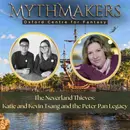
The Neverland Thieves: Katie and Kevin Tsang and the Peter Pan Legacy

 Apple Podcasts

 Amazon Music

 Spotify

 JioSaavn

 Castro
Key Takeaways
- Authors Katie and Kevin Tsang discuss their 18th co-authored book, The Neverland Thieves, which offers a fresh, modern perspective on the classic Peter Pan legacy.
- The book centers on Tom, a seriously ill patient at Great Ormond Street Hospital, bringing a high level of sensitivity and responsibility to portraying his experience as an adventure hero.
- Profits from The Neverland Thieves directly benefit the Great Ormond Street Hospital charity, honoring the historic connection J.M. Barrie left to the hospital.
- Katie and Kevin share their unique co-writing process, which involves extensive brainstorming sessions, structured outlines, and dividing tasks based on their individual strengths.
- London serves as a magical backdrop in the story, incorporating real elements of Great Ormond Street Hospital and reimagining iconic spaces for a new generation of readers.
When Great Ormond Street Hospital, home to the rights to Peter Pan, asks you to add to its beloved stories, you take on an awesome responsibility.
In this episode of Mythmakers, authors Katie and Kevin Tsang join Julia Golding to share their journey into Neverland in support of this worthy cause, with profits benefiting the hospital’s charity. They made the bold decision to centre the story on Tom, a seriously ill patient at Great Ormond Street, bringing with it a particularly high level of responsibility in how they portray his experience.
As you might expect, Tom finds adventure and friendship on a journey that takes him from the magical spaces of the hospital into the world of imagination. Katie and Kevin also spill the tea on what it’s really like to write as a partnership, before taking us into the world of their other stories, including the Dragon Realm series.
Learn more about Katie and Kevin, and order your own copy of The Neverland Thieves, at https://www.simonandschuster.co.uk/authors/Katie-Tsang/169163632
00:00 Introduction: Welcome to Mythmakers and The Neverland Thieves
01:31 Writing as a Couple: The Journey to 18 Books Together
05:15 The Creative Process: Brainstorming, Dividing, and Conquering
10:17 Introducing The Neverland Thieves: Tom, Felix, and Daisy's Adventure
13:50 Tom's Story: Writing a Seriously Ill Child as Adventure Hero
18:01 The Great Ormond Street Hospital Connection: Legacy and Charity
20:56 London as Magical Space: Flying Over the City
24:14 Inside Great Ormond Street Hospital: Research and Inspiration
26:57 Playing in the Peter Pan Legacy: Rules, Updates, and Respect
34:23 The Dragon Realm Series: Action-Packed Adventures
37:48 Choosing Your Neverland Tribe: Pirates, Mermaids, or Lost Children
For more information on the Oxford Centre for Fantasy, our writing courses, and to check out our awesome social media content visit:
Website: https://centre4fantasy.com/website
Instagram: https://centre4fantasy.com/Instagram
Facebook: https://centre4fantasy.com/Facebook
TikTok: https://centre4fantasy.com/tiktok
Frequently Asked Questions
Who wrote The Neverland Thieves?
The Neverland Thieves was co-authored by husband-and-wife writing team Katie and Kevin Tsang.
What is the connection between The Neverland Thieves and Peter Pan?
The Neverland Thieves is a next-generation Peter Pan story that plays in the existing Neverland legacy, with profits benefiting the Great Ormond Street Hospital charity, which holds the rights to Peter Pan.
How do Katie and Kevin Tsang co-write their books?
They start with massive brainstorming sessions and whiteboards, create a flexible outline, and write the first few chapters together side-by-side before dividing up chapters based on their respective strengths.
What other series have Katie and Kevin Tsang written?
In addition to The Neverland Thieves, they are known for the Sam Wu series and the action-packed Dragon Realm fantasy series.
0:05 Hello and welcome to Myth Makers. Myth Makers is the podcast for fantasy fans and fantasy creatives brought to you by the Oxford Centre for Fantasy. My name is Julia Golding and today I'm very excited because I have two guests with me. That's Katie and Kevin, is it Sang? Sang, yeah. whose newest book, The Neverland Thieves, is a riff on a sort of next generation Peter Pan story, I think is one way of calling it. So welcome. Welcome, Katie. So excited to be here. Thank you for having us. Thank you, Julia. We're super excited. We love fantasy and talking about all things fantasy, so it's a real privilege.
0:47 So, Katie, I can hear a definite American twang. or Canadians. I'm assuming you're in Oregon. But you are both sitting in London, is that right? Yeah, that's right. We've been in London now for about 14 years, but I did grow up in Atlanta, Georgia. I haven't developed quite the Southern accent growing up there, but I was actually born in Copenhagen. My first time. parents are from Hong Kong. So I've been really lucky to have been a number of places across the world. We've been in London 14 years. Before this, we lived in Hong Kong. But yeah, now London is home now. I'm originally from Southern California. Okay, so we can expect Kevin to be incredibly polite and occasionally call me ma'am.
1:29 I'm looking forward to that. So obviously the first question I need to ask you both is you are writing as a couple. How on earth did this very risky idea come about? What were your separate journeys as readers to meeting each other and to realising that you wanted to write together? Well, we do always say we're very happy that we're still happily married, even though it's so that the Neverland Thieves is actually our 18th published book together. So we've, um, you know, we've had had some time, but, um, Kevin, if you want to speak on. I think I never thought I would be an author. Kind of by chance that Katie was really my inspiration. So probably best to get Katie's story the night.
2:10 I always wanted to write. I was a huge reader. And you know, but when I was a child, you know, I didn't, they didn't really have school visits the way that they have author school visits the way they have now, which is so exciting for our children now. So saying I wanted to be an author felt a little bit like saying, I want to play you know, football or social American audiences, you know, for the World Cup, or I want to be an Academy Award winning actress that felt like this unachievable thing. And I thought, well, maybe what I'll do instead is I'll just try to get a job in publishing. So I studied comparative literature with an emphasis on Chinese literature. And Kevin and I actually met studying in Hong Kong. And then after I graduated university, I was trying a different job kind of in sales. But then when we moved to London, I was like, I'm going to try to get a job in publishing.
2:51 Let's And in the meantime, I had written a manuscript. I was sending it out to agents. And I got a lot of rejection, as it happens. And then I wrote another book, sent that out, got a lot of rejections. And then my third book that I finished, Manuscript, I completed, I did sign with my agent then. And she had actually rejected me twice before, which I like to tease her about now. And this was in 2015. So that was very exciting. So I actually started as I write on my own as well as with Kevin and... And I write young adult on my own. So I had a young adult debut novel. And then Kevin was always my first reader, would read all my drafts, give me really great feedback. So I really trusted him kind of creatively. And then at the time, I did eventually get a job not in publishing, but kind of in the book world.
3:32 I was working at the reading charity Book Trust, which was fantastic. I made so many really wonderful friends during that time. The program that I managed was a program called Letterboxd Club that sends books to children in foster care. Really great program. And as part of that, I was reading a lot of books like young fiction. And I kind of felt like there's a little bit of a gap in the market. And I also thought they were quite funny. And Kevin's very funny. And I was like, why don't we try doing a young fiction kind of illustrated chapter book? I'll never forget. I went to my agent. I said, oh, Kevin and I have written a book together. And she said, okay, I'm not going to sign him just because he's your husband, but let me see it. And then she saw it. She said, oh, I'll absolutely sign him. But we had to sign this whole thing saying like, you know, 50-50 split. She was like, I'm not saying that you're going to get divorced, but if you do, I need to make sure it's all in writing, who gets what and how it breaks down.
4:15 And then, Kev, you really took it to writing. So our first book was, again, it's called Sam Wu, It's Not Afraid of Ghosts. And it's quite like a funny illustrated series. And then we got into our fantasy headspace and we started writing the Dragon Realm books. Absolutely. I've always been young at heart. I've always like, I mean, not exactly like Katie, but also didn't think that me being an author could be a thing. But Katie really inspired me. And yeah, 18 books later now. We have a lot of rules in place to make sure that we don't murder each other while writing. I like to say that I'm bossier and Kevin is more stubborn, which makes more immediate action. We sometimes have to put ourselves in time out. We don't apply to it. But when we do school visits, we ask the kids, we say, do you think we always get along or do you think we disagree?
4:56 And they always vote for disagree. And then they give us suggestions. We say, who has suggestions for how we can collaborate? And they give us really nice suggestions. So it's really fun. Oh, so you get like couples counseling from your school. Yeah, from a 12-year-old. It's just the right – they're always like, maybe one of you could write one idea and another one could write another. It's very sweet. Yeah. So I guess what I'm thinking about here is how on earth does that actually work when it comes to the level of putting words down? Are you doing that thing of one does one thing and one does another or is it someone does a first draft and someone does a second draft? What happens? Yeah. So I think for all of our books, the most important thing is that we do a really big brainstorming session and planning and get all the ideas.
5:42 I just I love I love an idea. And I know me and Katie get really excited about ideas. But we cover our walls and whiteboard paper and we talk about the characters. We talk about we love a good baddie. There's a lot of discussion around baddies and names and the plot. And, you know, so. And then after that, then we come up with a really solid outline. And, you know, sometimes it's a chapter by chapter breakdown. Sometimes it's a bit looser, but definitely an overall arc of what happened. And then for, especially if it's a new series, definitely if it's a new series, we always write the first few chapters together to make sure. And then sitting directly next to each other, one laptop passing back and forth. talking about literally every line sometimes we'll cast it on our like the tv or whatever and just making sure because we're getting into a new voice a new character we want to make sure we're really like aligned on that and you know what it's really humbling to be getting you're basically getting live edited as you go and it's like oh no i don't think that works or oh you know this this is better um as kem said we had the outlines we'll always do the first few chapters like that and then especially now because we're much more, you know, kind of confident writers, this many books in, we will basically divide.
6:43 So we'll say, okay, you do these chapters, I'll do these chapters. And sometimes even on a scene level, like we'll be like, this scene, I know you would really nail. And then we go through and we edit over each other to make sure that it feels cohesive. And there's certain things like Kevin, any battle scene, which in our dragon books, there are so many. Kevin is much better at any of those. I am just never know where I am in time and space in real life. So put me in a book and I'm like, where are the dragons? Which I can't figure out where they are. Whereas I really love dialogue. I love food scene, a big emotional moment. Kevin is also much stronger kind of world building. He's got a really out there imagination. I mean, complimentary, obviously, especially for fantasy. Um, um, So yeah, and we kind of go through. What's nice is, especially now, now we work with amazing editors, but our drafts are pretty neat by the time we get them to an editor because we've been going through.
7:31 This is going to sound cheesy, but true. The best parts of our books are parts that we did not agree on. Yeah. When we come together and say, okay, let's do this. I think it's so exciting because writing can be so solitary sometimes. But you know, when you get an idea and you kind of sit up and you have someone you can tell about it immediately. Like we had an idea in Neverland Thieves for... for our baddie inspired by the fact that there was, I'm a, I, we did a big tour of gosh, and we're going to circle back to this, but they have hives on the roof of great normal street hospital. When we were like, how can we link that in? And I was like, what if there's this really quite scary beekeeper hidden in the depths of Neverland? And Kevin's face was just like, yes. And it's really nice when you're like, okay, be able to bounce off each other like that.
8:13 So yeah, it's definitely sort of evolved. But also mostly, you know, we always start everything directly next to each other. We also have two young kids. We have a four and a seven-year-old. So sometimes we just have to divide and conquer all things in our life. Yeah. So how sacrosanct is your outline? So if someone is sitting down and thinks, oh, actually, what needs to happen here is such and such. This character has to die, you know, something dramatic. And you're writing, you're changing the plot as you're writing, which means that the other person's chapter is down wrong. So what happens then? We would just, I mean, we lived together being married. I think we would just say, oh, I have an idea. It's not like we lock ourselves in different rooms.
8:53 It's like we're in the same room. And then like, I might have an idea where it might deviate a bit from the, you know, the outline. And so Katie's right there. I mean, if we're dividing and conquering and like one's doing bedtime, then maybe I'd help to her after bedtime. So yeah, well, definitely if you've got a good idea, we'll say. And then we think, okay, this is going to impact what's going to happen next. And I think, yeah, it's definitely a flexible, a more flexible outline. I also co-write with someone from a young adult, but she lives in Ireland and I live here. that we really have to stick to the outline because it's not at and those are quite slightly different because we do different it's um different povs for each chapter is that we do so that's a little bit more naturally divided whereas this um yeah because i'm always thinking about oh how can i make this more exciting always kevin is always like i do i do have a tendency to maybe deviate a bit from the outline and maybe sometimes that leads to a bit of a discussion um but but always i think a better part a better you know Yeah, kind of that, what if then?
9:48 Everything exploded. Exactly. That's what I was wondering about. So this is fascinating, but actually, though it is unusual for books to find co-writers like that. I mean, it's not unknown, but it's less usual. But what you're describing is very, very common within screenwriting. It does actually sound quite like a screenwriting process, if ever you could turn your hand to that next. But it does sound like the kind of thing I've heard screenwriters discuss. So let's talk about The Neverland Thieves, which has come up a couple of times. For those of you who are watching this on YouTube, you can see it's got a quite splendid front cover. with gold foil, always a good sign, and a lovely dragon and a bat and three children flying off over London.
10:38 Flying over London is quite classic Peter Pan. The dragon, the bat and who the three children are means that we're not back in the nursery of the original Peter Pan story. So tell us a little bit, before we talk about the legacy element of it, tell us a little bit about the plot so listeners can get an idea. It's these are three modern day children. And I really appreciate you kind of pulling out the fact that we wanted it to hit some of the kind of iconic moments that you associate with Peter Pan. Love flying over London, having Big Ben there. I'm so the story opens in Great Ormond Street Hospital, which sounds like we'll be discussing a little bit more.
11:19 And a boy named Tom has been living in hospital for a few months. He's quite seriously ill. He's been getting treatment. And it opens on the first day of summer and his best friend, Felix is visiting him. And there is some tension between the boys as you know, you can imagine because Tom is quite ill and he's feeling like he's missing out on a lot. And Felix is trying to be there as his friend, but he kind of doesn't really know how, because it's a little for a 12 year old to kind of take on. So there's kind of some tension between them. Um, And at the same time in the hospital, there is a little girl named Daisy, whose mom is a single parent who is a doctor and always working. So Daisy's feeling quite lonely. So you kind of meet these three characters. And then you also meet my personal favorite characters, a little golden bat named Squeak and a little golden dragon named Scorch.
12:01 And they... live in the chapel of Great Norman Street Hospital. It's a non-denominational chapel. And they kind of come to life when they say, oh, we need to find these three children. We know who Neverland needs and who needs Neverland. And then with the help of a fairy named Glimmerdale, some fairy dust, some horse thinking happy thoughts. And that's kind of where the adventure all really takes off when they all come together and they find out that they need Neverland and Neverland needs them. And they take off towards the second star on the right. We had to do things okay, we're not dealing with the darling children. And it's really interesting because kind of canonically, Neverland is meant to be the imagination manifest of the darling children. And if you're taking them out, you know, Wendy, John, and Michael, how do you do that?
12:44 And again, thinking like, how do you tie any things in? So this is, and sorry, I'm skipping ahead. I know we're going to talk about the kind of Peter Pan legacy of it all, but it was really interesting for us as writers thinking again, how can we make sure we are paying homage to, dealing with this respectfully, but also making it completely our own in a way, and also, you know, updated in a way for modern children and modern readers. And so, yeah, so the three take off flying with their new winged friends, and when they arrive in Neverland, they're immediately set upon by pirates who accuse them of being thieves. And they realize that someone is going around stealing people's, on Neverland inhabitants, most precious items for nefarious purposes. And they need to solve who it is, figure it out in order to clear their names and also kind of to save themselves and Neverland.
13:30 Yeah, so as we've mentioned, the sort of pictures on the front cover, and also there's pictures inside, we should mention it's illustrated by Christina Kista. She's amazing. She's based in Germany and she's such an incredible illustrator. So talented. And there's some lovely full-page illustrations inside, which is always a good sign in a book. So... One of the things which I found most unique about this book, and the thing that worried me most until I got to the end, is the fact that one of your three children, Tom, Tom Skywood, that he is seriously ill. To an adult, you can tell that he's going through cancer treatment because he's lost his hair.
14:10 And we meet him when he's ill and low energy. And I thought all of that was incredibly relatable. And unusual to find a sick child at the heart of a story to become the adventure hero. Can you tell us a little bit about, and the reason I was worried, because I was worried how you would resolve it. And I don't need to give away the end, but of course, if you are a sick child in hospital and this book is handed to you, you would be worried too about it. I don't want unbelievable things to happen. You know what I mean? Can you tell us about the responsibility of having a sick child as a main character?
14:52 Of course, and I think it's not a spoiler to say Neverland could not be a place of healing. It couldn't be like, he goes and magically gets better. It also couldn't be like, He didn't stand in. He definitely wasn't, you know, it's not supposed to say he doesn't die. And Neverland needed to kind of exist almost. And we say quite early on, they say when they go in, you know, they're kind of nervous because he's like, well, I have, you know, what's the rest of the day? And they say time works differently in Neverland. And that was a little bit of a cheat. But I love fudging with time when people are going into other realms and other worlds. I think that really helps with it. And then, Kev, you want to speak a little bit about kind of the work we did around Tom literature. Yeah, of course. I mean, we worked with Great Ormond Street Hospital Charity. We really wanted to make sure, as Kay said, we handled it sensitively.
15:33 We got a lot of, we worked with actually one of our best friends at the nurse at Great Ormond Street Hospital. So he was actually one of our first readers and And, you know, we got his views in terms of making sure we're representing the hospital in the right way and the patients. And so certainly we consulted with a lot of folks just to make sure we did handle it right. Yeah. And part of the ask is so, you know, J.M. Barry left the rights to Peter Pan to Great Ormond Street Hospital. And I actually changed UK copyright law so it will forever belong to the rights will forever belong to Great Ormond Street Hospital. But a lot of people, especially globally, don't know about that very special link. So Green Orange Street Hospital actually approached Kevin and I in 2024. We've written a lot of adventure dragon books at that point.
16:16 They asked if this would be something we were interested in doing. So that was a huge privilege. And so from the start, we were working very close with them. We did a big four-hour tour of the hospital. And in terms of just kind of managing Tom's experience, You know, while we were going to be centering a child who was a patient at Great Ormond Street, we also wanted to make the story as accessible as possible to as many children as possible. You know, they could be like they were going on an adventure. You know, we're not saying you can only get to Neverland if you're sick. Like, that's not it at all. No, no, no. That's why Felix go. But having one of their asks was, can you tie, can you make it really clear that there is a link between the hospital and Neverland. And so, you know, it was a real puzzle for us because this is our first book, because it's our 18th one, but our first book playing in an existing world.
17:01 And it was really fun in a lot of ways, but especially given the fact that it's not, you know, it wasn't just honoring the legacy of Neverland and Peter Pan, also really honoring the experience of children who are at GOSH. And I think something that's been so special about this, but you know, it's not, it's not even out yet. It's out. I don't know when the podcast is going out, but it comes out on September 24th. So if you are in the future, that's what I'm doing. It will be, the podcast will release after your book is out. So the book is out. The book is out. And people have, so many people come up to us to tell us about their, experience a connection to gosh. And it's not something that they would bring up normal, you know, out of conversation. It's been really moving and meaningful. Of course, you know, a children's hospital is going to be doing incredible work, but realizing how many people in our immediate day-to-day life the hospital has impacted and helped has been you know, you really do kind of feel the responsibility for it there.
17:51 And what's amazing with working with them is a large portion of any money the book makes will be going directly to Great Ormond Street Hospital charity, which is something we feel very, very proud to be supporting. Can I just mention for those listening that Gosh is Great Ormond Street Hospital. Thank you. Just in case you hadn't, you know. Yeah, of course. And one thing we wanted to explore with Tom. So Tom, you know, being in the hospitals, he's... it doesn't have a lot of control, a lot of control has been taken away from him. And so, you know, in Neverland, he kind of takes that back and, you know, takes charge. And so we really wanted to explore that as part of our story as well. Yeah, absolutely. And as you, as you said, you know, you are correct. He is, it is, he has, we know that he has leukemia, but we don't spell that out in the book kind of purposefully.
18:34 Because for him, it almost doesn't matter. He knows that something is wrong with him. And we kind of describe it when anyone starts talking about the details of his, you know, of his sickness or his treatment. He describes it kind of sounding like a buzzing in his ears. And you can imagine it's really overwhelming for a child. And that was kind of how we wanted to, you know, We wanted the focus to be Tom in Neverland and not the focus to be his illness, if that makes sense. So while he's having, of course, having this experience and, you know, it's definitely a part of his whole journey. You know, there's a lot of elements when he's in Neverland where he's feeling self-conscious compared to, say, Felix. He's like, oh, they have a scuffle with the pirates, which is one of my favorite scenes in the whole book. and um you know fields won't fight him because he's like you're sick and tom's like ready to deck him he's like no i will fight you still like you know um and i think one of the pirates is like oh my money's on the bald one like he's spitting mad i'm at i think we wanted to give tom a bit of anger like i think he's angry about the situation that that he's in and doesn't want to be kind of coddled and so yeah he was a really interesting character to write that we really you know We took a lot of care with.
19:37 We took a lot of care with all the characters, especially. I think you handled it really well. So I said I was worried when I was reading it, but I was relieved at the end that you actually landed the plane. There were so many sort of, if you'd veered off this way, it would have gone wrong. If you veered this way, it would have gone wrong. So I thought you did it very well. And he's actually my favorite element of the book. I thought this is so good that a child who is sick is, is a main character, is very active, and it's not about curing their illness, and it's not about the fact that he's sick. As soon as he gets to Neverland... It's about the adventure. And I thought that was very liberating.
20:18 And I could think of it as the perfect book to give someone who's not well because it's so positive, but also doesn't sort of promise the impossible. Yeah. It was interesting developing his best friend, Felix, because you think not to like center Felix, but also that would be hard for a child who has a friend who's sick. And trying to understand that. And Felix said, you know, his parents say, you know, Tom's going through so much. And Felix is like, well, so am I, my best friend. You know, you don't get to be the one, not get to, of course, but like, yeah. So it was just definitely a lot of elements of, you know, thinking about managing their friendship. That was really kind of important to us in writing the book. So the other aspect which I really enjoyed, well, I have lots of things to enjoy, but I noticed that you were also wandering at London.
21:07 So, and it's probably not too much of a plot spoiler that they come home again. Yeah. I think people might think that. But there is that sense of flying over London is as amazing as flying over Neverland in its own way. So... you said this is the first time you've used a real place as a location. Do you think that you were sort of bringing the fantasy? There's a line from C.S. Lewis about, you know, you read about enchanted woods to find that every wood then becomes enchanted. Is there is the element here that you go to another land and then every land becomes enchanted as a result?
21:50 I love that thought. I love that sentiment. We've always been charmed by London. Yeah. That's fine. I think so, definitely. And, you know, there's a bit, and again, that's where they say, you know, when you've been to Neverland and never really leaves you, that's kind of near the end. And I think that that is kind of true because I think, you know, whatever experiences you have, you're bringing. But, yeah, like Kevin said, we've always loved London. We feel so grateful to be living here now. My first experience with London, I was 10 years old. My grandparents had come to live here for a little bit. And I came to visit them and I was just obsessed. And then I came back to study abroad when I was 19, I think. I did a Shakespeare program over the summer and got to go to the Globe all the time, go Shadford, Juan Avon.
22:32 And so for me, London is a magical place. And even though I've been here 14 years, I love doing the walk down South Bank and looking at all of the amazing you know london sky you know london landmarks and icons and so for us you know very aptly you're very very astute reader um but you know aptly noticed that for the us you know it's the magical part because even in the original peter pan flying over london feels magical but for us yeah it it really truly feels like this very special place um and you know it's there it's sort of i guess it's kind of in the similar vein of like in um uh in Wizard of Oz, kind of like, there's no place like home, like seeing where, where you're from and kind of a new, a new life.
23:12 London is, I think the greatest, you know, with Oxford, it's also very magical. I give a shout out for Oxford. I think Oxford is kind of like, yeah, London adjacent. I mean, Oxford doesn't really exist. It's just a figment of our imaginations. What about the building of Great Ormond Street Hospital? Because I've never had a reason to go there, but I got the impression that your descriptions of it are things that exist, like the xylophone bench and this chapel. And you mentioned hives on the roof. It doesn't sound like your bog standard new build hospital. Yeah. Oh, they put so much care into the building, all of the care, you know.
23:53 And so we did actually a three-hour tour, a four-hour tour a couple summers back at Great Ormond Street Hospital. And actually two of our main characters we found at the hospital in that tour. Yeah, just a squeak and... Yeah, yeah, yeah. And so that was really... And you're right to say the xylophone bench and the horns, that was actually all real as well. So when we saw them... So we really wanted to, you know, in terms of the ask, the hospital and all the amazing thought and care that they put into everything they do to really highlight some of that in the book as well. That's interesting. The history of the hospital when it opened, one of their very first patrons was Charles Dickens, who was actually the person who introduced J.M. Berry to people raising money for the hospital.
24:33 And the person who... in the hospital, he was like, we need a hospital just for children. And people thought that was a wild idea. They were kind of, it kind of sounds terrible. Children get sick and die. And that was sort of just how people expected it. And still, even now, I think it's something like less than 3% of money raised for all cancer research goes to child cancer because child cancer is much different than adult cancer. And often there's less research in it because the children suffering from cancer, they don't live long enough for the research to be done. So it's so important to work the pre-born street hospital charity does is raising the money to do a lot of research you know cutting level incredible research but we got to actually see the original building it only had i think 10 or 12 beds and it opened on valentine's day which is amazing and then slowly over time of course the hospital has grown and built and built and built when it has you know been great thanks to to the gift that jay and barry left you know through the charity um they're able to add a lot because it is nhs run and anyone listening outside the uk that's our national health service which Pays to the doctors and the nurses, keeps the lights on.
25:37 But a lot of the extra things comes from the Great Ormond Street Hospital Charity. And so that's all, again, all things. So yeah, getting, I think for us, getting that tour, seeing the space, you know, it really, and seeing how hard they try to make it feel as kind of whimsical as possible, even for children going through really, really hard things. You know, they've Quentin Blake, you know, original illustrations. They have a school on site for kids. One of my favorite things I learned there is they have, they've recreated the whole hospital in Minecraft. So, you know, folks that actually explore the hospital and not have to leave, you know, wherever they might be. Yeah, so we wanted, you know, we weren't going to go as far as to say the hospital is magical. Because again, that's really kind of telling the line of like, and kind of almost disrespecting the doctors who are doing real life, you know, work.
26:22 They have made it feel as special as possible. And we wanted to capture that. And then we also, you know, at the beginning, Tom says, he doesn't, he feels like there's nothing magical at all. Of course, Scorch and Squeak are hiding, hiding and playing sight in the hospital itself. So maybe you can say the hospital is imaginative. Yes, very much so. Because, you know, the fairy dust, I've always read that as imagination, isn't it? Yeah. It's somewhere, something like that. Just on the copyright thing on the J.M. Barrie, it is a shame that it's only in the UK because Peter Pan is out of copyright in America, for example. But I'm married to someone who is like a copyright lawyer and it's his favourite case because the way it was argued was...
27:09 if it was House of Lords or something like that, where the person proposing the law that copyright should never lapse in Peter Pan, he said the reason for this is because Peter Pan never grows up. So it stops. Okay, so let's talk about... You know, the wide issue here of writing as part of an existing legacy. Your dragon books, which we'll talk about in a second, obviously are your own world. Whereas this, you're coming into a world where Peter Pan not only has had the original story, the original play, Peter Pan and Wendy, the Disney versions, the pantomimes, the, you know, hook...
27:58 Endless. I love Hook. That's just for Hook. People are always like, you know, Hook would be a good chair. I love that movie. It's great. I stand by Hook. Yeah, I mean, there's been, and there was the rather wonderful one with Jason Isaacs in the Peter Pan where Jason Isaacs was both the dad and Hook. Which I remember taking my kids to when they were little. So anyway, you're moving into a space which is very crowded. What elements were you bringing with you And what elements were you thinking, actually, for the modern audience, we need to update or diversify or have a look at the gender issues? Yeah. Which I just found tricky when reading it to my kids when they were little.
28:42 Yeah. Well, it's interesting just on things we wanted to keep in mind. So, you know, as you say, Ketopan famously never grows up. And when Greenwood's Hospital chair was talking to us about this, they were like, We don't want, they told us they didn't want us to use that phrase because they were like, we want the children at the hospital to grow up. Yeah. You know, so we actually, there is no, our opening line says all children. We do our own kind of riff on that. I mean, I think the opening line of the original Peter Pan is one of the greatest opening lines in children's literature. And one of the other asks, and this isn't too much of a spoiler, they said, we don't want Pan on page. And it kind of felt like a gift because I think trying to mimic Peter Pan in the style of J.M. Barry would be very difficult. Yeah. And he's a tricky character, an amazing, iconic character for so many reasons.
29:25 But it kind of, for us, being able to play in Neverland and kind of build our own Neverland from the ground up with some parameters felt really fun and freeing. And again, we were quite happy to have, make our own fairies, mermaids, you know, everything. So how we approached it really was we had Neverland as the place. And I suppose we could choose and play with some of the elements. And that was great because for us, it was like an open canvas. And I suppose we had been writing previously in Dragon Books. And it was really nice to be in a new world, a rich world, but also to be able to bring our own kind of unique aspects to it or our own magic. Yeah. Everyone has an idea when you say Neverland, kind of like what it is. So we were like, okay, how can we do things that are going to, again, change?
30:05 You know, make it recognizable. You know, when you say Neverland, you better have pirates. You better have mermaids and fairies and lost boys. And going to your notes saying about the gender thing. So we, of course, added Lost Girls. Had to have Lost Girls. And our actual leader of the Jolly Roger is Lydia Hook, who is Captain Hook, famous Captain Hook's granddaughter. So, you know. And then also a small thing we did, and I don't think a lot of children might pick up on, but adults who are familiar with Peter Pan. Of course, the original Wendy comes and everyone says, we need mothers. Wendy must mother us. And... You know, I have a mother. It's a great thing to be able to do, but not something that you want to force on a young girl. So with us, our kind of twist on that was when Daisy, who her mother is a doctor, and Daisy is a really, she's an aspiring doctor herself, even though she's only 12.
30:48 She's very ambitious. And to the pirates, when they're captured to save herself, she says, oh, but I'm a doctor, and someone there has a cut, and they need something. And they say, we have no doctors. Neverland, instead of Neverland needs mothers, Neverland needs doctors. Why don't you do that? This is why we need you. connecting it to Great Ormond Street Hospital. And then it also kind of created some tension because Tom hearing there are no doctors in Neverland, what happens if he needs one? But for us also, it was like, again, that kind of nod to Daisy being in demand. And she is the female character, but for being a, quote, doctor versus being a mother. So that was very much something, you know, darning their socks. Wendy in the original does a lot of sock darning. I did notice the brief appearance of a thimble.
31:32 Yeah, yeah. But that's an Easter egg I will leave people to discover. Yeah. So fun, so true. So you obviously felt... Well, you had rules, and I think having rules as you write is actually really helpful. It's actually worse to be told just do whatever you like. Absolutely. And actually saying, can you paint, this is your, so you said an open canvas, but actually there are edges to your canvas. Yeah. It's like in the dragon books, when our dragon mountain, I remember we were like, all right, they go to the mountain, and they go into the dragon realm. And then we looked at each other, and we were like, what's that what's what's what's the crime film whereas this was so nice again we knew there were going to be things we did add things to the map of neverland which felt like such a privilege so i'm in the finished copy there is a gorgeous map and um i love a map and there are some things that are in the original keter where sorry about um original keter pan but for anyone look here it says field of flowers which is a new place that we got initial permission to put on the map which was very cool yeah Yeah.
32:34 And I, again, not to spoil what the field of flowers really is, but it's not a place where you pick flowers. Yeah. It is Netherland after all. Yes. So I think Netherland is definitely, for me, at heart, a celebration of the child's imagination and playfulness, so that all the battles in the original and in yours are actually within this parameter of it feels like a child battle. In the same way as in Swallows and Amazons when they're fighting each other, it's an element of being at this, and it should remain like that. And so having all your characters as basically children, the pirates are all young characters, Well, are they all young?
33:19 Yeah. There's some other teenager-y ones, maybe like late teenage ones. We wanted them to be fearsome. And I think if you're, you know, our main characters are 12. And so seeing someone, you know, 17, 18, you know, looking like, you know, we did make that decision. Whereas in the original Peter Pan, of course, you know, Hook and his, crew are proper men. Yeah, exactly. So whereas we did want, you know, that was definitely a conscious choice that we made. Yeah. So it is a world of child play, which is why it always lives on and why it should evolve, why you should be able to put things on the map. Well, there is one character who seems not like a child.
34:01 Our baddie is... slightly not a child. Yeah, but I can't talk about... I know, I'm so... This character without giving too much away. So there is a presence. There is a presence lurking. Yes. Which is a big plot twist, so I didn't want to spoil that. Yeah. So... This is the legacy book, but because a lot of people listening to this are based in America, you also have books which are published over there, which are about dragons. Do you want to say a little bit about that in your previous books? Yeah, of course. So we have a Dragon Realm series where there are four dragons trapped in a mountain in China.
34:46 And there are four kids that find these dragons and the dragons need their help. And they then go on lots of adventures in the dragon realm. And that was, that would actually mean today's like really first big adventure fantasy series. And it was, it was so special to write. There's also a spinoff series, which is also out in the US, called Dragon Force. And so we say kind of the first one is in the world, like it seems like our world. And there's four children who again, discover these dragons in a mountain and go through into the dragon realm. And instead of having all these adventures, the dragons, the spinoff series takes place five years later after the end. And it's about, um, a new version from our world. So we call it things like New London, New New York. And all dragons have come into our world. And it's like, what does that look like?
35:27 And so the kids kind of go to, it's called Dragon Force, because not only the dragons come into our world, all sorts of beasts and monsters are falling through kind of rips and holes in the realms and in the universes. And so humans and dragons are pairing up to kind of protect their shared space. And so if you get a dragon ball and you get to go train at Camp Claw, right? and join Dragon Force. So that very much is kind of our, like our first book is much more like The Discovery of Dragons and this one is much more like, kind of like camp discovery, that kind of thing. So they're really super pacey, very action packed. And... And it's interesting with Neverland Thieves, we definitely took some elements. We wanted to make sure it was an exciting adventure. But inherently, given the kind of subject matter of, you know, starting in Great Ormond Street, we had to slow down some beats.
36:08 And that was different for us instead of just being like, action, action, action. And we say we write the Dragon Realm, the Dragon Force books, to be almost read like video games. As in like, you're always... you know oh we're gonna battle a giant giant uh scorpion to be thinking about the next yeah we need to turn the next page yeah it was kind of nice as well to start fresh because the two series combined we've done i've done eight of them and of course with the series you have to keep escalating so the big baddies just keep getting more and more and so with neverland thieves it was kind of nice to be like oh we can start so we're new and i mean new for us not new for for neverland so that felt like a real um yeah a real gift one other thing i loved about We didn't really have any strict rules around dragon.
36:51 Yeah. So it was, you know, uh, every dragon's different. Our dragons had powers. It was just so fun to read this, this whole, this whole world. And we played a lot with like myth dragon mythology from China. We also played a lot with like Western dragon mythology, you know, and our, and sometimes we play in our head. We were like a dragon, like Neverland, a dragon can be whatever you want it to be, you know, for, for every child. And, you know, we, we love, um, like, We meet with child readers. They tell us what their dream dragon would be like and what the powers would have. And so, yeah, but of course, because we love a dragon and we saw that, I know we've already mentioned a couple of times, we saw that little gold dragon. You don't see a dragon in a chapel very much. It felt quite startling. We said, oh, that dragon, we were putting him in and it felt like a way where we could, that was kind of our way to make Neverland Thieves and Neverland our own.
37:35 You know, it's a Cain in Heaven saying book because there's going to be dragons. Yeah, absolutely. So just to finish off as a little bit of, you know, fun, I usually ask people where in all the fantasy worlds is the best for something. But in this case, because Neverland is in a way all of fantasy, all of our imagination, I'm going to put you on the spot and say, who would you want to be in Neverland? You've got to choose one of the groups to embed yourself with. Pirate, mermaid, lost girl or lost boy. Yeah. fairies yeah fairies i think oh i'm really torn but i think i'd be with the lost boys and girls i just look how free we are and just fearless and chaotic and i just uh it's so fun to be just you know exploring neverland every day They're quite chaotic, but they're also quite cozy.
38:25 Like, they live in their hideout, and a lot of times they're having, like, acorn soup, and, you know, like, doing, getting out there, and they're slingshots and climbing trees. They're really super fun to write. So I have a soft spot for The Lost Boys and Lost Girls. I think for me, that's a little bit of a toss-up. I... really do like are quite feral mermaids i love a feral mermaid just generally speaking in any kind of fantasy i'm but i would have to be granted powers to breathe underwater because they would just try to drown you because oh no no you definitely would become a mermaid yes so i think i would like to be the mermaid and we when we gifted our mermaids you know the mermaids in the original peter pan all due respect they're a bit they kind of fawn over peter no no our mermaids do no fawning they we gave them some powers yeah they're very powerful i am that oh you know what if we become the actually maybe would be like other fairy boy fairy boy fairies i would be a boy fair boy fairy boy fairy so you get to have fairy dust to fly everywhere what's about uh is there a man uh yeah we could be a man have wings i'll have wings fly in fairy dust yeah so good i think what about you which where where we where is your alignment I would visit the field of flowers and grow there.
39:36 Yes. But I won't say why. I won't say why. Read the book to find out why I want to be there. Oh, amazing. Great choice. So thank you so much, Katie and Kevin, for coming to talk to us. And it's been so unusual meeting a couple who write in such harmony. It's absolutely fantastic. And just to reiterate, the profits from the Neverland Thieves go to what better cause could you imagine than to help very, very sick children and the research needed to help them get better. So do put the Neverland Thieves on your to be read pile or give it to a child who you think will enjoy it. So thank you so much for coming to join us.
40:18 Thank you so much. It's been a privilege and hooray for amazing spaces and podcasts that celebrate and talk about fantasy. So thank you for all that you do. Goodbye, everyone. Thanks for listening to MythMakers Podcast. Brought to you by the Oxford Centre for Fantasy. Visit OxfordCentreForFantasy.org to join in the fun. Find out about our online courses, In Person Stays in Oxford, plus visit our shop for great gifts. Tell a friend and subscribe wherever you find your favourite podcasts worldwide.