
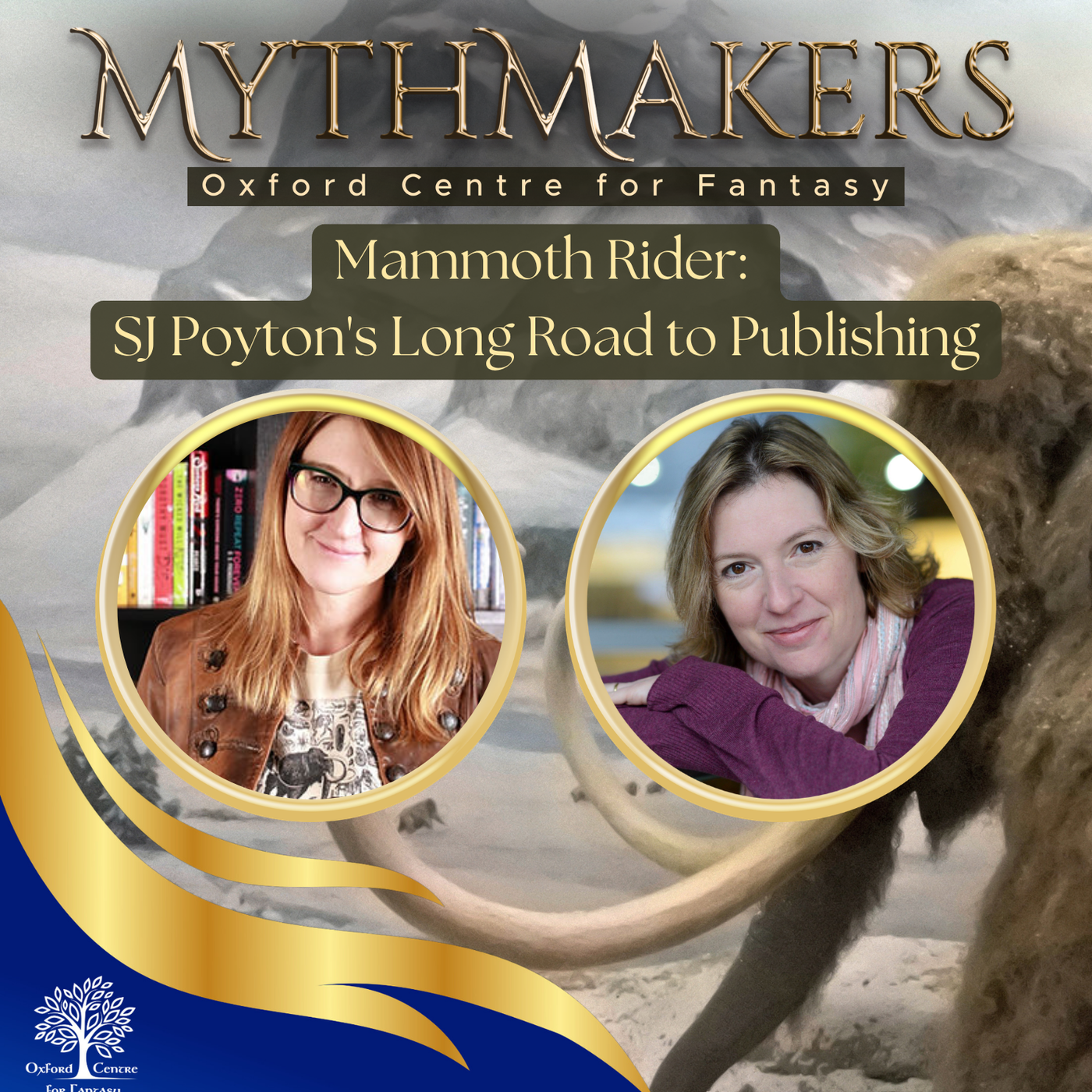
Mammoth Rider: SJ Poyton's Long Road to Publishing

What is the best mythical species to introduce into our world?

 Apple Podcasts

 Amazon Music

 Spotify

 JioSaavn

 Castro
Here’s a story that will encourage many of our listeners: SJ Poyton’s epic journey to publication has spanned nearly 20 years, and her perseverance has paid off with the release of her sci-fi children’s novel, Mammoth Rider. Think Jurassic Park, but much more plausible.
In this episode, SJ and Julia Golding sit down to discuss the environmental themes behind the book, as well as the importance of including neurodiverse characters in a way that portrays their unique minds as simply being part of who they are, and even as a part of their gifts. SJ and Julia go on to decide how one should name a mammoth, before speculating about which mythical creature they would wish to introduce into the real world.
To learn more about SJ, and to order your own copy of Mammoth Rider, visit https://www.sjpoyton.com/
(00:04) Introduction to SJ Poyton and Mammoth Rider
(00:47) A 19-Year Journey to Publication
(04:35) What Mammoth Rider Is About
(06:56) How Mammoths Could Help Fight Climate Change
(09:05) Greenland, Nyala, and the White Mammoth
(12:15) Neurodiversity in the Book and in SJ’s Life
(17:10) Dyslexia Representation in Fantasy
(21:01) Writing the Sequel to Mammoth Rider
(26:08) Science Notes, Ethics, and Questions for Readers
(26:56) Which Fantasy Creature Would You Bring Back?
For more information on the Oxford Centre for Fantasy, our writing courses, and to check out our awesome social media content visit:
Website: https://centre4fantasy.com/website
Instagram: https://centre4fantasy.com/Instagram
Facebook: https://centre4fantasy.com/Facebook
TikTok: https://centre4fantasy.com/tiktok
04:00 - Introduction to SJ Poyton and Mammoth Rider
47:00 - A 19-Year Journey to Publication
04:35:00 - What Mammoth Rider Is About
06:56:00 - How Mammoths Could Help Fight Climate Change
09:05:00 - Greenland, Nyala, and the White Mammoth
12:15:00 - Neurodiversity in the Book and in SJ’s Life
17:10:00 - Dyslexia Representation in Fantasy
21:01:00 - Writing the Sequel to Mammoth Rider
26:08:00 - Science Notes, Ethics, and Questions for Readers
26:56:00 - Which Fantasy Creature Would You Bring Back?
0:04 Hello and welcome to Mythmakers. Mythmakers is the podcast for fantasy fans and fantasy creatives brought to you by the Oxford Centre for Fantasy. My name is Julia Golding and today I'm doing one of my favourite things which is talking to another author. So I'm delighted to introduce to the Myth Makers audience SJ Poyton who has just written a fantastic book, middle grade book called Mammoth Rider and if you're looking at this on YouTube you'll see it has an absolute splendid mammoth on the front and SJ has a splendid mammoth sitting behind her which looks like the same picture.
0:46 There it is. So SJ how did you get to the stage when you had a book published because that is a long journey for most people. How did it happen for you? Well mine was possibly longer than most people. So I started writing when my children were coming up three and coming up to a year old and when it was published a few weeks ago it was two days shy of my eldest 22nd birthday. So it was literally 19 years. So for me the journey was the same as bringing a child from infant to adult and in that time I've written lots of books like 10, 12 novels, picture books, chapter books in all sorts always generally all raised children or YA started with YA fantasy went on to the middle grade and had some successes.
1:47 So I was a longlisted for the Times Chicken House children's writing competition twice, Undiscovered Voices, a load of other competition wins or kind of short listings, long listings. But this is the first time where actually the luck has gone all the way to in print. And so yeah, it's been a long, long journey but the art of not giving up has been key and having lots of supportive people around me like my writer groups, Abingdon Writers, Scooby, Oxford Writers, Green Pen, Golden Egg, people like that has really, really helped because they lift you up when you're down and they celebrate you when things go well and that's so important when you're doing something that's more of a marathon than a sprint.
2:40 Yeah, so amongst that list, you mentioned Scooby for those people who don't know, it's an acronym for the Society of Children Book Writers and Illustrators. It has an American section, which I think is where it started, but it's UK section and in fact, it's one of the places if someone is almost ready to publish and they ask me advice and they're working for the younger end of the market, I always say, that's a great place to go. It's very professionally run and they have conferences and it connects you to the industry in a way that your writer support group can't.
3:22 You sound like you had a good experience through the Scooby Network. Yes, so I volunteered, so I was part of the conference committee for a year. I ran their professional series, but then ended up being called the Industry Insiders, where I did, I think, six different talks across the year in central London, in Piccadilly, where we would do a different theme each time and we would have industry professionals as a panel event and I chair and we would have talks. So, yes, I was also in the Scooby Oxford critique group for a very long time, which is brilliant, but was also kind of very humbling because we had Terry Terry, Paula Harrison, Nicky Thornton, Amy Butler Green, who is, and they're all bestsellers, either this side of the pond or the other side of the pond and it would just be like me.
4:29 But now you can go to the meeting and say, look, everybody, I've got a fabulous hardback. Yeah, that's lovely. So, let's turn to Mammoth Rider itself. Tell us a little bit about it and why you wrote it. I mean, it is something where it does what it says on the tin. It is about mammoths. So, tell us, how would you describe this book? Mammoth Rider, I would say, is a climate change STEM action adventure story with a neurodiverse own voice protagonist. So, essentially, it's about three children that race across the tundra to help save a herd of mammoths that have been to help in the battle against global warming from hunters.
5:15 So, it's just a big adventure story, really. I just wanted to create a big adventure story, which kids would enjoy the reading of, that was quite fast paced. So, you know, a lot of children find it difficult to read a book or even watch a film now because concentration is getting smaller. So, I wanted to do something exciting. I wanted to do the mammoth cloning. In fact, it was a book that I didn't actually intend on writing. I was researching for a book, which was again science fiction, but for YA thriller about Neanderthal human Chimeras.
6:00 And I started reading a book for research called How to Clone a Mammoth by Professor Beth Shapiro, which was about de-extinction science, but more broadly, it was called How to Clone a Mammoth, because apparently if you're in that business, nobody says, when are we going to see a dinosaur or a dodo? They would say, when are we going to see mammoths? So, but I discovered there was a theoretical use for them, which is to help slow the rate of global warming. And also there's a place waiting to house them, which is called Pliocene Park in Siberia. And I just thought kids would love this. And it's a good way to get kids thinking about STEM solutions for climate change and conservation.
6:48 So, I just got a bit distracted and started to go down a wormhole of all things mammoths, really. Yeah. So, just to pick up on the use, how they would combat climate change, because that's not an obvious connection, though it's explained in the book. What is it that a mammoth can do to the landscape that would help with that? Well, mammoths were one of those cornerstone kind of species. And so, they can really help shape not just the ecosystem, but the geography of a landscape. There aren't very many creatures that can do that. Humans are one, beavers are another.
7:30 But what they can do is just live their best mammoth life. So, there are areas in the Arctic where there is land that has been permanently frozen for thousands of years. Within that frozen soil, there is massive amounts of methane gas, much more methane gas frozen and locked in that ice than there is currently in our atmosphere. However, as the world warms, our ice caps are melting. That is creating more snow in areas of the Arctic where there's not been snow for thousands of years. The snow is blanketing that permafrost and it's insulating it, which is making the permafrost beneath the snow thaw.
8:16 And as it melts, it releases the methane gas back into the atmosphere, which increases the rate of global warming. And the way that mammoths can help is by just living their best mammoth life. They trudge along the tundra. They clear that blanket because the food is underneath that blanket of snow. And with that blanket cleared, it stops that cycle because the permafrost stays frozen. And so, that nasty methane gas stays locked in the ice. So, it's not very obvious until you see it and then you go, oh yeah, I can see how that would happen. You've chosen Greenland for your population, which is an interesting choice at the current time.
9:00 Yes. But yeah, let's move on from that. A different way of looking at Greenland. So, you mentioned you had a list of things at the beginning that it sort of fitted into. So, you had the environmental action adventure and absolutely the star of the piece is the mammoth herd, particularly the mammoth baby. Do you say Nyala? Nyala. It's a secret to be told. I just thought it was a pretty spelling. And then somebody went, how do you say it? And I was like, oh. Because it's the sound of that creature. So, imagine a sort of. So, we're all around there going, I think it's Nyala.
9:41 It was a really interesting editorial as we're all around there trying to work out the correct way to say her. Who's a rare white mammoth. Is that an albino mammoth or a white mammoth? No, it's a white mammoth. It's a particular species of. Well, what they think is because they obviously there's a lot of mammoths coming out of the permafrost as it thaws. And a lot of those still have their fur on, still have their last meal in their stomach. But most importantly, we can get DNA from them and we can study that DNA. And so, our understanding of mammoths is ever evolving every time we get a new piece of DNA to study.
10:27 One of the things we do know about mammoths is that their DNA sequence for hair colour was similar to humans. So, the iconic image that you have when you summoned a mammoth in your mind will be brown. But they could come in different colours too. So, they reckon about 3% of them would have been lighter, blonder mammoths. And then the rest would have been a brownie russet and a lot of kind of red jeans. There is no evidence either way as to whether they went all the way to white. But you know, it is a fantasy that I'm saying.
11:07 Yeah, you're doing sci-fi. But we do know they did come in different colours. We've never found one in a different colour. But I think, personally, if you look at the natural world and any animals that were born a different colour, very rarely make it to adulthood or even out of infancy. And the amount of animals that we are finding in the ice is going to be a very small percentage than what actually ever roamed the Earth. So, I think the percentages of us finding one of these 3% of the ones that were lighter colours is just statistically very, very small.
11:52 But theoretically, they should have been able to come. Theoretically possible, which is what matters in this case. Because I would say that, whilst we're talking about fantasy and sci-fi, it feels very real. It feels as though this could be a real life story happening in 10 years' time or maybe a bit longer than that, 20 years' time. Time for the herd to grow. So, as well as the environmental theme and the action adventure, you mentioned it's about dyslexia, dyspraxia, those issues, which you talk about at the end in a very interesting way. Do you want to tell us a bit about that and the way the book is actually set out with that?
12:33 Yes. So, I am neurodiverse. I have dyslexia, which most people know what dyslexia is. It is when your brain doesn't process the written word in the same way as neurotypical people. It means accessing anything which is written down is difficult. Learning to read is difficult. Spelling is difficult. I always like to describe my spelling in the words of the very famous philosopher Winnie the Pooh, which is my spelling is wobbly, all the right letters in order. But I also have dyscalculia, which is much less understood. Very few people know what dyscalculia is.
13:14 That's probably because it only affects 2% of the population rather than 10%, which is dyslexia. Dyscalculia is like dyslexia but with numbers. So, I can't dial a telephone number. I don't know my times tables. Pin numbers are a disaster. I cannot put four pin numbers in and get the right number. I can't tell the time on an analog clock or a 48-hour digital one after one o'clock in the afternoon because that involves math. I also have something called dyspraxia, which is like the other two with coordination and dexterity. I don't know my left and my right.
13:54 I'm very clumsy. Now, when I was growing up, it was widely acknowledged that there were issues, but because I had a kind of multiple diagnosis, which at the time in the 80s, I don't think even the educational psychologists really knew what dyscalculia was. So, I didn't get a diagnosis until I was in university. And it was really, really frustrating. I never ever saw anyone like me reflected in a book at all. And it wasn't until I was an adult and I was reviewing children's books and I was a bookseller that I started to see books with dyslexic protagonists.
14:36 Not very many, but a few. Some were brilliantly crafted and envisioned, like Sally Gardner's Maggot Moon. The main protagonist in that is so wonderful. That's the first time I was like, oh, I'm not alone. But I've never seen any characters with dyscalculia or dyspraxia. So, it was important to me to have a main character that had those, but was just part of who they are. They weren't defined or limited by it. It was just part of their multifaceted personality and to show that actually there are benefits. And there was certain things that come with being neurodiverse, which are gifts.
15:20 And we deserve to be seen and reflected back, but without it just being purely about the neurodiverseness. So, to me, it was really important to do that. Thankfully, my publishers thought so too. And they were also very lovely because they shared my vision to make it as readable as possible. So, the actual text has been done with the National Dyslexia Guidelines Association guidelines. So, we have dyslexia-friendly font. We have generous spacing. And also, it's only justified to the left, which means it's really easy for tracking.
16:06 So, it's just really super readable, which we've had a lot of feedback on that people are really finding this readability a benefit. And actually, I've done a few school events now where I have to do reading. I'm so grateful it's readable because it makes it so much easier to read. I notice you use bold rather than italics as well. That was also the National Dyslexia Association Guidelines. They think it's easier than the italics. And I agree. Italics can be very difficult to read when you're dyslexic. I was a bit worried it might seem a bit shouty, but actually, it's okay when you read it.
16:48 Yeah, I think we can code switch, can't we? And so, you get used to it pretty quickly and you that's what that does, just in the way we get used to speech marks or no speech marks, or sometimes you get a book where it's a dash rather than a speech mark, and you just go, okay, that's the rules within this particular book. So, as you say, it's really important to have a character who has the condition without it being a book about a dyslexic child or whatever it is. That isn't the issue. The issue is the When you're looking at fantasy more generally, what would you say were the writers who deal with people of diverse conditions best?
17:33 You mentioned the Sally Gardner, but is there others? I was thinking that what came to my mind as you were talking was, of course, the Percy Jackson books. He's dyslexic and he's hardwired for ancient Greece. Yeah, I love that, actually. That was because it was such a positive way of doing it. You really turned it into a skill. Yeah, it was brilliant. And Sally Gardner's Magnet Moon was brilliant because she is also dyslexic in its own voice.
18:13 She got all of the other little things right, like having the same knot in his school tie that he would have for like three or four years, like pulling it up and down because he couldn't tie a tie. And all the little things that people that don't live it don't really realise is part and parcel of it. A lot of people will say to me, but grammar isn't an issue with dyslexia because my grammar is awful, or was when I first started writing. And they're right. Actually, it shouldn't affect grammar. But if, for instance, you are still on Biff and Chip books or, in my day, Peter and Jane books when you're 13, you don't get the grammar lessons because you are pulled out of lessons to try and teach you to read the basics of reading.
19:08 So, it's not an actual symptom of the neurodivergeness, but it is an indirect one because you miss massive amounts of learning. So, yes, Sally and Gardner was good. Oh, I'm trying to think of other. You know, I think it's still an underserved part of the population. And I was trying to think of adult material, as in YA and adult material. I can't think of any. It'd be really interesting to find out if that concern, which people, when they're thinking about children, are thinking about learning to read.
19:50 So, it might be something you put in. But what about an adult space captain? You know, I'd love to see it where it's just an ordinary thing to mention amongst all the other things that happen. And there's a TV show where the main character is dyslexic. And that's a murder mystery one. I think it's the Chelsea Detective. Oh, okay. Yeah, yeah, yeah. The main character's got dyslexia. And then, oh, obviously, I've not read the books, but I have watched the TV show because I lived while the TV show was on. So, I don't know how anybody got away without watching it, which is Jamie Lannister in Game of Thrones, who is dyslexic and his father really takes it out on him because he doesn't understand why he's not good at, academically.
20:39 So, it's a rather dark example, but it is a rather dark example. But it is the only one I can come to, that I can think of, which is, yeah, definitely an adult kind of fantasy person with dyslexia specifically. Yeah. Yeah. So, what's your plans going forward? I'm currently writing book two. Well, book two first draft is done. My edits for book two, very brilliantly timing wise, came in the day after the launch party. So, I've got in at one o'clock in the morning, got up, did a course, a publishing course I'd been put on in the morning, and then in came the edits, of course.
21:24 So, I'm doing the edits on book two at the moment, which is in the same, is the sequel to Mammoth Rider. So, there'll be more mammoths and a few surprises that I can't really speak out. Does it have a title or is it a working title? No, no title yet. I like to call it MR2, which sounds like a sports car from the early 90s. Or a COVID jab. Yeah. Well, all the best with that. So, let's have some fun with the idea of, I guess it's a bit Jurassic Park, isn't it? You referenced Jurassic Park in the afterward to your books. Was that a big influence on you in thinking of this sort of, or maybe Jurassic Park has influenced the people thinking it'd be great to have a park for mammoths, which then you found and then thought, oh, well, if I'm going to write about mammoths, it could have been that way around.
22:17 I don't know. So, when I was writing it, I was mostly thinking of the science and the race to clone mammoths. And the Pliocene Park, which is in Siberia, where they're already taking extant animals. Animals exist today that used to be in the tundra. They are putting them back in the tundra to do the same jobs that mammoths would. And they're having some positive results with that. But they would like something bigger, because mammoths can obviously clear that blanket much quicker.
22:59 But they can also do something which the other animals can't, which is they can uproot trees. Now, one of the big issues in the Arctic at the moment is there are more trees coming north of the taiga, which is that kind of forest that is the butter between the Arctic and further south. And that's because it is warming, temperatures are warming, so trees are growing further north into the tundra. But as they do that, their roots obviously are warm because they're living. And that also melts the permafrost. So, it's probably the only time you'll hear take trees out to help with usually it's plant trees.
23:42 But when it comes to the Arctic, you want to take them out. And mammoths could do that. But I was thinking more of that. But then when I started to think, how do you explain these big concepts to children? I was like, why am I panicking about it? Most children have seen Jurassic Park. It is the same kind of thing. And then I thought of a fantastic book from the 70s, which I came to when I was very young via the 1981 animated adaptation of the book, which is Mrs. Frisbee and the Rats of Nîm. And that obviously is, well, not obviously, if you've not read it, you won't know.
24:28 But for people that have read it or watched the film, it's about genetically engineered mice, where the National Institute of Mental Health of Nîm have taken street rats and they have changed their genetics. So, their intelligence and their lifespan is more similar to humans. The rats have escaped Nîm after them. And all the rats want to do is live an eco-friendly life in the mountains away from humans. So, I think the two books, Mrs. Frisbee and the Rats of Nîm and the book version of Jurassic Park, I love the films, but the book is better, really then started to get me to think how you could explain it to children.
25:11 Although children or adults do not get your children to read Jurassic Park. It's an adult's book. It's very scary. It's not like the film. Yeah. I often refer to something as Jurassic Park rules. I've been using that terminology about something I'm writing at the moment. By what I mean is, don't worry, none of the children are killed. It's just adults who need killing who get killed. But it sounds like that's a rule only seen in the film. No, the children do survive in the books. But they are the only ones that survive in the books. So, in the books, the people that die are the ones that survive in the film and vice versa.
25:54 It's really weird. Books are much better though. I love the books. Not maybe as easy to read, but I read them over a very, very long time. They are really good. And what I appreciated at the end of your book, which I think would be really good for someone, a child who's quite, I don't like all this fiction stuff. I like fact. Because at the end, you're talking about the factual basis behind the story. And you're also talking about the questions like, should we do this? You don't answer the question, you raise the question and say, well, what do you think, child reader who's just finished the book? So, I'm going to make you break your own careful scientific approach here because I'm going to ask you to consider reintroducing to an area of the world of your choice, maybe your own backyard.
26:48 A, imagine we're in all the fantasy worlds, which fantasy creature would you like to reintroduce into the world if you could, when you're a mad scientist white coat? Well, I really like a dragon. I love a dragon. I used to collect them when I was a kid. So, it would always be a dragon for me. And I think into the atmosphere, and a massive dragon that he doesn't breathe out fire, but its breath heals the ozone layer. So, how about that? A mammoth, not a mammoth, a dragon that helps save the planet.
27:32 That's what I would do. Yeah. I also think dragons would be excellent, but I'm thinking more on the domestic scale. I probably, if you were growing up roughly the same time as me, there was a very lovely animation called Ivor the Engine set in Wales about a steam engine. It's beautifully illustrated, but because it's in Wales, of course, they've got dragons, but these dragons are like little ones who are hatched in the firebox of the steam engine. So, I rather like the idea of just a little one. I've written a book with a little dragon in it, and I think that's me getting my Ivor the Engine love out of me somehow.
28:16 Yeah. So, thank you so much, SJ, for joining us, and all the best with Mammoth 2, the greater adventure. And it's so lovely to hear that after such a long journey, you've managed to get to the point where you've been published, which I think may encourage many people who listen to this who are similarly on their long trek. So, thank you very much. Thank you very much for having me. It's been wonderful. Thanks for listening to Mythmakers Podcast, brought to you by the Oxford Centre for Fantasy. Visit oxfordcentreforfantasy.org to join in the fun.
29:00 Find out about our online courses, in-person stays in Oxford, plus visit our shop for great gifts. Tell a friend and subscribe wherever you find your favourite podcasts worldwide.