
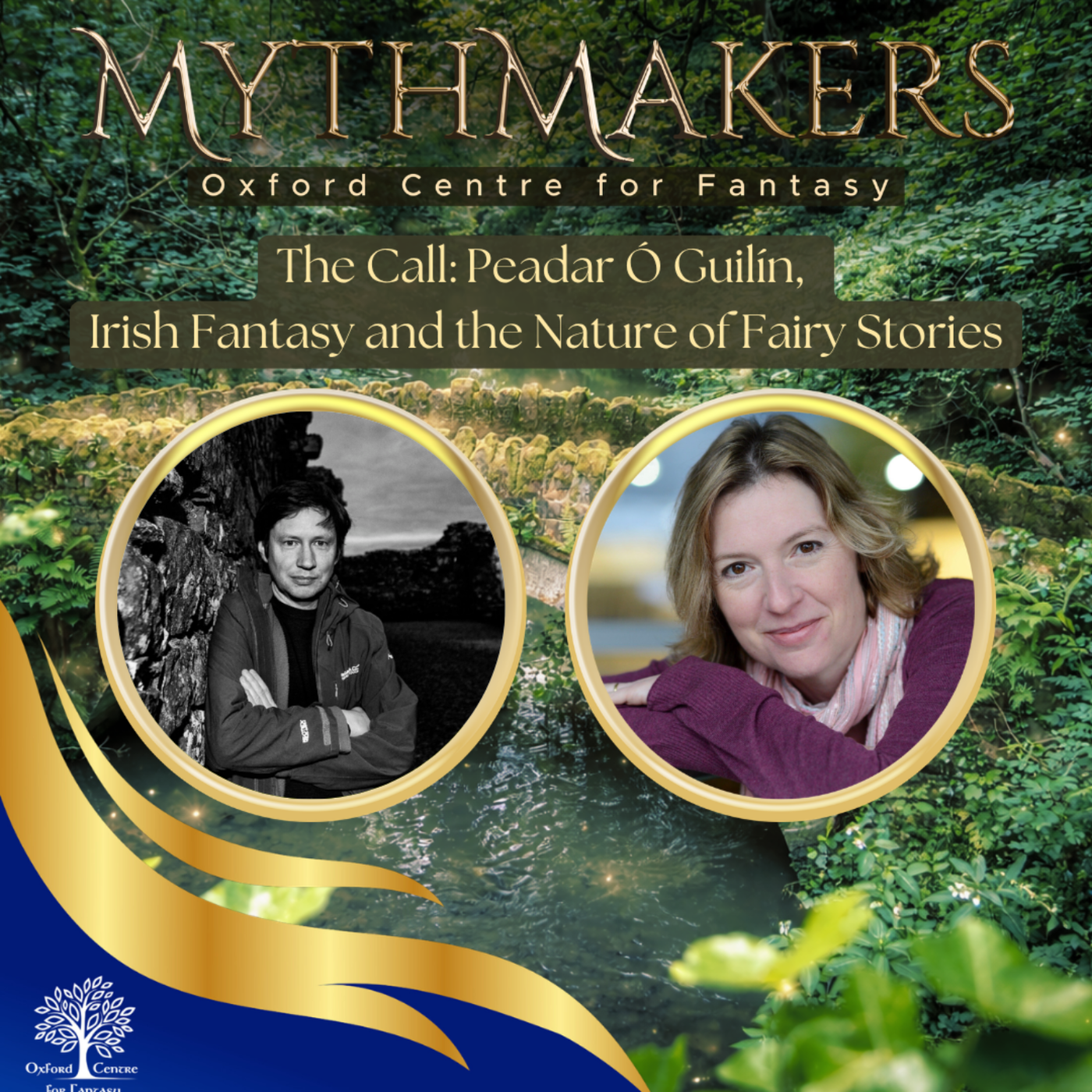
The Call: Peadar Ó Guilín, Irish Fantasy and the Nature of Fairy Stories

Where in all the fantasy worlds is the best place to take part in a magical contest?

 Apple Podcasts
 Amazon Music
 Spotify
 JioSaavn
 Castro
 Ireland is one of the world’s greatest fantasy hot spots. Join Irish fantasy writer Peadar Ó Guilín and Julia Golding as they embark on an exploration of Ireland’s rich storytelling tradition and its influence on Peadar’s work.
Discover how ancient tales of invasion gave rise to the Sidhe, and why the folk of the Mounds have it in for us. The Call features a brutal competition where they get their revenge—what might that tell us about the world Peadar grew up in and the themes emerging from his work? The conversation turns to The Sword Garden, his new book, which takes inspiration from Irish legend to begin a new tale of sci-fi fantasy world collisions. Be sure to stay to the end to hear Peadar and Julia pick the best place to take part in a magical contest—though most may be best avoided for health and safety reasons…
To dive deeper into Peadar’s various works, visit https://www.peadar.org/
(00:00) Introduction and Guest Overview
(01:40) Language Evolution and Writing Systems
(04:00) Ireland’s Influence on Fantasy Storytelling
(06:00) Reimagining Fairies: The Aas Sídhe Explained
(07:40) Irish Mythology and the Book of Invasions
(11:40) Themes of History, Class, and Conflict in Fantasy
(15:50) Irish Folklore Traditions and Story Cycles
(18:20) Local Legends and Landscape-Based Storytelling
(21:00) Stereotypes of Irish Writers and Global Perception
(23:00) Preserving Folklore: Monks, Records, and Oral History
(29:20) Tolkien, Fairy Stories, and Audience Perception
(34:40) Favourite Fantasy Worlds and Final Reflections
For more information on the Oxford Centre for Fantasy, our writing courses, and to check out our awesome social media content visit:
Website: https://centre4fantasy.com/website
Instagram: https://centre4fantasy.com/Instagram
Facebook: https://centre4fantasy.com/Facebook
TikTok: https://centre4fantasy.com/tiktok
00:00 - Introduction and Guest Overview
01:40:00 - Language Evolution and Writing Systems
04:00:00 - Ireland’s Influence on Fantasy Storytelling
06:00:00 - Reimagining Fairies: The Aas Sídhe Explained
07:40:00 - Irish Mythology and the Book of Invasions
11:40:00 - Themes of History, Class, and Conflict in Fantasy
15:50:00 - Irish Folklore Traditions and Story Cycles
18:20:00 - Local Legends and Landscape-Based Storytelling
21:00:00 - Stereotypes of Irish Writers and Global Perception
23:00:00 - Preserving Folklore: Monks, Records, and Oral History
29:20:00 - Tolkien, Fairy Stories, and Audience Perception
34:40:00 - Favourite Fantasy Worlds and Final Reflections
Hello and welcome to MythMakers. MythMakers is the podcast for fantasy fans and fantasy creators brought to you by the Oxford Centre for Fantasy. And today I am delighted that I am joined by Irish fantasy writer Peder O'Gillin. And before we go any further, Peder, we were talking about names because one of the things that global listeners will know is that when you look at Irish name, it might take a few runs at the fence before you can get over it. If you get over it's total. Like Shoshia. Shoshia, number of times I've heard people say that name. So you're about to tell me that Irish is an old written language which is one of the reasons why we get this difference. Yeah, well there are lots of reasons. One of the interesting things is that you know in English like why do we spell the word night with a GH? And most people will know it's because once upon a time the GH was pronounced. So it was neat, you know, and a night was a kinecht, right? Because we used to pronounce it. It wasn't for no reason. We didn't just decide, you know what, let's just throw in a few random letters in there. And the thing is then that writing tends to be standardized, you know, and then spoken words just to whatever they want. And so you get these situations where the spelling is left behind by the pronunciation. Now if you can imagine a language that's much older than English, I mean as a written language. You know, then you can imagine that it needs a lot more reforms, you know, for the spelling to catch up with the pronunciation. However, Irish is pretty much pronounced as it's written. There are lots of haches. You'll see lots of haches in Irish words. And this is kind of because, you know, when people were writing in Latin, the Latin alphabet was designed specifically for the Latin language. So you tend to have one sound for each letter. But then lots of other European countries we adopted the Latin alphabet. And suddenly you have a language like Irish, which has way more sounds and there are letters in the alphabet. So the only way you can make one of these new weird sounds is by putting a H after it. So, for example, in English, we have a chair in cheese. There was no chair in Latin. So they had to put a H after the scene to cope with it. So Irish is not as far from the pronunciation as people think. It's just that we pronounce things differently, you know. Yeah, and it's the fear of making yourself horribly embarrassingly wrong. My husband once had, we said we're going back a long time ago, he once had a summer job in a factory in the former West Germany, so he dates it. And one of his jobs was to tell the people there, this is before the internet, if the people applying for the job in the factory were Irish women or Irish men, because it made a difference to the extreme they went into. So he had to sit there and say, oh yeah, that's, you know, leave. That's a girl. Calm, that's a guy, you know. So he was responsible for getting the right job. So if you are an Irish person who was working in West Germany in the late 80s and you've got the wrong job, it could have been his job. Anyways, yeah, well, we're here mainly today to talk about your fantasy writing, of course, but we wanted to also have a chance to broaden it out and look at the presence of Ireland as a powerhouse in fantasy of its own in its own right, because your work reflects the environment, the landscapes of Ireland, the stories of Ireland, the longs of folkloric traditions, and also it powers the actual plots of your books as well. I've started reading The Call as I have in preparation to meeting you. So we're not talking a comfortable, fairytale world like Disney fairytale world, are we? Tell us a little bit about your fantasy novel The Call and what it's how it's set up. Yeah, often when people ask me, you know, what the call is about. I mean, I don't know what to say. I mean, there's a writer, you know, the ceiling, but I usually say something like it's a bit like a Harry Potter where everybody dies. I'm exaggerating a little, but it's not nice. A bad time has had by most people. And part of that is, are people often translate, there's an Irish word, she, which is often translated into English as fairy. And it's a really, really bad translation, because when you think of fairies, you know, you're thinking of a beautiful girl in the de affinist dress sitting on a told stool at the bottom of the garden or someone flying around with a magic wand and hitting the Disney castle, you know, these are the kind of things that come to mind. Are she are fairies? They're not like that. They don't like us. They don't help us out. They don't grant three wishes, right? Most of our superstitions are all about keeping away from them. A very famous example of keeping people keep bringing up is how I think it was around 2004. They were building a vastly expensive motorway across Ireland. And at a certain point is due to go through this field where there was a hawthorn tree belonging to the fairies. And they ended up spending millions to divert it around the tree. So, you know, it's about keeping away. Not having anything to do with them. But your characters in the cool are unable to keep away because teenagers at a certain point are summoned, are cooled into the other world as objects of a hunt. Yeah, yeah, the fox with the hounds after them, reversing our sort of expectations there. And as you say, it's got a high death rate. Yeah, no, it's a pretty, pretty high death rate. Yeah, I mean, it comes down to, you know, I said they don't like us. Why don't they like us? You know, I mean, who could possibly dislike me? I'm lovely, right? It's hard to explain. But in our, in Ireland, there's a very, very old book, Alves Labaragabala, which means literally the book of the taking of Ireland. And it's a kind of a history of all the people who came to Ireland and what happened to them? You know, the first group arrives and they all die of plague and then another group arrives and they marry with another group where they go to war with another group or whatever. It's just one group after another one wave of conquests, if you like, or one wave of invasions after another coming to Ireland. And the second last group are very unlucky. They're caused the two of Adan and the people of the goddess, Danny. And they loved Ireland. They absolutely adored it. They called it the many colored land. And you know, they loved all the colors of it, the sea, the grass, the sky, absolutely everything. But they were a bronze age people. And the people who came after them were the Malaysians who are kind of said to be the ancestors of Gaelic Ireland, basically of the modern inhabitants of Ireland. And they beat the living daylights out of the two of Adan and in a big battle. And at the end of the battle, the people of the goddess, Danny, were all like, oh my goodness, you're going to slaughter us now. And the Malaysian said, oh, you're going to enslave us then? No. Well, what are you going to do? What we're going to do is we're going to share Ireland with you. Half and half. Oh, that's so generous. So are we getting the north? Are we getting the south? No. Are we getting the east? Or are we getting the west? No, no, no, no, you're not. Well, what part are we getting then? You're getting the half. That's underground. You're never going to see those beautiful colors again. Tough luck. So basically the last line of this book of conquests or book of invasions or the book of the taking of Ireland's got lots of different translations for the realm. But the very last line of it is something like the king of the two of Adan and led his people under the mounds. So he basically led him underground and you've got all these mounds across Ireland, which we call in English fairyforts. And the Irish word for mound is she, which is of course the name of these people. They were the ashi, the people of the mounds after that. And we're basically living in their home. We're basically living in their many colored land. So generally they don't like us. And the call was basically exploring the idea of what would they do to us if they could get their revenge. So the first thing was where were they sent? Now we all know in history, but when one group defeats another group and takes over their land, what do they do? Do they give them the best land? People who are defeated? No, they don't. They usually send them somewhere awful. Like a trail of tears kind of idea or when Cromwell came to Ireland, his big line here was to hell or to conald. In other words, either I'll kill you all or you can go to the worst land. And it's just a very common theme throughout history. So I imagined in the book that where they were sent was the worst place possible. They go to a place called the Grey Land, which I hope kind of makes dentists and furniture look very comfortable. And from there they find a way to get their revenge. And what they do is they each teenager once in their life and be pulled into this Grey Land. And once they're there for an entire day, they're hunted down. And of course, to have some charge of them aren't going to get out of that situation. So that was the kind of basis of it. So when you're talking about this sort of history based on the book of conquest, was that the yeah, or book of invasions? Yeah, there's a different yeah. Is it when you are sort of using that as a background? Obviously there are strong themes here of like history and colonisation and class war and wealth war because I'm thinking of there is you know, the enclosure movement in Scotland that England had a similar thing where the poor, basically the poor people always get shafted in all these situations. So in a way, there's a kind of very obvious mapping on to real history, but also you've got the beautiful imagination of this idea of the the magic that goes along with the the fay folk, which gives them power. So it gives them the power they didn't have before. So when you're using it, how much are you thinking if at all that you're writing a sort of modern morality tale and how much you just really sort of enjoying the fantasy and seeing where it takes you? Because always this balance between the theme and author might be exploring, which can end up being messaging what you don't want to do. No, no. So how did you get about it? Well, well, I didn't I didn't deliberately in for a soon. Yeah. But but we all have themes in us. They merge, don't they? They emerge. I mean, it's basically like if you have an apple and you drop it, you expect it to fall. You don't expect it to float there. You expect it to fall. It's it's just you've grown up in this world. This is your instinct. This is something that you just know to be true. Right? Now you may be wrong about that. You may just not have seen the apples that float, but as far as you are concerned for your entire life, if you drop an apple, it falls. And in the same way, you were saying with the enclosures and so on and so was the poor people who get shafted, right? Maybe you're wrong about that. But more than likely, you believe that to be completely true. So if you're writing a book and you wanted to have some various militant, you're not going to have the poor people not getting shafted. Most of the time, you know, unless that's that's your story, like the poor people trying for, you know, have a great adventure and finally save themselves from a good shafting or whatever. But you know what I mean? Like if it's just the background to the world that you're writing, to your mind, the poor people get shafted. So that's not you making a political theme. That's just something you believe is true of the world. And therefore, when you're writing the world, that's that's what's going to come out. It's it's the same for me. I grew up on the the the border with Northern Ireland. I was in living next door to me at one point was arrested for being in a terrorist organization. We used to do all our shopping on the other side of the border. We would come in on a Saturday morning and the whole road would be covered in bottles and breaks from a riot of the night before. Everywhere I lived was was covered in graffiti. People had very, very strong opinions. My father was a surgeon who operated on people who, you know, were sometimes whisked in under great stress, having been attacked or whatever. So this is this is going to have an influence. You know, it's it's it's going to have an influence. Not not necessarily here's me making a political point, but that's just what I grew up with. It's just what I saw. You know, and if I grew up somewhere else, I'd have seen something different and come out with with something different. You know, so so so that was definitely in the background. Also in the background where all of these myths and legends, I mean, they were they were they were told in every school. Everyone knew these stories in the same way as a lot of people in Britain grew up with these kind of ladybird books. You know, Rumpel still skin and so on and shaping beauty and and all of these. You can probably still picture in your head the illustrations from some of them from from from when you were a kid, I bet, you know. Yeah, yeah, we had those too, but we also had we also had this this other set, you know, of stories. And again, they they affect you, you know, that they're a very different way of looking at the world from from those those ladybird books, like, you know, that they're a very different mentality, but it influences you. I mean, how local were your stories? Because I'm just thinking I'm an Essex girl, which is doesn't have a great reputation for the global history, but I do remember that the very local stories aside from the things in the library were to do with Epping Forest. Yeah, and there were a couple of things. There were two famous highwaymen who were local heroes, Dick Turpin and 16-string Jack. We proud of Dick Turpin. Yeah, the 16-string Jack was a bit more local. There was a pub named Doctin, but also Boedersia or Budica, but she had a camp in Epping Forest, and of course, she was a great figure of resistance. I didn't question this at the time, but since the old now, I look back and think, isn't it interesting how the local legends that were the ones which were highlighted were these, all of them in some way, resistance figures. Yeah. Because Essex itself, because it's not Chelsea, had that feeling of being with it on the edge, with a bit bit chippy. We got that sort of position, and so it was very local. We're talking 10, 20-mile radius of stories that were the ones told locally. So when you're thinking about your own upbringing, were there some very specific to your outside your front door, as well as the folklore of Ireland that have gone into the imagination? Yeah, no, that there are so many different layers, so many different layers. For example, in Irish legends, people who studied them, divide them into kind of distinct cycles. You have your stories of Finn McCool. This guy used to go back to place with his band of trusty warriors, a bit like Robin Hood, and his marry man, a very similar kind of vibe to that. Even though he was a king as such, these stories were basically the stories of ordinary people. They would tell stories among themselves, and each member of the band would have stories about him or her. Do you know what I mean? There were all kind of stories of local people, but then you have the famous epit of the Tonbokun about Bukkullin. And these were aristocratic stories, and told by professional bards to kings and the like. So a very, very different set of stories. But then of course, you have your little local folk tales, you know, a bit like when you go and see a place in Essex and say, so that's a bodicus camp. Yeah. I mean, it's really, really normal in Ireland, but there isn't a rock or a piece of grass out there that someone says, oh, yes, that's the place where such is a, for example, a Dalman in Ireland, the Irish word for Dalman is lava, which means bed. And so one of the one of the famous stories is a story of German didn't grow any of the runaway lovers. So this guy fin McCool when he's older, when he's an old man, he decides to marry this pretty young girl. She isn't having any of it. So she basically tricks one of his warriors into running away with her. And now they're kind of on the run and they've got like, you know, the army after them and to catch them. And everywhere you see one of these Dalmans, they say, oh, yes, that's where they spent the night. You know, that's that's one of their beds. That's that's where they spent the night when they were running away. You know, so this is very common. And then you some very, I mean, how high crude am I allowed get? Am I allowed to crude? And probably don't get us an E rating? Not at not an E rating. Okay. Well, well, there is a there is a place called there's a queen. There was a queen called Queen Mave. And there was a place called Maves a pit where where she had a week. Am I allowed to say that? Yes. Yes. Yes. Yes. It's it's it's called something a bit worse than that slightly worse than that, but a place where she had a week. And and basically she's watching this battle. And her, her, her troops are engaged and she's in top of the hill. And she says, right, I can't watch anymore. I desperately need a week. And and her, her general is saying, no, no, my lady, you can't, you can't, it's very close. We need your inspiration. We, we need you here. But I, but but I desperately desperately need a week. No, no, my lady, you've got to stay with her. Finally, the battle ends. She runs and we's so hard that this massive pace is carved into the earth. Right, earthy, earthy story. It's named for this, it's named for this. Yeah. So, so that's really common. So this sort of the cliché, and forgive me for repeating it to you, but the cliché of an Irish writer does lean into this sense of the, the sort of mystery and the legends and the poetry and all of these kind of things. Do you think that's a fantasy of itself? And, and do you resent it? Or do you think it's helpful and and something true about a sort of general tendency amongst Irish writers? I think there is every kind of, of, of writing. Of course there is. I just meant that there's a sort of under, I don't know, expecting you're going to be a good storyteller and perhaps start breaking, breaking the song every five seconds. You know, is that sort of cliché? I have no Irish writers like that. So there are, no, no, there definitely are. They're definitely, definitely are. People like Brendan Beacon, you know, and we're plenty, plenty, he used to break into song and we're very good at this. And, and plenty who, who love to tell stories and, and plenty who are singing drunkards and, and, and I mean, they absolutely, absolutely exist. What, what I will say is when I'm trying to sell a book like The Call, yeah, it's an, it's an incredibly helpful stereotype. You know, that's, that's, you, you, you, you will definitely sell more if you're from Ireland than, than if you're from, I don't know, hungry, even hungry, as, as amazing folk legends, but it's not the point. It's just, we've got this cliché working for us, you know, when I, when I try and sell my science fiction, not so much, you know. Yeah, it's, it's interesting that one isn't it because I think there is a, some countries have really strong global identities. And, and others kind of fly beneath the radar and have to explain themselves more. And I think particularly because of the strong Irish contingent in America, I think, as you say, there is like a appetite, so a reconnect to something maybe authentic or something from someone else's past that might help you there. But I was just wondering if you felt it was fair or actually a shoe that no longer fits because we're living in a modern world where everything is less local, more global. Things, things have an effect. And, and the effects last a long time. Like, I mean, everybody knows, for example, how America started with, you know, I mean, the American state with people throwing tea into Boston Harbor because they didn't want to pay tax on it. And, and, and how now it's, it's a notoriously like tax unfriendly country. You know what I mean? Like, I mean, it has an effect. These, these, these things last. In, in Ireland, one of the reasons we were so lucky and so blessed to, to have all these legends. I mean, they have them in every country. It's ever, it's absolutely natural that it gets dark and you're sitting around the fire and you start spinning your tail. And, and also that it's dark and did something move in the shadow. I'm a bit scared now. I'll, I'll make up an explanation for it. I mean, that, that, that probably happened absolutely everywhere around the world at the same time. We were kind of lucky in that, we, we had monks at one point. In, in, when a lot of places were going through what was unfairly called the dark ages, we had monks, we had so many months that if a monk scrapped himself two other monks fell out, you know what I mean? Like, yeah. We, we tons them and they wrote everything down. Absolutely everything. Recipes her, her beer, medicines, spells, curses. We know almost more about medieval Ireland than, than almost any other society at the time. They just wrote absolutely everything down. And one of the things they wrote were the, were the legends of the day. And, and, and like there's an example where there's someone writing, I was told to write these down. I don't believe in them. They're all just, it's all just pagan nonsense, full of sex and adventure and, and fighting and, and, and fun and romance. And, and I'm not enjoying it at all. Not even one tiny little bit. I'm just writing it down. Is it a pretty good flair, though? Yeah, but, but that's not exactly what they clearly did like it, you know, they clearly did enjoy it. And, and they wrote them down with Gusto, you know, and, and so we have them now. And then back in the 1930s, like a very short time after Ireland became independent. One of the first things the state did was it paid money, like it was a, it was like the poorest country in Europe, more or less at the time, but it paid money for, for people to go around with very primitive recording devices to all the old people and collect their stories and record them. You know, so these things have an effect, you know, they, they, they stick around a bit, they, they do affect people. And then, you, you know, that up until, about 15 years ago, professional artists, which includes writers and storytellers and things like that, did not pay tops in Ireland on their art earnings, right? So the country looked after them. And, and even more recently, like in the last two or three years, we have this, you know, universal basic income for, for artists, including writers. Aren't you talking about that? Yeah, well, it's only, it's only a certain number every year I get it. Okay. But it's, but it's, it was an experiment that, that we're doing. Like it shows that, that this is a country that cares about the arts, about writers that values it as an export, if you like, but not just as an expert, but just, just values it. And, and that has an effect. It means that when you're growing up, you, you, it's in the water already that this is a country that respects what you do, you're like making up funny stories to refer to it because, you know, you have a chance, you know, that, that's really unexpected actually to me because what you've just described there is a part, I mean, I was aware of the long Irish tradition, but I hadn't really factored in just the careful curation and that's gone on since medieval times onwards, which has enabled that to happen. These things don't just survive by chance, do they? It's been a, it's been a decision by a society to protect and to remember. I spent some years living in Poland shortly after the fall of the Berlin Wall. And one of the things that was sort of present in Poland was sort of rediscovery of, of their own sort of national story and their, their own literature and traditions, which have kind of got flattened by communism and the propaganda of the earlier era. So these things can survive either under adverse circumstances, but you have to dig them up and say, look, this is, this matters. Pan-tade or shit matters. Yeah, no, that's, that's really interesting. We, just before we started recording, I was talking to you about how one of Tolkien's most famous essays is called on fairy stories. And he was writing to reestablish fairy stories as a serious subject for academic respect, because they had been, you know, all there for children. And there's nothing really in Irish fairy stories that is particularly for children, is there? Oh, no, there are. Of course, there are. It's, it's, um, oh, should I say only for children? Yeah, I mean, that there's, there's a, there's a, there's a huge variety. There's a huge variety of, of stories in the Irish tradition. I told you, they wrote everything down like, I mean, there's a, there's a massive amount. So it's hard, it's hard to, hard to get your brain around it. Some of it, I didn't say exactly. Absolutely filthy. And some is funny. A lot of it is tragic, but it's not all like, you know, there's, there's everything. I didn't phrase that very well. What I meant was fairy stories had been relegated to the nursery. As if that was, that's what I meant. It's the only place that you read fairy stories was as a young child in the nursery, whereas when actually the tradition of fairy stories, which Tolkien is talking about, is actually more in, it's better really calling it folklore, really, because it's for society. And obviously there are some tales you would tell to younger children and not want to scare them too much. You don't, you want them to go to sleep at night, but there's also the element that they grow with you in there for all ages. And it seems as though what you're describing in Ireland is that full, full spectrum story telling tradition. Yeah, yeah, no, the, the, some, just some amazing stuff. It's some of it is, absolutely hilarious. And some of it is, like, very science fiction, you know, like some, some real kind of, like, there's, there's an amazing concept, which I'm sure lots of traditions have, but, but it's, it's very clear in the Irish tradition where, where you have two worlds overlapping at the same time. And I absolutely love it. Like, there's one, one famous story of, you know, these people who are working in the, the, the, the feels of a random monastery. And, and they look up and they see a ship just closing through the wire. And at a certain point, the ship gets caught, the anchor of the ship was caught on a tree, like down down on the farm. And someone jumps off the ship and they swim down through the wire and they're trying to free the anchor from the tree, but then they start to drown. So one of the persons climbs up and cuts the anchor free. And, and then, then the, the, the pressing can go back up to the ship. And everyone in the ship wades down at the people in the farm and, and off the ship goes again. I suggest to, isn't it that one? Yeah. Steerishing counter. Yeah, I think it's amazing. Yeah. So, um, how the, where are you going to be going next in your, your writing? Is it, are you returning to another form of art? You know, where are you going in your sort of rich subsoil of ideas you've got around you? Yeah. So I, I have, I mean, based on that idea, I just said, there are two worlds overlapping at the same time. I have a, a science fiction book just about to come out called the Sword Garden. The Sword Garden. Sword Garden. Yeah. And it, it looks like a fantasy book like when it starts, so I won't say much more than this, but, but when it starts, that you have, you have this city, which is the richest city in, in an empire, which is about to rebel. And one of the things the city is famous for is ghosts. So everyone in this city is, I would say dark skinned, but the ghosts are white skinned and wear furs. And when they breed out, like, smoke comes out of their mouths, which is, you know, a rather extraordinary thing that the, that the people find. And so, so that's, that's kind of how it starts, you know. So again, you've got your two worlds kind of, kind of overlapping there, you know. So that's fascinating. So I look forward to seeing that. So I'm always like to broaden the focus at the end of a chat with another author. Thank you about all the wonderful fantasy worlds that we've read about us watched on film. And I wanted to ask in honor of your story, The Cool, in all the fantasy worlds, they're all available to you. Where would you most like to take part in a magical contest or survival contest in your sense? But to be the winner of a contest in a magical realm, there is some I wouldn't want to be, you know, you can rule out my 100 games, for example, you know. Yeah. Yeah. I mean, I mean, I guess the world I found most, most, uh, alluring, um, there was a book, uh, by a guy called, David Zindal. I think David was his first name Zindal was definitely a second one. Um, and the book was called Nevernals. Um, and it's basically this, this city, um, that's, that's basically an Arctic wonderland. And everyone sits around in giant ferries drinking hot chocolate. And the streets are called glitteries because you just skate is, is all you do from place to place. Um, and, and it just absolutely captivated me when, when I sought, um, very magical contest. If I was going to win it, um, I would, I would, if I was going to win, if I was going to lose, definitely not. But if I was going to win, um, possibly, um, Michael Swanwick's the Iron Dragons daughter, um, it's, it's a horrific world. Uh, but, but the, the well off to very well indeed that's, um, but, but the, uh, the world's building, it's, it's basically, um, a mix of the modern and fantastical. So one of the images in it is, is, is, you see a photograph of grinning elves with, uh, M16s, a top of a, a big pile of dead orks in, in one of their foreign wars. Um, so an amazing book. So do you want to the question for me? I was thinking, I mean, those, most, most magical contests like your own are very much staying in the tail thing. So, you know, the tribus up, you end up being in a graveyard with Voldemort, you know, is it's not really. Yeah. They don't have very good reputation. So perhaps I'd play safe and I would go for, um, answered Wonderland because everyone gets prizes. Oh yeah. That, that seems to be the safest place for a magical contest. I, I, I would be terrified to go to Wonderland. Or true. True. Thank you so much, um, for joining us. And we look forward to saying the, the title of your book again. Oh, the Sword Garden. The Sword Garden. There we go. So that's do, look out for that. Thank you very much. Thank you very much indeed. Thanks for listening to MythMakers Podcast. Brought to you by the Oxford Centre for Fantasy. Visit Oxford Centre for Fantasy.org to join in the fun. Find out about our online courses in person stays in Oxford plus visit our shop for great gifts. Tell a friend and subscribe wherever you find your favourite podcasts worldwide.