
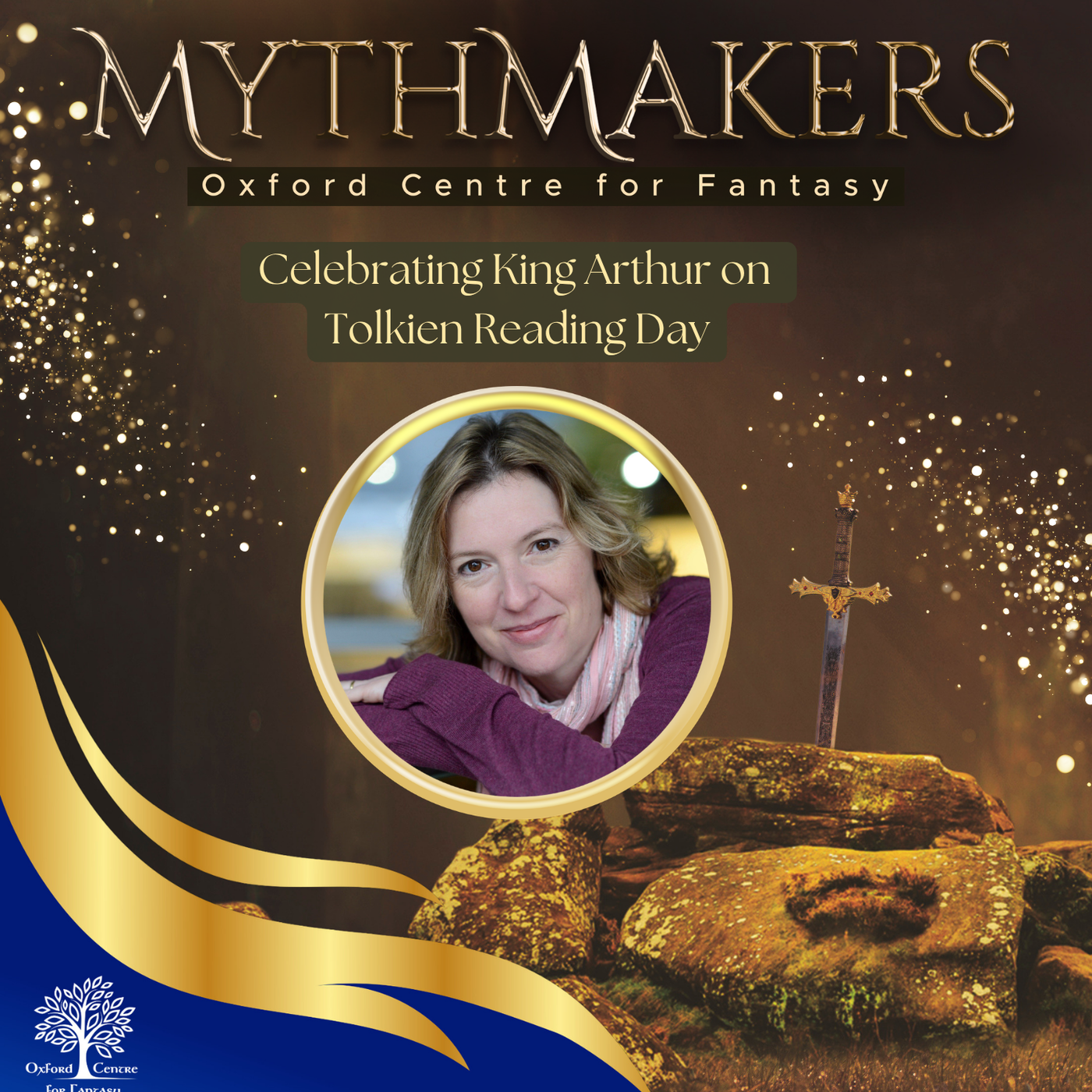
Celebrating King Arthur on Tolkien Reading Day


 Apple Podcasts

 Amazon Music

 Spotify

 JioSaavn

 Castro
Saddle up and join the Round Table as Mythmakers embarks on a journey through some of the most famous retellings of King Arthur in celebration of Tolkien Reading Day. Which author started the ball rolling, and who poetically kicked it on into the 19th century? Where do the traces of these tales become most apparent in the works of Tolkien and C.S. Lewis? And who has continued the Arthurian tradition into modern times?
Finally, we turn to the screen—what is the most successful adaptation of them all? Tune in to see if you agree with our pick!
(00:00) Tolkien Reading Day and the Power of Arthur
(03:09) Malory and the Rise of Arthur in Print
(05:26) Arthur Pulls the Sword from the Stone
(09:24) Keats and the Melancholy of Arthur
(12:08) Tennyson, Avalon, and Echoes in Tolkien
(15:15) William Morris and Arthur’s Expanding World
(16:52) T.S. Eliot, Charles Williams, and the Modern Grail
(22:22) Film, Comedy, and Reinventing Arthur
(23:00) Tolkien and Lewis Through an Arthurian Lens
(27:02) Modern Retellings and Julia Golding’s Own Arthur Stories
(29:12) Why BBC’s Merlin Works So Well
(30:43) Reading Arthur to Better Understand Tolkien
For more information on the Oxford Centre for Fantasy, our writing courses, and to check out our awesome social media content visit:
Website: https://centre4fantasy.com/website
Instagram: https://centre4fantasy.com/Instagram
Facebook: https://centre4fantasy.com/Facebook
TikTok: https://centre4fantasy.com/tiktok
00:00 - Tolkien Reading Day and the Power of Arthur
03:09:00 - Malory and the Rise of Arthur in Print
05:26:00 - Arthur Pulls the Sword from the Stone
09:24:00 - Keats and the Melancholy of Arthur
12:08:00 - Tennyson, Avalon, and Echoes in Tolkien
15:15:00 - William Morris and Arthur’s Expanding World
16:52:00 - T.S. Eliot, Charles Williams, and the Modern Grail
22:22:00 - Film, Comedy, and Reinventing Arthur
23:00:00 - Tolkien and Lewis Through an Arthurian Lens
27:02:00 - Modern Retellings and Julia Golding’s Own Arthur Stories
29:12:00 - Why BBC’s Merlin Works So Well
30:43:00 - Reading Arthur to Better Understand Tolkien
0:04 Hello and welcome to Mythmakers. Mythmakers is the podcast for fantasy fans and fantasy creatives brought to you by the Oxford Centre for Fantasy. My name is Julia Golding. Now, the 25th of March, which is during this week when this podcast is being released, is celebrated as the Tolkien Reading Day. And that's because it's the day that the ring goes into the fire, if you're following Tolkien's calendar in the Lord of the Rings. And also in terms of the church year, which was very important to Tolkien, it's Lady Day.
0:45 So one of the special feast days in the Roman Catholic Church. So in terms of celebrating, I thought we would have a focus on what people have been reading through the ages. And shortly, we're going to be having a special guest on the podcast, Malcolm Gite, whose new Galahad and the Grail, the first of his proposed Arthurian epic poetical work, has just come out. And I thought we could talk about what Arthur has meant to people over the centuries. We have touched on Arthur once before on the podcast, with an expert to do with all things Arthurian.
1:25 But here I'm thinking more about how people have responded as readers. So we're not really looking into the historical evidence for Arthur. That is another kind of podcast entirely. But we're looking at what people have got over the centuries reading about Arthur. Now, Arthur is ubiquitous in the UK. You'll go to many places and visit all sorts of different parts of the kingdom. And you'll find places named after Arthurian characters or after himself. And for those of you who have somehow managed to avoid what Arthur is about, he is a king of legend or myth, who supposedly existed after the Romans left and before more recorded history.
2:22 And he joined together the different tribal groups at the time and became a great king. Now, a lot of that is based on stories attached to real kings that kind of have been scooped up by Arthur. And then there's also this Celtic folkloric element, which has also been sort of put around him. So he's one of those figures who've attracted stories, barnacles. So he's like something that's sunk in the sea. And if you go down now and have a look at it, it's got barnacles and seaweed and starfish and all sorts of things growing on it.
3:02 What the original structure was, who knows? And it doesn't matter, because the stories are so powerful. Where did it all come from? Well, originally, there were brief mentions in histories written by the very early chroniclers, and they don't really interest us so much as in terms of readership. It's more they were the sources that got Arthur's stories into the English language. And there is a history where he was taken up by the Germans and the French and all sorts of people. But where we really start is with the story of the Morte d'Arthur.
3:46 It's a French title, isn't it? But actually, it is one of the very first books printed. I've got a pretty ancient edition here, not the Caxton version. But Thomas Mallory collected all sorts of stories and organized them into a long... Let's see how many books there is in my... I think it's 12 books. Well, no, no, no, much more than that. 21 books in this story. And you'll find in here all the sort of popular versions of what you know as Arthur's stories. So you'll get the Arthur and Mordred and Excalibur and Guinevere and Lancelot.
4:28 They're all in here. And you, of course, get the story of the Grail. The Grail is the cup used at the last supper by Jesus and his disciples, also thought to have caught some of his blood on the cross and then brought to England. Yeah, you're with me still? By Joseph of Arimathea, and it becomes a sort of mystical cup that is much sought after. It's the kind of thing that would be the aim of an Indiana Jones quest, that kind of religious object. So Mallory, in a sense, really kicked off the main reading phase of King Arthur.
5:11 Before then, it would have been in poetry and songs that were performed. But now there was something you could have in your household or in your library and you could read. So what does it sound like? What is Mallory like? It's fairly close to modern English, even though the actual date of first publication, 1470, in the ninth year of Edward IV. So if you think about history, this is before the Tudors. It's really where the medieval world is turning into the Renaissance world. It's that period.
5:52 And the printing press is a big part of that. And it was a bestseller in its era and it still is a jolly good read. So I'm going to choose a little bit to read to you, just so that you can get a flavour of it. So I'm going to read you the bit where Arthur pulls Excalibur from the stone. So this sword has arrived. It's set in a stone and no one so far has been able to pull it out. So upon New Year's Day, when the service was done, the barons rode unto the field, some to Joust and some to Tourney. And so it happened that Sir Hector, that had great livelihood about London, rode unto the Joust.
6:34 And with him rode Sir Kay, his son, and young Arthur, that was his nourished brother. And Sir Kay was made knight at all Hallowmas afore. So they rode to the Joust ward. Sir Kay lost his sword for he'd left it at his father's lodging. And so he prayed young Arthur for to ride for the sword. I will well, said Arthur, and rode fast after the sword. And when he came home, the lady and all were out to see the jousting. Then was Arthur Ross and said to himself, I will ride to the churchyard and take the sword with me that sticketh in the stone for my brother Sir Kay shall not be without a sword this day.
7:15 So when he came to the churchyard, Sir Arthur alighted and tied his horse to the stile. And so he went to the tent and found no knights there for they were at the jousting. And so he handled the sword by the handles and lightly and fiercely pulled it out of the stone and took his horse and rode his way until he came to his brother Sir Kay and delivered him the sword. And as soon as Sir Kay saw the sword, he whisked well, it was the sword of the stone. And so he rode to his father Sir Ector and said, Sir, lo, here is the sword of the stone, wherefore I must be king of this land. When Sir Ector beheld the sword, he returned again and came to the church.
7:58 And there they all alighted, all three, and went into the church. And anon he made Sir Kay swear upon a book, how he came to that sword. Sir, said Sir Kay, bye-bye brother Arthur, for he brought it to me. How gatchy this sword, said Sir Ector to Arthur. Sir, I will tell you, when I came home for my brother's sword, I found nobody at home to deliver me his sword. And so I thought my brother Sir Kay should not be swordless. And so I came hither eagerly and pulled it out of the stone without any pain. So, gives you a flavour. These days, that sort of repetition and what have you would probably be edited out.
8:41 I noticed that there was, you know, you say something once and then you say it again and then again. But anyway, it still reads pretty well. There's only a few archaic words, like wist and attorneying, all things which I think you can get over quite quickly. So, if in terms of going to the source of Arthur Tales, don't be put off by the age of the Mork D'Arthur. But I would very much advise dipping in rather than trying to sit down and read it all in one gulp. I remember studying this at university and I think I had a week to do it. And I got sort of dizzied by the number of different knights. But you can see the very strong bones, shall I say, of the Arthurian legends here.
9:24 And Malory has absorbed all the stories that have gone before and produced a very readable version of King Arthur, which has really influenced what came next. So, while King Arthur was a popular folkloric figure, he really comes again in sort of a new flourishing when it came to the romantic poets. And in particular, I would point to Keats, who I think gives the sensibility rather than the knockabout stuff that you find in Malory, which is much more folkloric in its feel, the sort of Jack the Giant Killer feel to Malory.
10:13 Keats gives it that melancholy air, which I think is often found in the art about Arthur and the sense of loss that's in the Arthur tale. And, of course, probably his most famous Arthurian poem is La Belle Dame Sans Merci. So, this is a ballad, which is the verse form which, of course, many Arthurian tales come in, including Malcolm's Grail poem, and it has a haunting call and answer. Oh, what can ail the knight-at-arms, alone and palely loitering?
10:54 The sedge has withered from the lake, and no birds sing. Oh, what can ail the knight-at-arms, so haggard and so woe-begone? The squirrel's granary is full, and the harvest's done. I see a lily on thy brow, with anguish moist and fever-dew, and on thy cheeks a fading rose, fast whizzereth to. I met a lady in the meads, full beautiful, a fairy's child. Her hair was long, her foot was light, and her eyes were wild. I made a garland for her head, and bracelets too, and fragrance own. She looked at me, and she did love, and made sweet moan.
11:34 I set her on my pacing steed, and nothing else saw all the day long. For side long was she bend, and sing a fairy's song. And so it goes on. So the poor knight has been put under the spell and left in the wasteland. So if you're looking for a place to read about King Arthur, which picks up this feeling of melancholy and loss, Keats is definitely one to go for. But of course, the poet of the 19th century, came after Keats, who is most famously associated with the stories of King Arthur, is Tennyson. And there's a really interesting connection between Tennyson and Tolkien, because of course, he is the writer that was the most famous poet of that era, and would have been in the bones of all of Tolkien's generation.
12:31 He wrote, of course, The Lady of Shalott and poems like that. She left the web, she left the loom, she made three paces through the room, the one with the mirror cracked from side to side. So famous it's become used for titles of books like Agatha Christie. But a longer cycle of poems that he wrote, The Idols of the King, is a very ambitious retelling, a bit like Mallory, of pretty much the span of Arthur's life. I'm going to read you Arthur's passing. And tell me if you feel there's a resonance here about something that happens in Tolkien.
13:13 Arthur announces that he is going to the island valley of Avilon, to be healed of a grievous wound. So said he, that's Arthur, and the barge with oar and sail move from the brink, like some full-breasted swan that, fluting a wild carol ere her death, ruffles her pure cold plume and takes the flood with swarthy webs. Long stood Sir Bedivere, revolving many memories, till the hull looked one black dot against the verge of dawn, and on the mere, the wailing died away. But when that moan was passed for evermore, the stillness of the dead world's winter dawn amazed him, and he groaned, the king is gone, and therewith all came on him the weird rhyme, from the great deep to the great deep he goes.
14:10 So that's standing watching the boat sailing west, with the man left on the shore, who is the one to go home and tell the tale. It can't help but remembering Into the West, and Sam and Pippin and Mary watching the boat sailing off to the Undying Lands. And that architecture of the lands of the West being the places of healing, of course, is something which is taken from the Arthurian legend, but is passed through Tolkien's own imagination to become the land of the elves, the Undying Lands.
14:52 So there is Tennyson who sits, you know, he is the colossus poet of things Arthurian in the 19th century. But we shouldn't forget that someone who Tolkien admired, that is William Morris. And he is very interesting when it comes to the world of King Arthur, because he actually gives it a feminist spin. Some of his early poetry is a defense of Guinevere. Her defense, when I say feminist, I mean, the defense is that of the defiant queen actually able to have her own voice.
15:32 And it's an interesting one in that she's posing a problem to the lords who are accusing her. And she's asking them to imagine that someone comes, someone comes to them one night and says, one of these cloths is heaven and one is hell. Now choose one cloth forever, which they be, I will not tell you, you must somehow tell. It's also sort of saying the impossibility of making right choices in life. William Morris also writes other poems from the Arthurian cycle, but he is part of the visual world of Arthur in the Pre-Raphaelite and in the paintings that you've probably seen much reproduced.
16:18 There was the enjoyment of the whole world of heraldry that surrounds the bigger world, the universe in our modern world. It's the Arthurian universe. So going on from the time of the Victorians who had great fun with the Arthur stories, and they became an important part of the island story and you move into the more cynical 20th century. But what you get there is a change in tone, but some very interesting runs at Arthur. And one of which of course is T .S. Eliot's The Wasteland.
17:01 One of the stories which is an important part of the Arthurian cycle is that of the quest for the grail and the Fisher King's castle is surrounded by a wasteland. And it's that wasteland that T.S. Eliot is nodding to when he calls his impressively revolutionary poem The Wasteland. So it's using everybody's familiarity with Arthur to have that as a heartbeat underneath his poem. His poetic contemporary takes us into the world of the Inklings and that is Charles Williams, who is the most bizarre and intriguing of the Inklings.
17:53 The London born publisher who became friends with first C.S. Lewis and then Tolkien and spent some of the war years in Oxford taking full part in the Inklings, but sadly died during an operation in 1945. And he regarded Arthur as his main theme really. It appears as the main theme of his own poetry, Taliesin through Logres. Logres being a word for England in the Arthurian cycle and regions of the summer stars, which are an unusual take on the Arthurian stories.
18:37 But he also uses the quest for the Holy Grail as the main theme in his fabulous fantasy work The War in Heaven. And he was also working on an Arthurian piece as he died. So just to give you a little taste of how Charles Williams sees King Arthur, I thought I'd read you a little bit from his poetry. They're very dense and quite hard to understand. So I'm going to take one of his most unusual ones, which is where Lancelot turns into a werewolf. Now bear with me. It sounds strange, but there is a source for this in the story, which is that Lancelot comes to Peles's castle, Peles's Carboneck, where the Grail is kept, the wounded king, the Fisher King.
19:31 And he is tricked into sleeping with the king's daughter Elaine, believing her to be Guinevere. And finding out this double betrayal is what drives him mad. And he turns into this wolfish character. And it's referred to in the legends as him running mad. And Williams gives it this particular spin. So here we are. Peles the wounded king lay in Carboneck, bound by the grating pain of the dolorous blow. His flesh from dawnstar to noontide day by day, ran as a woman's under the moon.
20:11 In midsun he called on the reckless heart of god and the emperor, he commended to them and commanded himself and his land. Now in the wolf month, nine moons had waned since Lancelot Ridden, on a merciful errand, came that night to the house. There drugged and blurred by the medicated drink of Bryson, Merlin's sister, he lay with the princess Elaine, supposed Guinevere. In the morning he saw, he sprang from the tall window, he ran into a delirium of lycanthropy. He grew backward all summer, laired in the heavy wood. In autumn King Peles's servants brought him news of a shape glimpsed on the edge of Brosselandi, a fear in the forest, a foe by the women's well.
21:03 All the winter the wolf haunted the environs of Carboneck. Now what was left of the man's contrarious mind was twinned and twined with the beast bent to feed. Now it crept to swallow the seed of love's ambiguity, love's taunt and truth. Man he hated, beast he hungered, both stretched his sabres and strained his throat. Rumble of memories of love in the gaunt belly told his instinct, only that something edible might come. Slathering he crouched by the dark arch of Carboneck, head high howling, lusting for food, living for flesh, a child's flesh, his son's flesh.
21:48 Now a bit of a plot spoiler, his son by that strange happenstance turns out to be Galahad who later saves the day and heals everybody by achieving the grail quest. So that is the extraordinary world of Charles Williams and Arthurian Tales and of course at this time we're getting films taking on King Arthur but the kind of Arthur you get in the films is more of the romance as in the medieval romance version. It's taken away from its intensely Christian roots of the grail quest and those kind of stories and and concentrating more on the court drama and of course over in America you've got Mark Mark Twain writing a Yankee in the Court of King Arthur and things like that so it's just shifting the story in a more sort of commercial in that case comedic version.
22:52 So you can see how the King Arthur story is reinvented at all times and in many places. Moving to Tolkien himself, I mentioned the echo at the end of Lord of the Rings of the ships leaving for the west but all throughout Tolkien there are echoes of the Arthur story with the special swords, the return of the king, Arthur is obviously fated to return. In Tolkien's version it isn't the same king who returns it's his heir, Elendil's heir who is returning but that idea of the king coming back in the hour of need is underpinning Aragorn's story and Tolkien himself was working on his own Arthur stories and Sir Gawain in the Green Knight was a huge area of scholarly interest to Tolkien and he did his own translation.
23:52 Moving over to C.S. Lewis, he too loved the Arthur stories and where I find it most apparent in C.S. Lewis's work is in Prince Caspian because the children Peter, Lucy, Susan and Edmund are basically King Arthur. They are summoned back to Narnia like King Arthur and come to the rescue of Prince Caspian. So, Lewis is doing his own little version of the Arthurian tale but it runs all throughout the Arthur stories including the way people behave in Narnia with the quest for the white stag and things like that.
24:43 They are all Arthurian themes and the way they are imagined as dressed in the regalia of a knightly court and the balance of the shared power structure if you put it like that is quite round table in Narnia. But there is another version of the Arthurian tale which comes in Lewis's Ransom Trilogy, the Space Trilogy, which is that hideous strength. The Ransom Trilogy is a very uneven work in many ways because it shifts around from different genres really.
25:31 The first being more of a kind of Flash Gordon out into space version and then you've got this meditative Miltonic visit to Paralandra. And then in the last one, very influenced by Charles Williams, you've got the matter of Arthur coming up and so taking over the story and Ransom, our philologist hero, becomes the Fisher King, the wounded king. You've got Merlin returning and you've got the replaying of many of the Arthur stories in that book. I find that one a hard read, so I wouldn't suggest this is the first thing you start to read if you are doing an Arthur reading for your Tolkien celebration.
26:18 There was a very recent and excellent adaptation by the BBC, a radio drama, of that which ironed out some of the judicious editing and reinterpretation of some of the less happy parts of that story and I really enjoyed it. In fact, when I go back to that Hideous Strength, the more I like it. It's one of those books which I really didn't like first reading and then when I've gone back, I found more things in it to like. I think one of the problems is the married relationship between Jane and Mark in it, which feels pretty, I don't like it.
26:58 And if you read it, you'll see why. A very odd version of how a successful marriage would work. I haven't mentioned T.H. White, of course, the once and future king, a brilliant retelling of the Arthur story, which underpinned the Disney versions of the story. And then you've got the Roger Lansing Green retellings, which as a young inkling, he should be mentioned. He was one of the people who brought Arthur stories to young people in an easier form to read than Mallory. I've also had a go at doing my own retellings in some ways.
27:38 When I first was trying to think up a story for my sons, I wrote a trilogy called Young Knights of the Round Table. It came out in 2013 and it was followed by Pendragon, who has a magnificent dragon on the front, and Merlin. And in here, the idea is the Arthurian characters, when Arthur goes to Avalon, he is out of time, but Merlin is still in time. So Merlin is actually hiding in Silicon Valley as a sort of tech wizard, and Arthur is in a sort of time capsule.
28:25 And the children who are fighting the Fae folk in the story, have to go and gather the team in classic fashion to fight the battle with them. But it has a sort of time slip element. So one of my favourite scenes in it is they bring back, they've got King Arthur, they bring him back and they end up at Blenheim Palace, where one of these show jousts is happening. And Arthur thinks, finally, my kind of people, and he actually is taking it seriously and trying to do damage, which, of course, isn't at all the idea of those show tourneys. So it's a clash of expectations between the past and the present in that.
29:11 So I've had fun with the story myself. And as for the most successful screen adaptations of the Arthurian story, there have been many attempts at this, including some films. One of the problems for filmmakers is, what do they choose as a story? The beginning, the setup is the easiest. But the end is sad and sour. And the bits in between are really, Arthur isn't the main character anymore, it's everybody else. So in fact, I think one of the most successful attempts at this was the BBC TV programme Merlin, which decided to feature Merlin and look at the story from the young wizard's point of view in a world where magic is banned and outlawed.
30:06 So he's sort of in hiding. And it's dangerous to reveal that. It's a long journey. But if you stay with the series, there's actually a very sweet coda right at the end of the characters in the modern world, which I love. So do look that up if you haven't found that BBC series. BBC doesn't have a huge budget for special effects, but they had enough to do a dragon, which has the voice of John Hurt, the famous actor who also played Ollivander in the Harry Potter series. So nice little connection there. Anyway, so how better to celebrate Tolkien Reading Day than dipping into some of the Arthurian stories?
30:51 Because you'll see, filtered through a different world and a different light, many of the ideas actually inspired Tolkien's. So it's a good place to celebrate Tolkien when you're choosing your next read. Thank you very much for listening. Thanks for listening to Mythmakers Podcast, brought to you by the Oxford Centre for Fantasy. Visit OxfordCentreForFantasy.org to join in the fun. Find out about our online courses, in-person stays in Oxford, plus visit our shop for great gifts. Tell a friend and subscribe wherever you find your favourite podcasts worldwide.